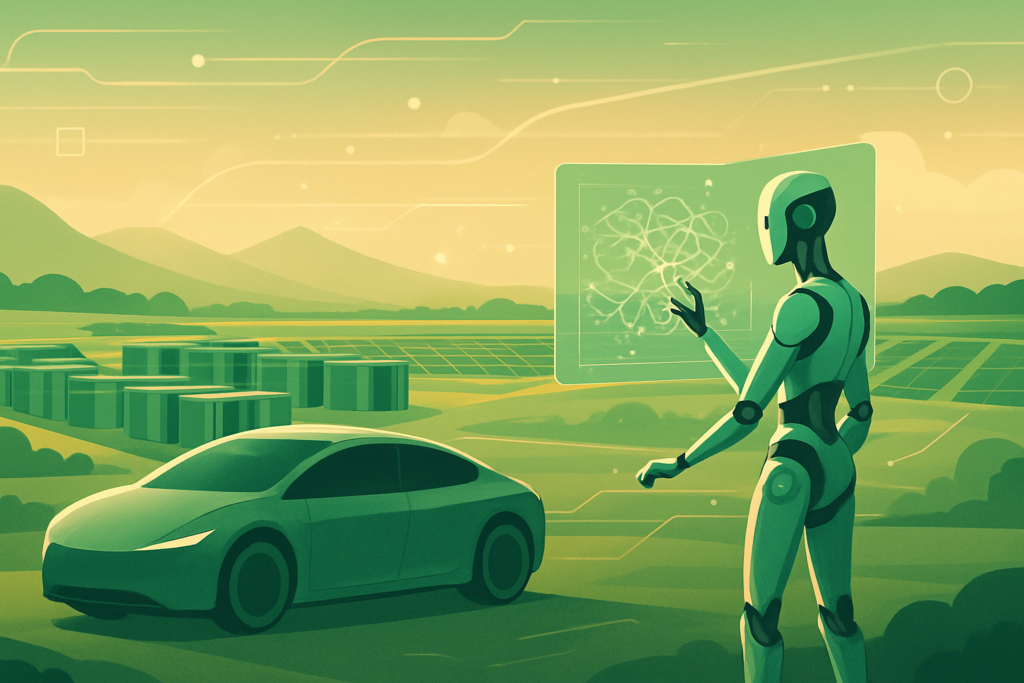
Today is January 9, 2026. In the early trading hours of the new year, Tesla, Inc. (NASDAQ: TSLA) has emerged as a primary focus for global markets. Following the release of its Q4 2025 delivery figures and updated timelines for its autonomous driving and robotics initiatives, the stock is experiencing high-volume volatility, reclaiming its status as a leading market mover.
Tesla currently stands at a historical crossroads. While its identity as the pioneer of the electric vehicle (EV) revolution remains intact, the company is aggressively pivoting toward artificial intelligence, autonomous transport, and humanoid robotics. PredictStreet’s latest AI-generated estimates suggest a pivotal year ahead, as the market weighs a slowdown in core automotive sales against a parabolic expansion in energy storage and high-margin AI software.
Historical Background
Founded in 2003 by Martin Eberhard and Marc Tarpenning, and famously joined and funded shortly thereafter by Elon Musk, Tesla’s journey has been one of survival and scale. From the niche Roadster (2008) to the luxury Model S (2012), Tesla shattered the myth that EVs were slow or unappealing.
The 2017–2019 period, often referred to by Musk as "production hell," saw the company nearly collapse while scaling the Model 3. However, the successful rollout of the Model 3 and subsequent Model Y transformed Tesla from a speculative play into a global manufacturing powerhouse. By 2021, Tesla’s market capitalization surpassed $1 trillion, a feat once unthinkable for an automaker. The last two years (2024–2025) have seen a second major transformation: the transition from "Tesla as a car company" to "Tesla as an AI and Robotics conglomerate."
Business Model
Tesla’s revenue ecosystem is no longer a monolith of car sales. It is currently categorized into four primary pillars:
- Automotive Sales & Leasing: The core revenue generator, featuring the Model 3, Model Y, Model S, Model X, and the Cybertruck. This also includes regulatory credit sales to other OEMs.
- Energy Generation & Storage: A surging division that produces the Powerwall for homes and the Megapack for utility-scale storage. In 2025, this segment became a critical contributor to the company’s bottom line.
- Services & Other: This includes the massive Supercharger network, insurance, and vehicle service.
- AI & Software: Revenue from Full Self-Driving (FSD) subscriptions and one-time purchases, along with the nascent "Cybercab" ride-hailing infrastructure.
Stock Performance Overview
Over the last decade, TSLA has been one of the most polarizing and high-performing assets in the S&P 500.
- 10-Year Horizon: Investors who held through the volatility of the mid-2010s have seen returns exceeding 1,500%, despite multiple drawdowns of 50% or more.
- 5-Year Horizon: Performance has been more stagnant, reflecting a "consolidation phase" as the company moved from hyper-growth to a more mature, competitive market environment.
- 1-Year Horizon (2025): The stock underwent a recovery in the second half of 2025. After hitting local lows amid a 2025 delivery decline, the stock rallied following the October "We, Robot" event and positive regulatory developments in the U.S. As of today, January 9, 2026, the stock is trading in the $430–$435 range.
Financial Performance
PredictStreet’s analysis of the preliminary FY 2025 data shows a complex financial picture. Total revenue for 2025 is estimated at approximately $98 billion, representing a flat-to-modest decline year-over-year. This was driven by a decrease in total vehicle deliveries (1.64 million in 2025 vs. 1.79 million in 2024).
However, the "under the hood" metrics reveal a shift in profitability. While automotive gross margins have been compressed by price competition to roughly 16.5%, the Energy Storage division’s margins have expanded significantly. Tesla’s debt remains remarkably low, and its cash position—exceeding $30 billion—allows it to self-fund the massive R&D required for the Optimus humanoid robot and the "Dojo" supercomputing clusters.
Leadership and Management
Elon Musk remains the polarizing visionary at the helm. While his involvement in various other ventures (X, SpaceX, xAI, and government efficiency roles) has led to concerns about "CEO distraction," the market continues to price in a "Musk Premium" based on his track record of achieving the impossible.
Beneath Musk, the leadership team has stabilized. CFO Vaibhav Taneja has been credited with maintaining a lean cost structure during the 2025 delivery slump. Tom Zhu, who oversaw the success of Giga Shanghai, continues to lead global automotive operations, ensuring that the next-gen "Model 2" and "Cybercab" remain on schedule for their 2026 production targets.
Products, Services, and Innovations
The focus for 2026 is entirely on "Autonomy and Robotics."
- FSD Version 14: Currently in wide release, FSD v14 is the first version to leverage a 10x expansion in neural network capacity. Early testers in Jan 2026 report significant improvements in "reasoning" for complex urban environments.
- The Cybercab: Unveiled as a dedicated Robotaxi, mass production is slated to begin in April 2026 at Giga Texas.
- Optimus Gen 3: Tesla’s humanoid robot has reached a "human-equivalent" dexterity level in factory tasks. Several thousand units are currently integrated into Tesla’s own assembly lines to reduce labor costs and improve precision.
- Megapack 3: Tesla Energy deployed nearly 47 GWh of storage in 2025, a nearly 50% increase from 2024.
Competitive Landscape
The competitive landscape has shifted dramatically. In late 2025, BYD (OTC: BYDDY) officially surpassed Tesla as the world’s largest BEV (Battery Electric Vehicle) seller by volume. In China, Tesla’s market share has faced pressure from local rivals like Xiaomi and Geely, who are offering comparable tech at lower price points.
In the West, legacy automakers like Ford and GM have pulled back on their EV ambitions, leaving Tesla to compete primarily with Rivian (NASDAQ: RIVN) and a wave of affordable Chinese imports that are currently being hampered by trade tariffs. Tesla’s main competitive moat has shifted from "the car" to "the data," as its millions of vehicles on the road provide a data flywheel for AI training that rivals cannot easily replicate.
Industry and Market Trends
The "EV Hype" of the early 2020s has cooled, replaced by a "Pragmatic EV" phase. Consumers are increasingly price-sensitive, which has hurt Tesla’s older Model 3/Y lineup. However, the macro trend of AI-driven data center expansion has created a secondary tailwind for Tesla Energy. Data centers require massive battery backups for grid stability, a niche that Tesla’s Megapack currently dominates.
Risks and Challenges
Despite the stock's recent momentum, several risks remain:
- Execution Risk: The April 2026 launch of the Cybercab is a "make or break" moment. Any delay could severely impact investor confidence.
- Regulatory Scrutiny: Unsupervised FSD requires state-by-state approval, which remains a slow and litigious process.
- Key Man Risk: The company’s valuation is intrinsically tied to Musk. His political activities and multi-company commitments remain a point of contention for institutional ESG funds.
- Chinese Competition: If trade barriers fall or if Chinese OEMs successfully navigate tariffs, Tesla’s margins could face further downward pressure.
Opportunities and Catalysts
Investors are looking toward several upcoming catalysts:
- Model 2 Unveil (Q2 2026): A $25,000 consumer vehicle could re-ignite volume growth for the automotive segment.
- Robotaxi Network Launch: The potential "Tesla Network" app could transition the company into a high-margin software-as-a-service (SaaS) business model.
- Optimus External Sales: Rumors suggest Tesla may begin taking external pre-orders for Optimus for industrial use by late 2026.
Investor Sentiment and Analyst Coverage
Sentiment is currently split between "Value Bears" and "AI Bulls."
- The Bulls (e.g., Wedbush, New Street Research): Argue that Tesla is an AI company and should be valued like Nvidia or Microsoft. They maintain price targets as high as $600 based on the "sum-of-the-parts" of FSD and Robotics.
- The Bears (e.g., GLJ Research, JPMorgan): Focus on the 8.5% delivery decline in 2025 and argue that the core business is a slowing cyclical automaker with a massive over-valuation.
PredictStreet’s AI sentiment index currently sits at "Bullish-Contrarian," noting that institutional accumulation has increased as the FSD v14 results began to manifest in real-world performance.
Regulatory, Policy, and Geopolitical Factors
The geopolitical landscape of early 2026 is favorable for Tesla in the U.S. Following the 2024 election, the regulatory environment has shifted toward streamlining autonomous vehicle certifications. However, the ongoing "Trade War" with China remains a double-edged sword; while it protects Tesla’s U.S. market share from BYD, it also complicates Tesla’s supply chain and its ability to grow within the Chinese market.
Conclusion
As we look at Tesla on January 9, 2026, the company is no longer a simple story of selling cars. It is a high-stakes bet on the future of autonomous labor and intelligence. The decline in vehicle deliveries in 2025 served as a sobering reminder of the limits of the current EV market, yet the explosive growth of Tesla Energy and the tangible progress of Optimus and FSD v14 suggest that the "second act" of the Tesla story is just beginning.
For investors, the key will be watching the April 2026 Cybercab launch. If Tesla can successfully bridge the gap from "driver-assist" to "unsupervised autonomy," the current $430 price point may one day look like a bargain. If not, the floor of its automotive valuation will be the only thing left to catch it.
This content is intended for informational purposes only and is not financial advice.