
The end of an earnings season can be a great time to discover new stocks and assess how companies are handling the current business environment. Let’s take a look at how Progressive (NYSE: PGR) and the rest of the property & casualty insurance stocks fared in Q4.
Property & Casualty (P&C) insurers protect individuals and businesses against financial loss from damage to property or from legal liability. This is a cyclical industry, and the sector benefits when there is 'hard market', characterized by strong premium rate increases that outpace loss and cost inflation, resulting in robust underwriting margins. The opposite is true in a 'soft market'. Interest rates also matter, as they determine the yields earned on fixed-income portfolios. On the other hand, P&C insurers face a major secular headwind from the increasing frequency and severity of catastrophe losses due to climate change. Furthermore, the liability side of the business is pressured by 'social inflation'—the trend of rising litigation costs and larger jury awards.
The 33 property & casualty insurance stocks we track reported a strong Q4. As a group, revenues beat analysts’ consensus estimates by 2.9%.
Amidst this news, share prices of the companies have had a rough stretch. On average, they are down 7.5% since the latest earnings results.
Progressive (NYSE: PGR)
Starting as a small auto insurance company in 1937 with a pioneering focus on high-risk drivers, Progressive (NYSE: PGR) is a major auto, property, and commercial insurance provider that offers policies through independent agents, online platforms, and over the phone.
Progressive reported revenues of $22.75 billion, up 12.2% year on year. This print exceeded analysts’ expectations by 0.6%. Despite the top-line beat, it was still a mixed quarter for the company with a narrow beat of analysts’ revenue estimates.
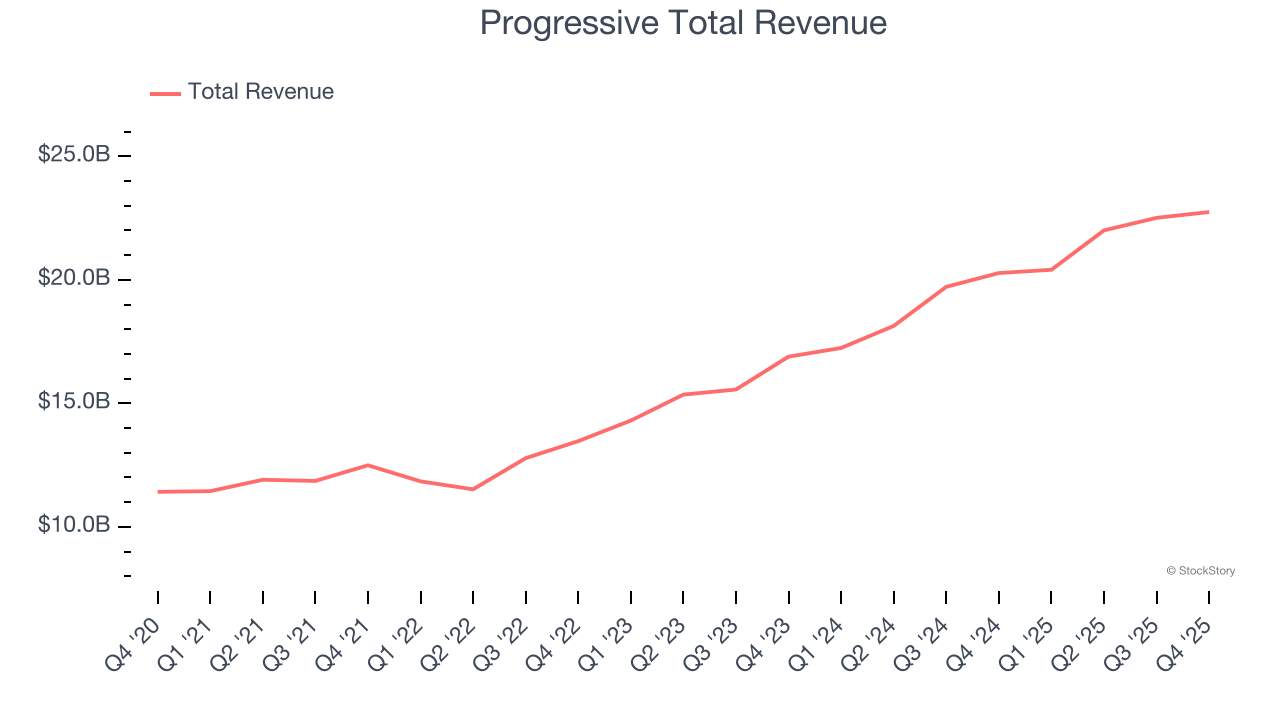
Unsurprisingly, the stock is down 6.9% since reporting and currently trades at $193.80.
Is now the time to buy Progressive? Access our full analysis of the earnings results here, it’s free.
Best Q4: First American Financial (NYSE: FAF)
Tracing its roots back to 1889 when California was experiencing its first major real estate boom, First American Financial (NYSE: FAF) provides title insurance, settlement services, and risk solutions for residential and commercial real estate transactions across the United States and internationally.
First American Financial reported revenues of $2.05 billion, up 21.6% year on year, outperforming analysts’ expectations by 15.2%. The business had an incredible quarter with a beat of analysts’ EPS estimates and a solid beat of analysts’ revenue estimates.
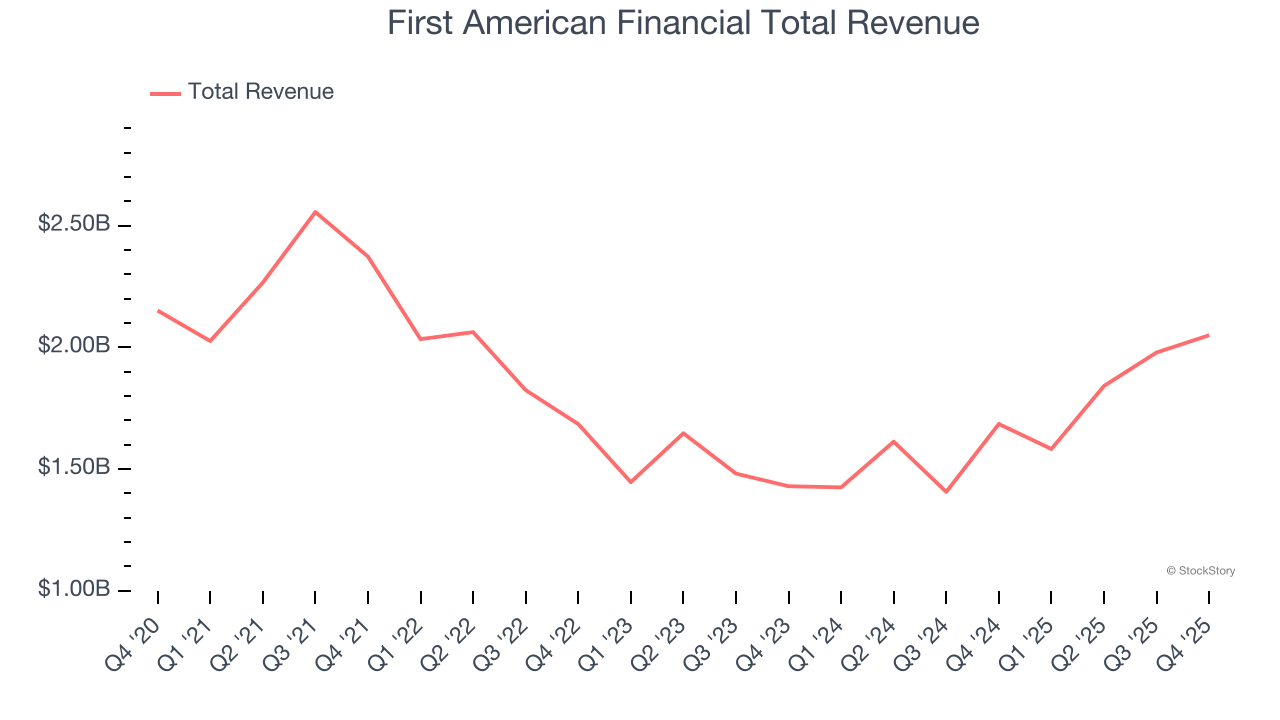
Although it had a fine quarter compared its peers, the market seems unhappy with the results as the stock is down 7.9% since reporting. It currently trades at $59.28.
Is now the time to buy First American Financial? Access our full analysis of the earnings results here, it’s free.
Weakest Q4: Old Republic International (NYSE: ORI)
Founded during the Roaring Twenties in 1923 and weathering nearly a century of economic cycles, Old Republic International (NYSE: ORI) is a diversified insurance holding company that provides property, liability, title, and mortgage guaranty insurance through its various subsidiaries.
Old Republic International reported revenues of $2.36 billion, up 9.5% year on year, exceeding analysts’ expectations by 1.6%. Still, it was a softer quarter as it posted a significant miss of analysts’ EPS estimates and a significant miss of analysts’ book value per share estimates.
As expected, the stock is down 8.2% since the results and currently trades at $39.61.
Read our full analysis of Old Republic International’s results here.
Employers Holdings (NYSE: EIG)
With roots in Nevada and a strong concentration in California where 45% of its premiums are generated, Employers Holdings (NYSE: EIG) is a specialty provider of workers' compensation insurance focused on small and select businesses engaged in low-to-medium hazard industries across the United States.
Employers Holdings reported revenues of $170.5 million, down 21.3% year on year. This print came in 21.9% below analysts' expectations. Taking a step back, it was a satisfactory quarter as it also produced a beat of analysts’ EPS estimates but a significant miss of analysts’ revenue estimates.
Employers Holdings had the weakest performance against analyst estimates and slowest revenue growth among its peers. The stock is down 3.5% since reporting and currently trades at $40.95.
Read our full, actionable report on Employers Holdings here, it’s free.
Trupanion (NASDAQ: TRUP)
Born from a vision to help pet owners avoid economic euthanasia when faced with expensive veterinary bills, Trupanion (NASDAQ: TRUP) provides medical insurance for cats and dogs through data-driven, vertically-integrated products priced specifically for each pet's unique characteristics.
Trupanion reported revenues of $376.9 million, up 11.7% year on year. This number was in line with analysts’ expectations. Taking a step back, it was a softer quarter as it recorded a significant miss of analysts’ EPS estimates.
The stock is down 20.8% since reporting and currently trades at $25.44.
Read our full, actionable report on Trupanion here, it’s free.
Market Update
Late in 2025 into early 2026, there was hand wringing around artificial intelligence. For software companies, the fear was that AI would erode pricing power and compress margins as new tools made it easier to replicate what once required expensive enterprise platforms. Crypto investors had their own version of the same anxiety: if AI agents could trade, allocate capital, and manage wallets autonomously, what exactly was the long-term value of today’s crypto infrastructure?
These concerns triggered a noticeable rotation away from these sectors and into safer havens. But markets rarely dwell on one narrative for long. Spring 2026 came, and the focus shifted abruptly from technological disruption to geopolitical risk. The US’ conflict with Iran became the dominant driver of market psychology, and when geopolitics takes center stage, the script changes quickly. Investors stop debating growth rates and start worrying about oil supply, inflation, and global stability.
Want to invest in winners with rock-solid fundamentals? Check out our Hidden Gem Stocks and add them to your watchlist. These companies are poised for growth regardless of the political or macroeconomic climate.
StockStory’s analyst team — all seasoned professional investors — uses quantitative analysis and automation to deliver market-beating insights faster and with higher quality.