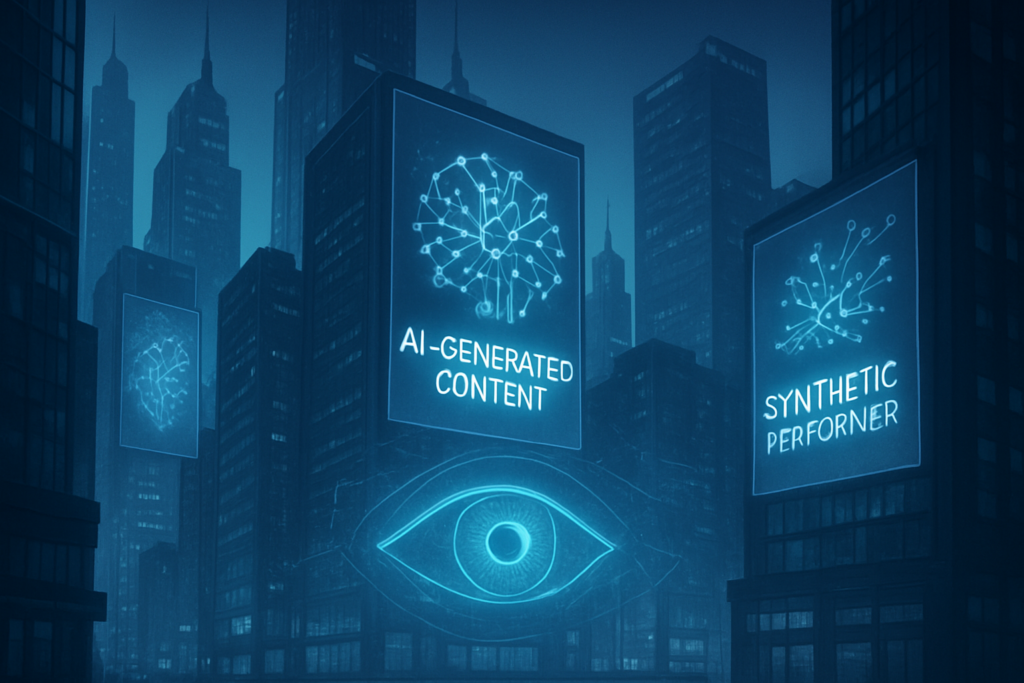
New York has taken a monumental step towards regulating artificial intelligence in commercial spaces, with Governor Kathy Hochul signing into law groundbreaking legislation (S.8420-A/A.8887-B and S.8391/A.8882) on December 11, 2025. This new mandate requires explicit disclosure when AI-generated "synthetic performers" are used in advertisements, marking a pivotal moment for consumer awareness and ethical marketing practices. While the law is officially enacted as of today, its specific compliance requirements are anticipated to take effect 180 days from the signing date, giving the industry a crucial window to adapt.
The legislation’s primary aim is to combat deception and foster transparency in an increasingly AI-driven advertising landscape. By compelling advertisers to clearly indicate the use of AI-generated content, New York seeks to empower consumers to distinguish between real human performers and digitally fabricated likenesses. This move is poised to redefine standards for responsible AI integration, ensuring that the proliferation of advanced generative AI tools enhances creativity without compromising trust or misleading the public.
Decoding the Mandate: Specifics of New York's AI Advertising Law
The core of New York's new legislation revolves around the concept of a "synthetic performer." The law meticulously defines this as a digitally created asset, reproduced or modified by computer using generative AI or other software algorithms, designed to give the impression of a human performer who is not recognizable as any identifiable natural person. This precise definition is crucial for delineating the scope of the disclosure requirement, aiming to capture the sophisticated AI creations that can mimic human appearance and behavior with alarming accuracy.
Under the new law, advertisers must provide "clear and conspicuous" disclosure whenever a synthetic performer is utilized. This means the disclosure must be presented in a way that is easily noticeable and understandable by the average viewer, preventing subtle disclaimers that could be overlooked. While the exact formatting and placement guidelines for such disclosures will likely be elaborated upon in subsequent regulations, the intent is unequivocally to ensure immediate consumer recognition of AI-generated content. Furthermore, the legislation extends its protective umbrella to include provisions requiring consent for the use of digital renderings of deceased performers in commercial works, addressing long-standing ethical concerns around digital resurrection and intellectual property rights.
This proactive regulatory stance by New York distinguishes it from many other jurisdictions globally, which largely lack specific laws governing AI disclosure in advertising. While some industry bodies have introduced voluntary guidelines, New York's law establishes a legally binding framework with tangible consequences. Non-compliance carries civil penalties, starting with a $1,000 fine for the first violation and escalating to $5,000 for subsequent offenses. This punitive measure underscores the state's commitment to enforcement and provides a significant deterrent against deceptive practices. Initial reactions from the AI research community and industry experts have been largely positive, hailing the law as a necessary step towards establishing ethical guardrails for AI, though some express concerns about the practicalities of implementation and potential impacts on creative freedom.
Shifting Sands: Implications for AI Companies and Tech Giants
The introduction of New York’s AI disclosure law is set to create ripples across the artificial intelligence and advertising industries, impacting tech giants, established advertising agencies, and nascent AI startups alike. Companies heavily reliant on generative AI for creating advertising content, particularly those producing hyper-realistic digital humans or voiceovers, will face significant operational adjustments. This includes a mandatory audit of existing and future creative assets to identify instances requiring disclosure, the implementation of new workflow protocols for content generation, and potentially the development of internal tools to track and flag synthetic elements.
Major tech companies like Alphabet (NASDAQ: GOOGL), Meta Platforms (NASDAQ: META), and Adobe (NASDAQ: ADBE), which develop and provide the underlying AI technologies and creative suites, will see both challenges and opportunities. While their clients in advertising will need to adapt, these tech giants may also find new revenue streams in offering AI detection, compliance, and disclosure management solutions. Startups specializing in AI governance, ethical AI tools, and content authenticity verification are particularly well-positioned to benefit, as demand for their services will likely surge to help businesses navigate the new regulatory landscape.
The competitive implications are substantial. Companies that proactively embrace transparency and integrate disclosure mechanisms seamlessly into their advertising strategies could gain a reputational advantage, fostering greater consumer trust. Conversely, those perceived as slow to adapt or, worse, attempting to circumvent the regulations, risk significant brand damage and financial penalties. This law could also spur innovation in "explainable AI" within advertising, pushing developers to create AI systems that can clearly articulate their generative processes. Furthermore, it may lead to a shift in marketing strategies, with some brands potentially opting for traditional human-led campaigns to avoid disclosure requirements, while others might lean into AI-generated content, leveraging the disclosure as a mark of technological advancement.
A Broader Canvas: AI Transparency in the Global Landscape
New York's pioneering AI disclosure law is a significant piece in the broader mosaic of global efforts to regulate artificial intelligence. It underscores a growing societal demand for transparency and accountability as AI becomes increasingly sophisticated and integrated into daily life. This legislation fits squarely within an emerging trend of governments worldwide grappling with the ethical implications of AI, from data privacy and algorithmic bias to the potential for deepfakes and misinformation. The law's focus on "synthetic performers" directly addresses the blurring lines between reality and simulation, a concern amplified by advancements in generative adversarial networks (GANs) and large language models capable of creating highly convincing visual and auditory content.
The impacts of this law extend beyond mere compliance. It has the potential to elevate consumer literacy regarding AI, prompting individuals to critically assess the content they encounter online and in traditional media. This increased awareness is crucial in an era where AI-generated content can be weaponized for propaganda or fraud. Potential concerns, however, include the practical burden on small businesses and startups to implement complex compliance measures, which could stifle innovation or disproportionately affect smaller players. There's also the ongoing debate about where to draw the line: what level of AI assistance in content creation necessitates disclosure? Does minor AI-driven photo editing require the same disclosure as a fully synthetic digital human?
Comparisons to previous AI milestones reveal a shift in regulatory focus. Earlier discussions often centered on autonomous systems or data privacy. Now, the emphasis is moving towards the output of AI and its potential to deceive or mislead. This law can be seen as a precursor to more comprehensive AI regulation, similar to how early internet laws addressed basic e-commerce before evolving into complex data protection frameworks like GDPR. It sets a precedent that the authenticity of digital content, especially in commercial contexts, is a public good requiring legislative protection.
Glimpsing the Horizon: Future Developments in AI Disclosure
The enactment of New York's AI disclosure law is not an endpoint but rather a significant starting gun in the race for greater AI transparency. In the near term, we can expect a flurry of activity as businesses and legal professionals work to interpret the law's nuances and develop robust compliance strategies. This will likely involve the creation of industry-specific best practices, educational programs for marketers, and perhaps even new technological solutions designed to automate the detection and labeling of AI-generated content. It's highly probable that other U.S. states and potentially even other countries will look to New York's framework as a model, leading to a patchwork of similar regulations across different jurisdictions.
Long-term developments could see the scope of AI disclosure expand beyond "synthetic performers" to encompass other forms of AI-assisted content creation, such as AI-generated text, music, or even complex narratives. The challenges that need to be addressed include developing universally accepted standards for what constitutes "clear and conspicuous" disclosure across various media types, from video advertisements to interactive digital experiences. Furthermore, the rapid pace of AI innovation means that regulators will constantly be playing catch-up, requiring agile legislative frameworks that can adapt to new technological advancements.
Experts predict that this law will accelerate research and development in areas like digital watermarking for AI-generated content, blockchain-based content provenance tracking, and advanced AI detection algorithms. The goal will be to create a digital ecosystem where the origin and authenticity of content can be easily verified. We may also see the emergence of specialized AI ethics consultants and compliance officers within advertising agencies and marketing departments. The overarching trend points towards a future where transparency in AI use is not just a regulatory requirement but a fundamental expectation from consumers and a cornerstone of ethical business practice.
A New Era of Transparency: Wrapping Up New York's AI Mandate
New York's new law mandating AI disclosure in advertisements represents a critical inflection point in the ongoing dialogue about artificial intelligence and its societal impact. The key takeaway is a clear legislative commitment to consumer protection and ethical marketing, signaling a shift from a hands-off approach to proactive regulation in the face of rapidly advancing generative AI capabilities. By specifically targeting "synthetic performers," the law directly confronts the challenge of distinguishing human from machine-generated content, a distinction increasingly vital for maintaining trust and preventing deception.
This development is significant in AI history, marking one of the first comprehensive attempts by a major U.S. state to legally enforce transparency in AI-powered commercial content. It sets a powerful precedent that could inspire similar legislative actions globally, fostering a more transparent and accountable AI landscape. The long-term impact is likely to be profound, shaping not only how advertisements are created and consumed but also influencing the ethical development of AI technologies themselves. Companies will be compelled to integrate ethical considerations and transparency by design into their AI tools and marketing strategies.
In the coming weeks and months, all eyes will be on how the advertising industry begins to adapt to these new requirements. We will watch for the specific guidelines that emerge regarding disclosure implementation, the initial reactions from consumers, and how companies navigate the balance between leveraging AI's creative potential and adhering to new transparency mandates. This law is a testament to the growing recognition that as AI evolves, so too must the frameworks governing its responsible use.
This content is intended for informational purposes only and represents analysis of current AI developments.
TokenRing AI delivers enterprise-grade solutions for multi-agent AI workflow orchestration, AI-powered development tools, and seamless remote collaboration platforms.
For more information, visit https://www.tokenring.ai/.