In a move that signals the dawn of a new era in industrial-scale artificial intelligence, OpenAI is reportedly in the final stages of a historic $100 billion fundraising round. This capital infusion, aimed at a staggering valuation between $750 billion and $830 billion, positions the San Francisco-based lab as the most valuable private startup in history. The news, emerging as the tech world closes out 2025, underscores a fundamental shift in the AI landscape: the transition from software development to the massive, physical infrastructure required to achieve Artificial General Intelligence (AGI).
Central to this expansion is a landmark $100 billion strategic partnership with NVIDIA Corporation (NASDAQ: NVDA), designed to build out a colossal 10-gigawatt (GW) compute network. This unprecedented collaboration, characterized by industry insiders as the "Sovereign Compute Pact," aims to provide OpenAI with the raw processing power necessary to deploy its next-generation reasoning models. By securing its own dedicated hardware and energy supply, OpenAI is effectively evolving into a "self-hosted hyperscaler," rivaling the infrastructure of traditional cloud titans.
The technical specifications of the OpenAI-Nvidia partnership are as ambitious as they are resource-intensive. At the heart of the 10GW initiative is Nvidia’s next-generation "Vera Rubin" platform, the successor to the Blackwell architecture. Under the terms of the deal, Nvidia will invest up to $100 billion in OpenAI, with capital released in $10 billion increments for every gigawatt of compute that successfully comes online. This massive fleet of GPUs will be housed in a series of specialized data centers, including the flagship "Project Ludicrous" in Abilene, Texas, which is slated to become a 1.2GW hub of AI activity by late 2026.
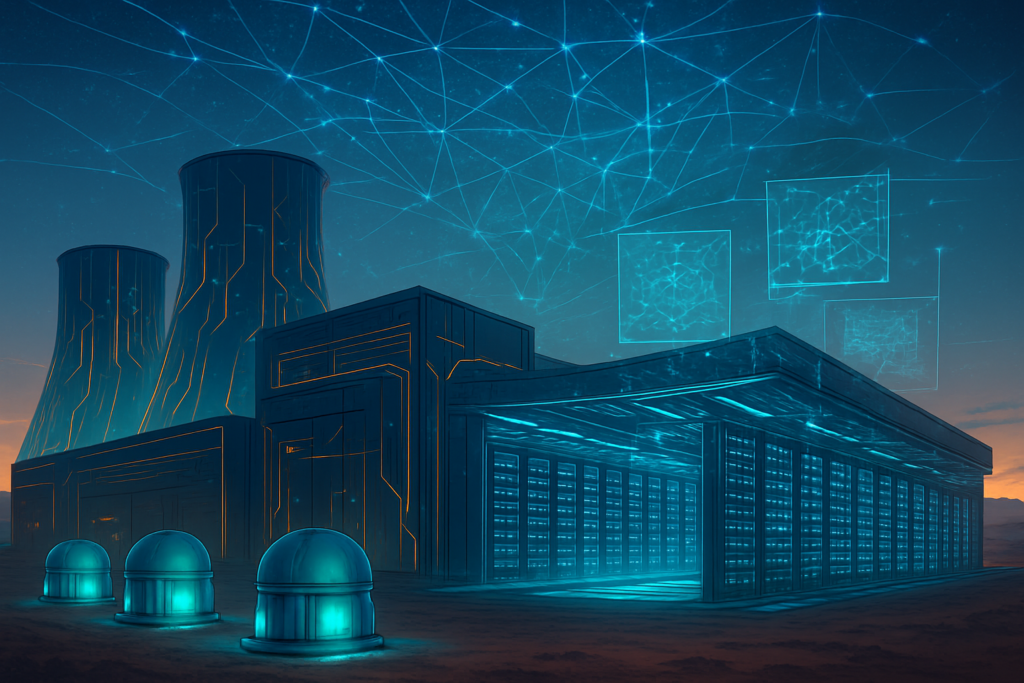
Unlike previous generations of AI clusters that relied on existing cloud frameworks, this 10GW network will utilize millions of Vera Rubin GPUs and specialized networking gear sold directly by Nvidia to OpenAI. This bypasses the traditional intermediate layers of cloud providers, allowing for a hyper-optimized hardware-software stack. To meet the immense energy demands of these facilities—10GW is enough to power approximately 7.5 million homes—OpenAI is pursuing a "nuclear-first" strategy. The company is actively partnering with developers of Small Modular Reactors (SMRs) to provide carbon-free, baseload power that can operate independently of the traditional electrical grid.
Initial reactions from the AI research community have been a mix of awe and trepidation. While many experts believe this level of compute is necessary to overcome the current "scaling plateaus" of large language models, others worry about the environmental and logistical challenges. The sheer scale of the project, which involves deploying millions of chips and securing gigawatts of power in record time, is being compared to the Manhattan Project or the Apollo program in its complexity and national significance.
This development has profound implications for the competitive dynamics of the technology sector. By selling directly to OpenAI, NVIDIA Corporation (NASDAQ: NVDA) is redefining its relationship with its traditional "Big Tech" customers. While Microsoft Corporation (NASDAQ: MSFT) remains a critical partner and major shareholder in OpenAI, the new infrastructure deal suggests a more autonomous path for Sam Altman’s firm. This shift could potentially strain the "coopetition" between OpenAI and Microsoft, as OpenAI increasingly manages its own physical assets through "Stargate LLC," a joint venture involving SoftBank Group Corp. (OTC: SFTBY), Oracle Corporation (NYSE: ORCL), and the UAE’s MGX.
Other tech giants, such as Alphabet Inc. (NASDAQ: GOOGL) and Amazon.com, Inc. (NASDAQ: AMZN), are now under immense pressure to match this level of vertical integration. Amazon has already responded by deepening its own chip-making efforts, while Google continues to leverage its proprietary TPU (Tensor Processing Unit) infrastructure. However, the $100 billion Nvidia deal gives OpenAI a significant "first-mover" advantage in the Vera Rubin era, potentially locking in the best hardware for years to come. Startups and smaller AI labs may find themselves at a severe disadvantage, as the "compute divide" widens between those who can afford gigawatt-scale infrastructure and those who cannot.
Furthermore, the strategic advantage of this partnership extends to cost efficiency. By co-developing custom ASICs (Application-Specific Integrated Circuits) with Broadcom Inc. (NASDAQ: AVGO) alongside the Nvidia deal, OpenAI is aiming to reduce the "power-per-token" cost of inference by 30%. This would allow OpenAI to offer more advanced reasoning models at lower prices, potentially disrupting the business models of competitors who are still scaling on general-purpose cloud infrastructure.
The wider significance of a $100 billion funding round and 10GW of compute cannot be overstated. It represents the "industrialization" of AI, where the success of a company is measured not just by the elegance of its code, but by its ability to secure land, power, and silicon. This trend is part of a broader global movement toward "Sovereign AI," where nations and massive corporations seek to control their own AI destiny rather than relying on shared public clouds. The regional expansions of the Stargate project into the UK, UAE, and Norway highlight the geopolitical weight of these AI hubs.
However, this massive expansion brings significant concerns. The energy consumption of 10GW of compute has sparked intense debate over the sustainability of the AI boom. While the focus on nuclear SMRs is a proactive step, the timeline for deploying such reactors often lags behind the immediate needs of data center construction. There are also fears regarding the concentration of power; if a single private entity controls the most powerful compute cluster on Earth, the societal implications for data privacy, bias, and economic influence are vast.
Comparatively, this milestone dwarfs previous breakthroughs. When GPT-4 was released, the focus was on the model's parameters. In late 2025, the focus has shifted to the "grid." The transition from the "era of models" to the "era of infrastructure" mirrors the early days of the oil industry or the expansion of the railroad, where the infrastructure itself became the ultimate source of power.
Looking ahead, the next 12 to 24 months will be a period of intense construction and deployment. The first gigawatt of the Vera Rubin-powered network is expected to be operational by the second half of 2026. In the near term, we can expect OpenAI to use this massive compute pool to train and run "o2" and "o3" reasoning models, which are rumored to possess advanced scientific and mathematical problem-solving capabilities far beyond current systems.
The long-term goal remains AGI. Experts predict that the 10GW threshold is the minimum requirement for a system that can autonomously conduct research and improve its own algorithms. However, significant challenges remain, particularly in cooling technologies and the stability of the power grid. If OpenAI and Nvidia can successfully navigate these hurdles, the potential applications—from personalized medicine to solving complex climate modeling—are limitless. The industry will be watching closely to see if the "Stargate" vision can truly unlock the next level of human intelligence.
The rumored $100 billion fundraising round and the 10GW partnership with Nvidia represent a watershed moment in the history of technology. By aiming for a near-trillion-dollar valuation and building a sovereign infrastructure, OpenAI is betting that the path to AGI is paved with unprecedented amounts of capital and electricity. The collaboration between Sam Altman and Jensen Huang has effectively created a new category of enterprise: the AI Hyperscaler.
As we move into 2026, the key metrics to watch will be the progress of the Abilene and Lordstown data center sites and the successful integration of the Vera Rubin GPUs. This development is more than just a financial story; it is a testament to the belief that AI is the defining technology of the 21st century. Whether this $100 billion gamble pays off will determine the trajectory of the global economy for decades to come.
This content is intended for informational purposes only and represents analysis of current AI developments.
TokenRing AI delivers enterprise-grade solutions for multi-agent AI workflow orchestration, AI-powered development tools, and seamless remote collaboration platforms.
For more information, visit https://www.tokenring.ai/.