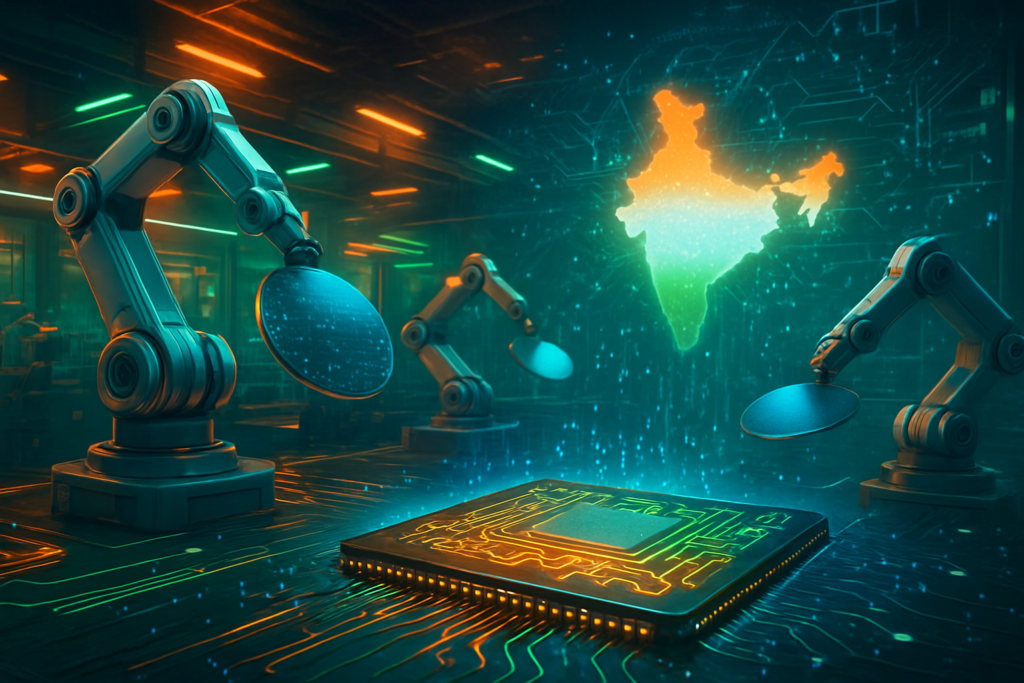
As of January 1, 2026, the global semiconductor landscape has undergone a tectonic shift, with India emerging from the shadows of its service-sector legacy to become a formidable manufacturing powerhouse. The India Semiconductor Mission (ISM), once viewed with skepticism by global analysts, has successfully transitioned from a series of policy incentives into a tangible network of operational fabrication units and assembly plants. With over $18.2 billion in cumulative investments now anchored in Indian soil, the nation has effectively positioned itself as the primary "China Plus One" destination for the world’s most critical technology.
The immediate significance of this transformation cannot be overstated. As commercial shipments of "Made in India" memory modules begin their journey to global markets this quarter, the mission has moved beyond proof-of-concept. By securing commitments from industry titans and establishing a robust domestic ecosystem for mature-node chips, India is not just building factories; it is constructing a "trusted geography" that provides a vital fail-safe for a global supply chain long haunted by geopolitical volatility in the Taiwan Strait and trade friction with China.
The Technical Backbone: From ATMP to 28nm Fabrication
The technical realization of the ISM is headlined by Micron Technology (NASDAQ: MU), which has successfully completed Phase 1 of its $2.75 billion facility in Sanand, Gujarat. As of today, the facility has validated its high-spec cleanrooms and is ramping up for high-volume commercial production of DRAM and NAND memory products. This Assembly, Test, Marking, and Packaging (ATMP) unit represents India’s first high-volume entry into the semiconductor value chain, with the first major commercial exports scheduled for Q1 2026. This facility utilizes advanced packaging techniques that were previously the exclusive domain of East Asian hubs, marking a significant step up in India’s technical complexity.
Parallel to Micron’s progress, Tata Electronics—a subsidiary of the diversified Tata Group, which includes the publicly traded Tata Motors (NYSE: TTM)—is making rapid strides at the Dholera Special Investment Region. In partnership with Powerchip Semiconductor Manufacturing Corporation (Taiwan: 6770), the Dholera fab is currently in the equipment installation phase. Designed to produce 300mm wafers at mature nodes ranging from 28nm to 110nm, this facility targets the "workhorse" chips essential for automotive electronics, 5G infrastructure, and power management. Unlike the cutting-edge sub-5nm nodes used in high-end smartphones, these mature nodes are the backbone of the global industrial and automotive sectors, where India aims to achieve dominant market share.
Furthermore, the Tata-led mega OSAT (Outsourced Semiconductor Assembly and Test) facility in Morigaon, Assam, is scheduled for commissioning in April 2026. With an investment of ₹27,000 crore, the plant is engineered to produce a staggering 48 million chips per day at full capacity. Technical specifications for this site include advanced Flip Chip and Integrated Systems Packaging (ISP) technologies. Meanwhile, the joint venture between CG Power, Renesas Electronics (TSE: 6723), and Stars Microelectronics has already inaugurated its first end-to-end OSAT pilot line, moving toward full commercial production of specialized chips for power electronics and the automotive sector by mid-2026.
A New Competitive Order for Global Tech Giants
The emergence of India as a chip hub has forced a strategic recalibration among "Big Tech" firms. Intel (NASDAQ: INTC) recently signaled a major shift by partnering with Tata Electronics to explore local manufacturing and assembly, aligning with its "Foundry 2.0" strategy to diversify production away from traditional hubs. Similarly, NVIDIA (NASDAQ: NVDA) has transitioned from treating India as a design center to a strategic manufacturing partner. Following its massive strategic investments in global foundry capacity, NVIDIA is now leveraging Indian facilities for the assembly and testing of custom AI silicon tailored for the Global South, a move that provides a competitive edge in emerging markets.
The impact is perhaps most visible in the operations of Apple (NASDAQ: AAPL). By the start of 2026, Apple has successfully moved nearly 25% of its iPhone production to India. The domestic growth of semiconductor packaging (ATMP) has allowed the tech giant to significantly reduce its Bill of Materials (BoM) costs by sourcing components locally. This vertical integration within India shields Apple from the volatile trade tariffs and supply chain disruptions associated with its traditional China-based manufacturing.
For major AI labs and hardware companies like Advanced Micro Devices (NASDAQ: AMD), India’s semiconductor push offers a "fail-safe" for global supply chains. AMD, which now employs over 8,000 engineers in its Bengaluru R&D center, has begun integrating its adaptive computing and AI accelerators into the "Make in India" initiative. This shift provides these companies with a market positioning advantage: the ability to claim a "trusted" and "resilient" supply chain, which is increasingly a requirement for government contracts and enterprise security in the West.
Geopolitics and the "Trusted Geography" Framework
The wider significance of the India Semiconductor Mission lies in its role as a geopolitical stabilizer. The mission is the centerpiece of the US-India Initiative on Critical and Emerging Technology (iCET), which was recently upgraded to the "TRUST" framework (Transforming the Relationship Utilizing Strategic Technology). This collaboration has led to the development of a "National Security Fab" in India, focused on Silicon Carbide (SiC) and Gallium Nitride (GaN) chips for defense and space applications, ensuring that the two nations share a secure, interoperable technological foundation.
In the broader AI landscape, India’s focus on mature nodes (28nm+) addresses a critical gap. While the world chases sub-2nm nodes for LLM training, the physical infrastructure of AI—sensors, power regulators, and connectivity modules—runs on the very chips India is now producing. By dominating this "legacy" market, India is positioning itself as the indispensable provider of the hardware that allows AI to interact with the physical world. This strategy directly challenges China’s dominance in the mature-process market, offering global carmakers like Tesla (NASDAQ: TSLA) and Toyota (NYSE: TM) a Western-aligned alternative.
However, this rapid expansion is not without concerns. The massive water and power requirements of semiconductor fabs remain a challenge for Indian infrastructure. Environmentalists have raised questions about the long-term impact on local resources in Gujarat and Assam. Furthermore, while India has successfully attracted "the big fish," the next phase of the mission will require the development of a deeper ecosystem, including domestic suppliers of specialized chemicals, gases, and semiconductor-grade equipment, to truly achieve "Atmanirbharta" (self-reliance).
The Road to 2030: ISM 2.0 and the Talent Pipeline
Looking ahead, the Indian government has already initiated the rollout of ISM 2.0 with an expanded outlay of $20 billion. The focus of this next phase is twofold: incentivizing sub-10nm leading-edge fabrication and deepening the domestic supply chain. Experts predict that by 2028, India will host at least one "Giga-Fab" capable of producing advanced logic chips, further closing the gap with Taiwan and South Korea. The near-term applications will likely focus on 6G telecommunications and indigenous AI hardware, where India’s "Chips to Startup" (C2S) program is already yielding results.
The most potent weapon in India’s arsenal is its talent pool. As of early 2026, the nation has already trained over 60,000 of its targeted 85,000 semiconductor engineers. This influx of high-skill labor has mitigated the global talent shortage that slowed fab expansions in the United States and Europe. Predictably, the next few years will see a shift from India being a provider of "design talent" to a provider of "operational expertise," with Indian engineers managing some of the most advanced cleanrooms in the world.
A Milestone in the History of Technology
The success of the India Semiconductor Mission as of January 2026 marks a pivotal moment in the history of global technology. It represents the first time a major democratic economy has successfully built a semiconductor ecosystem from the ground up in the 21st century. The key takeaways are clear: India is no longer just a consumer of technology or a back-office service provider; it is a critical node in the hardware architecture of the future.
The significance of this development will be felt for decades. By providing a "trusted" alternative to East Asian manufacturing, India has added a layer of resilience to the global economy that was sorely missing during the supply chain crises of the early 2020s. In the coming weeks and months, the industry should watch for the first commercial shipments from Micron and the progress of equipment installation at the Tata-PSMC fab. These milestones will serve as the definitive heartbeat of a new era in silicon sovereignty.
This content is intended for informational purposes only and represents analysis of current AI and semiconductor developments.
TokenRing AI delivers enterprise-grade solutions for multi-agent AI workflow orchestration, AI-powered development tools, and seamless remote collaboration platforms.
For more information, visit https://www.tokenring.ai/.