Forget obsessing over the perfect Shopify theme. In modern dropshipping, the seller who tests the fastest takes the entire pie.
Social media trends do not care about your shipping delays. A posture corrector or a glowing dog collar that explodes on TikTok on a Tuesday is often completely saturated by Friday. If you want to find a winning product, your testing volume needs to be aggressive. You spot a gadget, spin up a quick landing page, blast video ads across social feeds, and watch the metrics. If nobody clicks, you kill it and move on.
But there is a massive chokepoint strangling independent sellers: making the actual video ads.
The traditional dropshipping playbook is agonizingly slow. You spot a trending product on a supplier’s website. You order a sample. You wait two to three weeks for a crumpled box to arrive from overseas. You burn your entire Saturday trying to film the gadget on your desk with decent lighting. Then, you spend your Sunday wrestling with editing software. By the time your ad goes live, almost a month has passed. If the product flops, you didn’t just lose a few ad dollars—you lost a month of momentum.
To scale your store today, you must completely decouple your testing phase from physical logistics. You need to know if a market actually wants to buy an item long before you ever hold that item in your hands. This is where artificial intelligence rewrites the rules.
The “Sample-Free” Testing Cheat Code
The secret to rapid testing is leveraging the digital assets that already exist. Suppliers always provide high-resolution images and basic product details on their listings. You just need to transform those raw materials into scroll-stopping social media content.
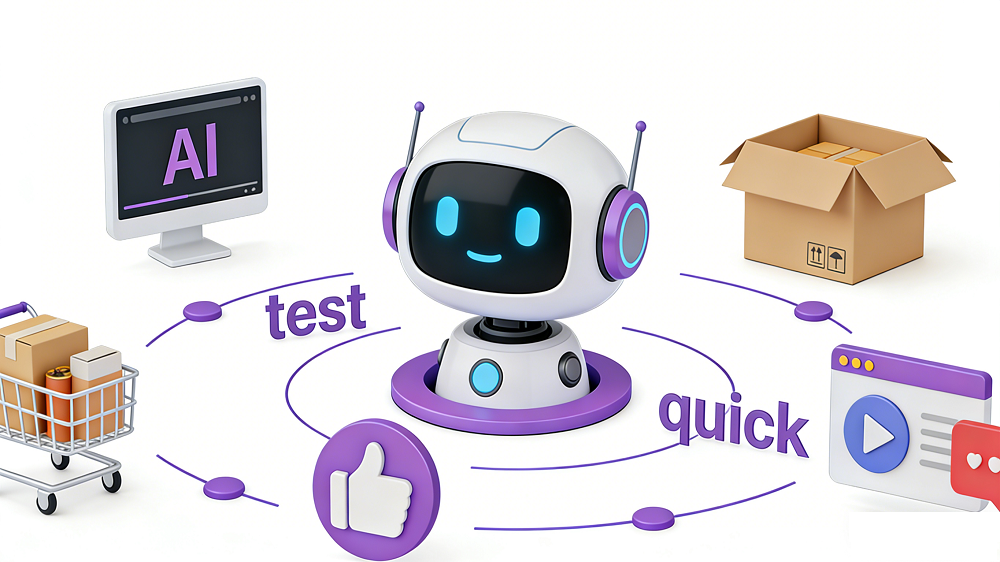
Instead of manually downloading JPEGs and staring at a blank timeline, the dedicated Nemovideo editor acts as your instant creative department. It ingests a simple product link and automatically outputs a polished, ready-to-run social media ad in minutes. It crawls the page, writes the script, and edits the footage for you. This effectively turns a three-week waiting game into a five-minute automated task.
Let’s break down exactly how to execute this rapid-testing workflow to validate products at lightning speed.
Step 1: The URL-to-Video Extraction
When you spot a high-potential product, copy the URL directly from the AliExpress, Amazon, or supplier’s page. Paste that link directly into your AI platform.
The system instantly scans the webpage. It grabs the cleanest photos and strips out the messy backgrounds. More importantly, it reads the product description to figure out exactly why someone would buy it. It translates dry, boring bullet points into compelling marketing hooks. The AI automatically pieces these visuals and selling points together into a fast-paced video sequence. You have just built the visual foundation of your ad without ever touching a camera.
Step 2: Instant Angle Testing
Launching just one video ad is a terrible way to test a product. If the ad fails, you are left completely blind. Did the audience hate the product, or did they just hate your video? You need to test different psychological angles to get a clear answer.
Because you aren’t doing the manual labor, you can force the AI to generate multiple variations instantly. Tell the built-in scriptwriter to create three distinct narratives. Let’s use a “smart neck massager” as an example:
- Angle A (The Painkiller): Hooks the viewer by talking about chronic tech-neck from staring at phones all day and positions the product as medical relief.
- Angle B (The Spa Experience): Focuses on luxury, relaxation, and self-care after a stressful, exhausting workday.
- Angle C (The Gifting Angle): Positions the massager as the perfect, unique holiday gift for a stressed-out partner.
The software generates unique AI voiceovers and text layouts for every single angle. You instantly possess a complete A/B testing matrix ready for your Facebook or TikTok ad manager.
Step 3: Beating the “Slideshow” Curse
Buyers are smart. They have built-in ad blockers in their brains. If your video looks like a cheap, robotic PowerPoint presentation of product photos, they will swipe away in a millisecond. Your ad must feel native to the platform. It needs to look exactly like User-Generated Content (UGC).
The AI avoids the slideshow trap through intelligent asset matching. It mixes your product images with hyper-relevant, royalty-free stock video to create a lifestyle context. If the AI voiceover mentions “working long hours,” it seamlessly cuts to a high-quality video clip of someone rubbing their tired neck at a computer desk, before snapping back to your product.
Next, the AI applies dynamic, bouncy subtitles right in the middle of the screen to trap the viewer’s attention, even if their phone is on mute. It pairs this with a realistic AI voice that sounds exactly like a native TikTok creator, complete with casual pacing and natural breaths. The final export feels fast, organic, and highly engaging.
Step 4: Launching the Micro-Budget Campaign
Armed with three polished, native-looking videos, you can immediately launch a low-budget testing campaign. You don’t need complex targeting; modern ad algorithms are smart enough to find your buyers based on the content of your video.
Set a budget of $20 to $50 a day and test your different angles against each other. Let the algorithm do its job for 24 to 48 hours. Because you didn’t waste weeks waiting for shipping or spend hundreds of dollars on a freelance video editor, your financial risk is practically zero.
Step 5: Read the Data to Scale or Kill
After 48 hours, the dashboard will tell you everything you need to know without emotion.
If the Click-Through Rate (CTR) is abysmal across all three videos and your cart is completely empty, kill the campaign instantly. Do not get attached to the product. You only lost a tiny bit of ad spend, and you are ready to test a completely different product tomorrow morning.
But, if one of those AI-generated angles hits a high Return on Ad Spend (ROAS) and the sales start rolling in, you have found a validated winner. The market has spoken. Now, you can confidently bulk-order inventory. Now, you can invest in ordering a physical sample to shoot custom UGC with real actors to scale the brand even further.
Conclusion
In modern dropshipping, speed is your sharpest weapon. By using AI to skip the physical sample phase and instantly flip product URLs into highly engaging video variations, you multiply your testing velocity. Stop trusting your gut, stop waiting on overseas shipping, and start letting rapid, AI-driven data tell you exactly what to sell.