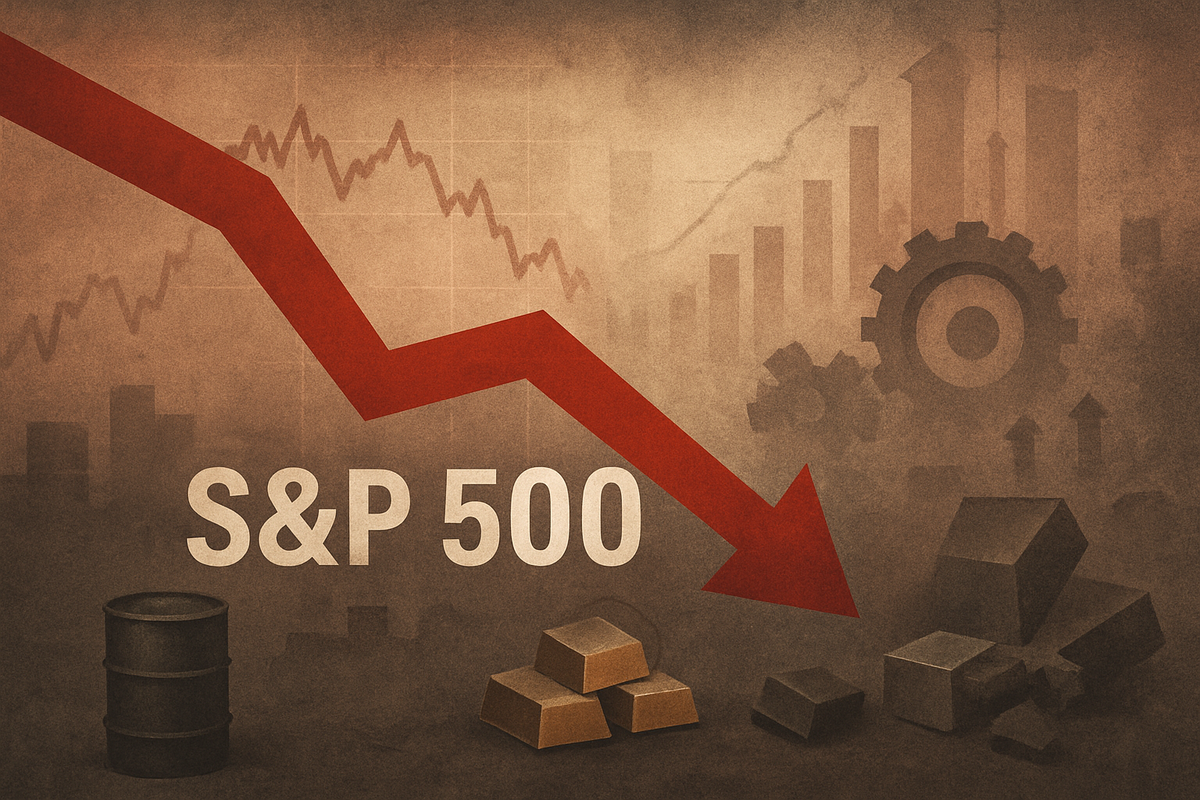
New York, NY – December 1, 2025 – The S&P 500 has begun December 2025 with a notable decline, signaling a profound shift in market sentiment as investors grapple with a confluence of challenging economic factors. This downturn, described by analysts as "rediscovering gravity," comes after a period of sustained upward momentum, suggesting a sharp correction as asset prices adjust to underlying economic fundamentals rather than speculative enthusiasm. The immediate implications include heightened caution across nearly all sectors and a bracing for what could be a more volatile period ahead, with a particular spotlight on the potential broader impact on commodity prices.
The cautious start to the final month of the year reflects growing concerns over persistent inflationary pressures, a hawkish stance from central banks, emerging signs of an economic slowdown, and anxieties about elevated valuations, particularly within the technology sector. This combination has fostered a "risk-off" mood, prompting investors to reassess their portfolios and brace for a potentially challenging economic landscape.
Detailed Coverage: Market Dynamics and Initial Reactions
The S&P 500's decline on December 1, 2025, was not an isolated event but rather the culmination of several interconnected economic forces that have been building throughout the year. On the first trading day of the month, S&P 500 futures were down 0.7% in pre-market trading, with the index subsequently falling to 6808 points, marking a 0.60% loss from the previous session. The Vanguard S&P 500 ETF (NYSEARCA: VOO), which tracks the index, also saw a 0.59% decrease in pre-market trading. This performance underscored a significant recalibration of investor expectations.
Leading up to this moment, persistent inflationary pressures have eroded consumer purchasing power and squeezed corporate profit margins, setting the stage for a re-evaluation of asset valuations. Central banks, notably the Federal Reserve, have maintained a more restrictive monetary policy than investors had anticipated, with hints of further tightening, such as the Bank of Japan's potential interest-rate hike, weighing on global bonds. Simultaneously, emerging signs of an economic slowdown, including weaker economic indicators, have fueled fears of a recession, further dampening market sentiment. Concerns over stretched valuations, particularly in big technology firms and AI stocks, led to a "risk-off" sentiment, with mega-cap stocks like Nvidia (NASDAQ: NVDA), Microsoft (NASDAQ: MSFT), Apple (NASDAQ: AAPL), Alphabet (NASDAQ: GOOGL), Amazon (NASDAQ: AMZN), Meta (NASDAQ: META), Broadcom (NASDAQ: AVGO), and Tesla (NASDAQ: TSLA) all lower in pre-market trading. Even a renewed selloff in cryptocurrencies, with Bitcoin sliding below $86,000, dragged down crypto-linked stocks and further dampened overall market mood.
The initial impact on commodity prices has been largely reflective of these broader economic concerns. Oil prices typically tend to decline during periods of economic slowdown or recession fears, as reduced industrial activity and consumer travel translate to lower demand. Industrial metals like copper and silver, highly sensitive to economic health, also tend to fall significantly due to anticipated weaker demand in construction, manufacturing, and infrastructure. Gold, often seen as a safe-haven asset, can initially experience a temporary fall in a widespread market panic but typically rebounds faster than risk assets as capital seeks safety. Agricultural commodities present a mixed picture; while a global economic slowdown can depress overall demand, specific supply and demand reports and structural challenges like climate volatility can also play a significant role.
Companies in the Crosshairs: Winners and Losers
In this challenging market environment, characterized by an S&P 500 decline, persistent inflation, hawkish central banks, economic slowdown fears, and fluctuating commodity prices, certain public companies and sectors are poised to face significant headwinds, while others may demonstrate relative resilience or even find opportunities.
On the losing side, Consumer Discretionary companies are highly vulnerable as inflation erodes purchasing power and economic slowdown fears lead consumers to cut back on non-essential spending. Companies like automotive manufacturers, airlines, hotels, and luxury retailers will likely see reduced sales volumes and margin pressure. The Information Technology sector, particularly high-growth segments and companies with elevated valuations, faces significant challenges. Higher interest rates discount future earnings more heavily, making current valuations less sustainable. Tech giants such as Nvidia (NASDAQ: NVDA) and Microsoft (NASDAQ: MSFT), despite their strength, could see their stock performance suffer from valuation compression. Real Estate and homebuilders are directly impacted by rising interest rates, which increase mortgage costs and reduce housing affordability. Homebuilders like D.R. Horton (NYSE: DHI) or Lennar (NYSE: LEN) would likely face lower sales and potentially reduced home prices. Industrials tied to capital expenditures and cyclical demand, as well as Materials companies involved in industrial metals mining, will suffer from economic slowdown fears and falling industrial metal prices. Similarly, Energy companies, especially those in oil and gas exploration and production (E&P) like ExxonMobil (NYSE: XOM) or Chevron (NYSE: CVX), will be negatively affected by declining oil prices.
Conversely, some sectors are better positioned to weather the storm. Consumer Staples companies, such as Procter & Gamble (NYSE: PG) or Coca-Cola (NYSE: KO), which produce essential goods, tend to exhibit stable demand regardless of economic conditions, offering relative stability. The Healthcare sector, with its inelastic demand for medical services and products, is also considered defensive, with pharmaceutical companies and medical device manufacturers like Johnson & Johnson (NYSE: JNJ) or Pfizer (NYSE: PFE) often showing resilience. Utilities, providing essential services like electricity and water, offer stable and predictable demand, making companies like Duke Energy Corporation (NYSE: DUK) attractive to investors seeking stability and dividends. Well-capitalized banks, while facing nuanced impacts from interest rates and default risks, could see expanded net interest margins in a hawkish central bank environment, though an economic slowdown could lead to increased loan loss provisions. Discount Retailers may benefit as consumers trade down to more affordable options. Finally, Gold Miners like Barrick Gold (NYSE: GOLD) or Newmont (NYSE: NEM) could see improved profitability as gold gains traction as a safe-haven asset, following an initial potential dip.
Wider Significance: Ripple Effects and Historical Echoes
The S&P 500's decline at the dawn of December 2025, driven by a perfect storm of inflation, hawkish monetary policy, economic slowdown fears, and stretched valuations, signifies more than just a market correction; it heralds a systemic repricing of risk and a potential end to an era of exuberant growth fueled by easy money. This event is deeply embedded in broader industry trends, most notably a pivot in investment strategy from speculative, high-growth ventures to more established companies with robust fundamentals.
The ripple effects will be far-reaching. The technology sector, which has enjoyed a prolonged boom, will face intensified pressure to demonstrate clear profitability and sustainable business models beyond mere growth narratives. This could lead to reduced investment in research and development, impacting the entire ecosystem of suppliers and service providers, including semiconductor manufacturers like Taiwan Semiconductor Manufacturing Company (NYSE: TSM) and cloud service providers. Financial institutions will likely adopt more cautious lending practices, affecting credit availability across industries. Global supply chains will need to become more agile to adapt to fluctuating demand, and consumer discretionary companies will feel the pinch as economic uncertainty tightens household budgets. Globally, the interconnectedness of financial systems means a U.S. downturn could trigger declines in international exchanges, impact global trade, and lead to increased currency volatility.
Regulatory and policy implications are also significant. Central banks, particularly the Federal Reserve, will face immense pressure to navigate the delicate balance between curbing inflation and avoiding a deep recession. This could necessitate further adjustments to interest rates and quantitative tightening policies, potentially leading to internal divisions within the Fed. The cryptocurrency market, already experiencing a sell-off, could face intensified calls for stricter oversight, accelerating discussions around comprehensive regulatory frameworks. Governments might consider fiscal stimulus, though high public debt levels could limit their scope, and trade policies, such as tariffs, could add another layer of complexity, affecting global trade dynamics and inflation.
Historically, this scenario echoes the stagflation of the 1970s, characterized by high inflation, slow economic growth, and rising unemployment, which eventually required aggressive central bank action. It also shares similarities with the early 2000s tech bust, highlighting the dangers of overvalued growth assets when market sentiment shifts. More recently, historical data indicates that the S&P 500 has often fallen by more than 20% after the first rate cut when valuations were high, suggesting that even anticipated easing might not prevent a significant downturn. The current liquidity squeeze across various asset classes also mirrors conditions seen in December 2018, potentially forcing the Fed to adopt a more accommodative stance if conditions worsen.
What Comes Next: Navigating the Uncertain Path Ahead
The S&P 500's stumble into December 2025 sets the stage for a period of significant uncertainty, demanding strategic pivots from both companies and investors. The short-term outlook (next 3-6 months) is likely to be characterized by continued market volatility and a potential for further declines as high inflation and rising interest rates weigh on economic growth and consumer spending. Elevated market valuations suggest that a more profound correction may be necessary to align with underlying economic fundamentals. Commodity prices will remain a key focus; while some (like gold) may act as safe havens, others (like industrial metals and oil) could see tempered demand due to an economic slowdown.
In the long term (6 months and beyond), a market recovery is possible, but it may be protracted given the underlying issues of persistent inflation and hawkish monetary policies aimed at slowing growth. This environment could lead to lower asset valuations and higher equity risk premia, potentially favoring value stocks over growth stocks as companies with strong pricing power and tangible assets prove more resilient. Globally, hawkish policies in major economies could strengthen domestic currencies but also make exports more expensive, affecting international trade.
Companies will need to implement aggressive cost restructuring and efficiency measures, prioritize financial discipline and cash flow management, and adopt strategic pricing to offset rising input costs. Diversifying revenue streams, focusing on core competencies, and even exploring proactive mergers and acquisitions during the downturn could be crucial for long-term survival and growth. For investors, strategic adaptations include reviewing portfolio diversification and asset allocation, potentially increasing exposure to inflation-hedge assets like gold, commodities, real estate (via Equity REITs), and Treasury Inflation-Protected Securities (TIPS). Maintaining a long-term perspective and avoiding emotional decisions during volatile periods will be paramount.
Potential scenarios range from a "controlled slowdown and gradual recovery," where central banks successfully curb inflation without a deep recession, leading to a U-shaped or W-shaped market recovery. A more challenging scenario is "stagflation," where high inflation persists alongside economic stagnation, leading to prolonged market underperformance and a strong preference for inflation-protected assets. The most pessimistic outcome is a "deep recession and bear market," where aggressive monetary tightening triggers a severe economic contraction, resulting in a significant and sustained market decline, widespread bankruptcies, and depressed commodity prices.
The Road Ahead: A Comprehensive Wrap-Up
The S&P 500's challenging start to December 2025 is a stark reminder that market cycles are inevitable, and periods of exuberance are often followed by a "rediscovery of gravity." The key takeaways from this event underscore the formidable challenges posed by persistent inflation, hawkish central bank policies, growing fears of an economic slowdown, and the inherent risks of elevated market valuations. This confluence of factors has created a complex and volatile environment that demands prudence and strategic foresight from all market participants.
Moving forward, the market will remain highly sensitive to incoming inflation data, central bank commentary, and critical economic indicators such as GDP growth, employment figures, and corporate earnings reports. The ability of central banks to tame inflation without triggering a severe recession will be the ultimate determinant of the market's trajectory. This early December decline represents a critical re-pricing event, potentially ushering in an era of more subdued equity returns compared to the recent past, especially for smaller, highly leveraged companies. The lasting impact will depend on the speed and effectiveness of inflation control and the resilience of the global economy.
For investors, the coming months will test resolve and demand a disciplined approach. Prioritizing portfolio diversification, assessing risk tolerance, and considering allocations to traditional inflation hedges like gold and certain commodities will be crucial. Scrutinizing corporate earnings for signs of resilience amidst rising costs and slowing demand, while exercising caution with highly valued growth stocks, is advisable. Maintaining a long-term perspective and avoiding panic selling during market lows can position investors to capitalize on potential opportunities that emerge from the current volatility.
This content is intended for informational purposes only and is not financial advice