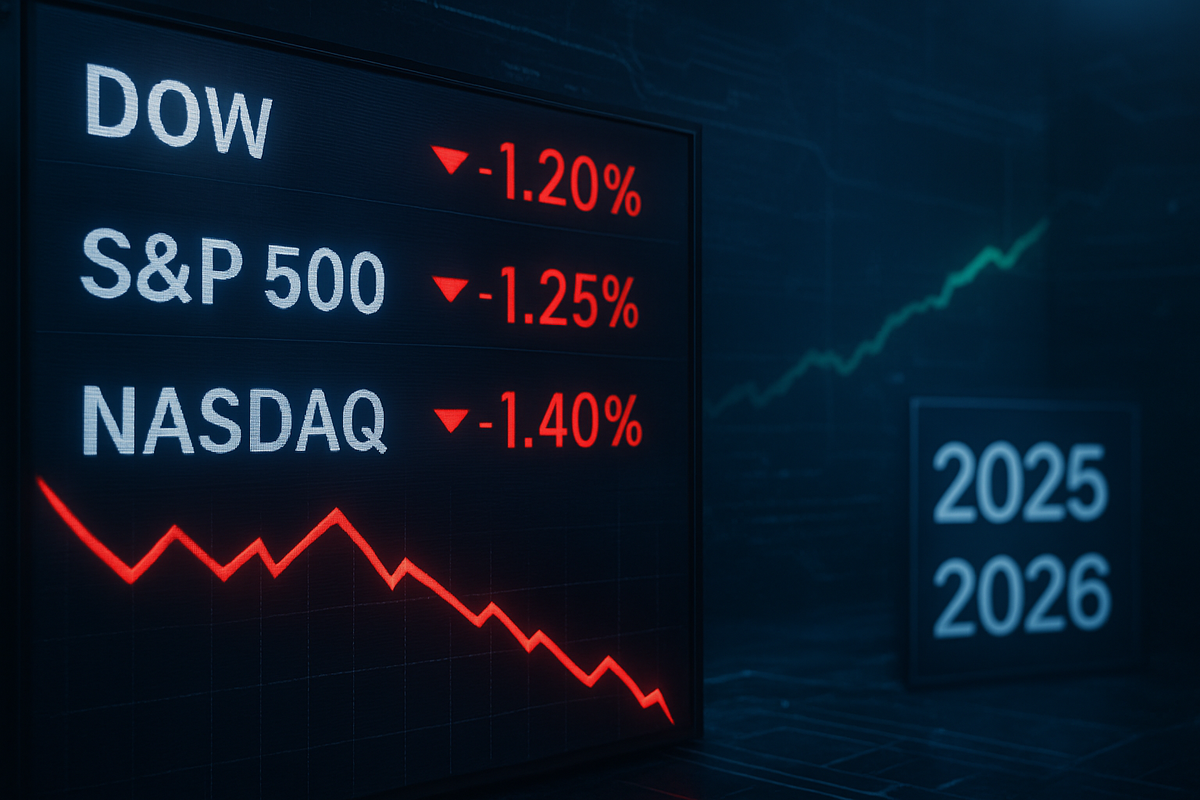
The final week of 2025 proved to be a sobering reminder that market momentum is never a straight line. In a year defined by the relentless expansion of the artificial intelligence "hardware super-cycle," the final four trading sessions saw the Dow Jones Industrial Average, the S&P 500, and the Nasdaq Composite all retreat in a synchronized slump. This late-December pullback effectively extinguished hopes for a traditional "Santa Claus Rally," leaving investors to navigate a landscape of technical exhaustion and growing policy uncertainty as the calendar turns to 2026.
Despite the gloomy finish, the broader context of 2025 remains one of significant triumph for the bulls. The Nasdaq Composite (INDEXNASDAQ: .IXIC) finished the year with a robust gain of approximately 20.4%, while the S&P 500 (INDEXSP:.INX) climbed 16.4%, marking its third consecutive year of double-digit growth. However, the four-day slide that concluded on Wednesday, December 31, 2025, has raised critical questions about whether this is a mere technical reset or the beginning of a more profound "Year 2" presidential cycle correction.
The Anatomy of a Year-End Fade
The slump began in earnest on December 26, following a Christmas break that saw trading volumes plummet to roughly 50% of their 20-day average. In this "thin" market environment, even modest sell orders triggered outsized price swings. By the final closing bell on December 31, 2025, the Dow Jones Industrial Average (INDEXDJX:.DJI) had fallen 0.6% on the day to close at 48,063.29. The S&P 500 dropped 0.7% to finish at 6,845.50, and the tech-heavy Nasdaq declined 0.8% to 23,241.99. For the week, the indexes lost between 1.2% and 1.5%, a sharp reversal from the mid-December optimism.
Several factors converged to create this "Holiday Fade." Chief among them was aggressive tax-loss harvesting and institutional profit-taking. After a year of triple-digit gains in select AI and semiconductor names, fund managers moved to lock in performance fees and rebalance portfolios. Simultaneously, investors sought to offset capital gains by selling off the year's underperformers. This technical selling was compounded by the release of minutes from the Federal Reserve’s December meeting, which revealed a central bank deeply divided over the pace of 2026 rate cuts. Traders, who had been pricing in a January cut, saw those odds evaporate to less than 15% by year-end.
Geopolitical jitters also played a role. Renewed rhetoric regarding 100% tariffs on imports from China and new levies on North American partners introduced a "risk-off" sentiment that permeated the final sessions. This was further exacerbated by a brief, albeit resolved, federal government shutdown in late December and extreme volatility in the precious metals market. The CME Group’s decision to hike margin requirements for silver and gold futures twice in a single week rattled commodity-linked equities, adding another layer of instability to an already fragile week.
The Winners and Losers of the 2025 Reset
The year-end rotation created a stark divide between the 2025 champions and those left behind. NVIDIA Corporation (Nasdaq: NVDA) remained the undisputed heavyweight of the year, finishing up 39% despite the final week's volatility. Similarly, Micron Technology, Inc. (Nasdaq: MU) and Palantir Technologies Inc. (NYSE: PLTR) emerged as major winners, with gains of 239% and 135% respectively, driven by the insatiable demand for AI infrastructure. These companies represent the "hardware" phase of the AI boom, which successfully transitioned from hype to tangible earnings throughout the year.
Conversely, the final week was brutal for companies caught in the crosshairs of policy shifts and sector rotation. The Trade Desk, Inc. (Nasdaq: TTD) ended the year down approximately 70%, a victim of aggressive tax-loss selling as investors abandoned the struggling ad-tech space. The renewable energy sector also faced significant headwinds following the implementation of the "One Big Beautiful Bill Act" (OBBBA), which reshuffled clean energy tax credits. This legislative shift led to sharp declines for Bloom Energy Corporation (NYSE: BE) and New Fortress Energy Inc. (Nasdaq: NFE) in the final weeks of December.
However, a new class of winners is emerging at the intersection of AI and energy. As data center power demands skyrocket, utilities like Dominion Energy, Inc. (NYSE: D) and Constellation Energy Corporation (Nasdaq: CEG) have begun to trade more like high-growth tech stocks than defensive assets. Constellation, in particular, has benefited from the "Nuclear Renaissance," as hyperscalers seek 24/7 carbon-free power to fuel their AI clusters. This "AI-Energy Supercycle" is expected to be a dominant theme as we move into the first quarter of 2026.
Broader Significance and Historical Precedents
The weak finish to 2025 fits into a well-documented historical pattern. Statistically, the second year of a presidential term—which 2026 will be—is often the weakest of the four-year cycle, averaging gains of only 3.3% to 4.6%. The current market environment draws striking parallels to 1996 and 2010. In 1996, following a massive 1995 rally, the market faced significant early-year volatility and interest rate concerns before eventually finding its footing. Similarly, 2010 saw a sharp 6% drop in January as investors fretted over the withdrawal of post-recession stimulus.
The wider significance of this slump also lies in the evolving regulatory and fiscal landscape. The OBBBA legislation represents a pivot in U.S. industrial policy, favoring domestic manufacturing and nuclear energy over traditional renewables. This shift is forcing a massive reallocation of capital that is likely to continue well into 2026. Furthermore, the Federal Reserve's "higher for longer" stance—with a projected rate floor of 3.0% to 3.5%—means that the era of "cheap money" is firmly in the rearview mirror. Valuation multiples will now be scrutinized under a much harsher light, favoring companies with actual cash flow over those with mere potential.
What Lies Ahead for 2026
As we look toward the start of 2026, the "January Effect" will be the first major test. Historically, beaten-down small-caps and tech laggards tend to rebound in the first month of the year as tax-selling pressure lifts. Investors will be watching the "January Barometer"—the idea that the first month's performance dictates the year—very closely. Given that this barometer has a 77% accuracy rate, a sluggish start to 2026 could signal a year of consolidation rather than expansion.
The major strategic pivot for 2026 will be the transition from "Agentic AI" development to deployment. Market participants are looking for a shift from massive infrastructure spending to measurable ROI. If the $2 trillion in global AI investment fails to produce significant productivity gains by mid-2026, the sector could face a "Minsky Moment"—a sudden collapse of asset values. Additionally, the appointment of a new Federal Reserve Chair in May 2026 looms as a major volatility catalyst for the bond market, potentially impacting mortgage rates and corporate borrowing costs.
Final Thoughts for the Investor
The four-day slump to end 2025 should be viewed as a healthy, albeit painful, reset. It has flushed out some of the speculative excesses of the AI boom and provided a more realistic entry point for long-term investors. The key takeaway is that while the "macro" environment remains supportive, the "micro" details—such as policy changes and energy constraints—are becoming increasingly important.
Moving forward, investors should keep a close eye on the "AI-Energy Supercycle" and the potential for a small-cap rebound in January. However, caution is warranted as we enter the historically volatile second year of the presidential cycle. The market's ability to absorb the "higher for longer" rate environment and the upcoming leadership change at the Fed will be the defining stories of the coming months. For now, the 2025 rally is in the books, and 2026 begins with a clean, if slightly bruised, slate.
This content is intended for informational purposes only and is not financial advice