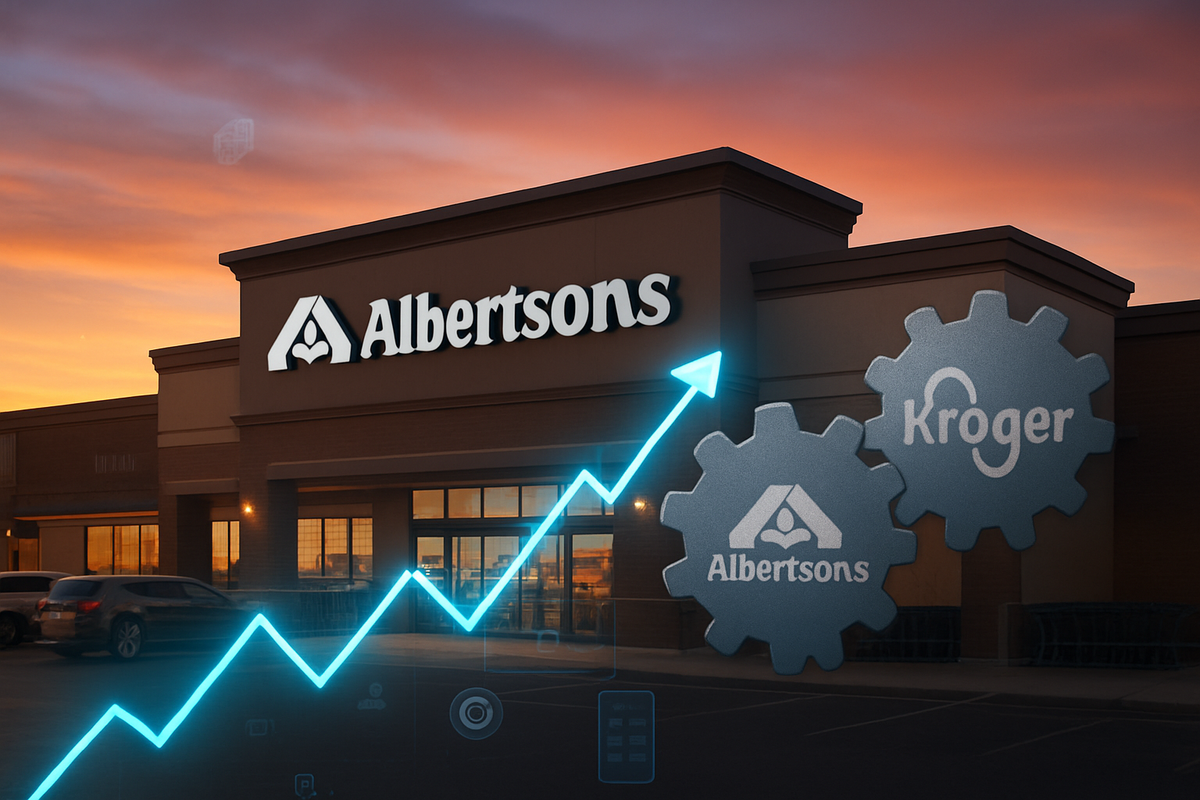
As the calendar turns to the close of 2025, Albertsons Companies (NYSE: ACI) finds itself at a pivotal crossroads, emerging from the shadow of one of the most contentious merger attempts in retail history. Despite the definitive collapse of its $24.6 billion tie-up with Kroger (NYSE: KR) late last year, a growing chorus of Wall Street analysts is doubling down on the grocer. Maintaining "Strong Buy" ratings, these experts argue that the market has fundamentally mispriced the company’s standalone value, ignoring a robust "Plan B" that prioritizes aggressive shareholder returns and digital transformation over raw scale.
The immediate implications for Albertsons are twofold: the company is now a leaner, more focused entity, yet it continues to grapple with the "merger hangover"—a combination of suppressed valuation multiples and significant margin pressures from a shifting sales mix. While the broader retail sector has faced headwinds, Albertsons’ current trading price of approximately $17.50 represents a steep discount to its intrinsic value, which some analysts peg as high as $40.00 per share. This valuation gap has turned the stock into a premier "value recovery" play for 2026, even as the company navigates a complex legal battle to extract billions in damages from its former suitor.
The Regulatory Block and the Pivot to Independence
The saga that defined Albertsons for over three years reached its climax in December 2024, when a U.S. District Court in Oregon granted the Federal Trade Commission’s (FTC) request for a preliminary injunction. The ruling effectively killed the Kroger merger, with the court citing concerns that the deal would stifle competition, harm union bargaining power, and lead to higher grocery prices for consumers. This decision followed a timeline that began in October 2022, when the two giants first announced their intent to merge. Over the subsequent 26 months, the companies proposed various divestiture plans—including the sale of nearly 600 stores to C&S Wholesale Grocers—but regulators remained unconvinced that a third party could effectively replicate the competitive pressure of a standalone Albertsons.
In the wake of the deal's termination, the relationship between the two grocery titans soured rapidly. Albertsons promptly filed a lawsuit against Kroger for breach of contract, alleging that Kroger failed to exhaust "any and all actions" to secure regulatory approval. As of late 2025, this litigation remains a central catalyst for the stock, with Albertsons seeking a multi-billion dollar payout in addition to the $600 million termination fee already owed. This legal maneuver, combined with the company’s immediate pivot to a $2 billion share buyback program and a significant dividend hike, signaled to the market that management was no longer waiting for a "white knight" and was instead focused on unlocking value from within.
Winners and Losers in the New Grocery Landscape
The failure of the merger has reshuffled the deck for the entire grocery industry. The primary winners appear to be Walmart (NYSE: WMT) and Costco Wholesale (NASDAQ: COST), which have continued to gain market share as the two largest traditional grocers were distracted by years of litigation and integration planning. These retail behemoths have used their massive scale to maintain price leadership, putting further pressure on Albertsons to invest in "value pricing" to keep its customer base loyal. Conversely, C&S Wholesale Grocers emerged as a notable loser, missing out on a transformative acquisition of 579 stores that would have instantly elevated it to a top-tier national player.
For Kroger (NYSE: KR), the fallout has been strategic. The loss of the merger means Kroger must now find alternative ways to compete with Walmart’s data capabilities and Amazon’s logistics. For Albertsons, however, the "loser" label initially applied by the market is being challenged. While its stock price took a hit following the FTC injunction, the company's "Year of Investment" in 2025 has begun to bear fruit. By retaining its most profitable stores—which would have been divested in the merger—Albertsons has preserved its core cash flow, allowing it to fund a $1.5 billion productivity program that analysts from RBC Capital Markets (NYSE: RY) and JPMorgan Chase (NYSE: JPM) believe will stabilize margins by mid-2026.
Industry Trends and the Margin Conundrum
The "Strong Buy" thesis for Albertsons exists in tension with real margin pressures. The company has seen its gross margins compressed by nearly 80 basis points over the last year, driven largely by a shift in sales mix. The explosion in popularity of GLP-1 weight-loss drugs has boosted pharmacy sales, which carry lower margins than traditional groceries. Additionally, the rapid growth of digital sales—now accounting for nearly 10% of total revenue—comes with higher fulfillment costs. These trends are not unique to Albertsons; they reflect a broader industry shift where "the box" (the physical store) is becoming a multi-purpose hub for health, e-commerce, and advertising.
To combat these pressures, Albertsons has leaned into the "Retail Media" trend. The Albertsons Media Collective has become a high-margin revenue stream, leveraging first-party shopper data to sell targeted advertising to consumer packaged goods (CPG) brands. This high-margin income is crucial for offsetting the thinning margins in the aisles. Furthermore, the company’s aggressive push into automation—with 30% of its distribution volume slated for automated systems by the end of 2025—represents a historical precedent in the sector. Much like the industry's shift toward self-checkout a decade ago, this move toward back-end automation is seen as the only viable path to maintaining profitability in a high-wage, inflationary environment.
The Road to 2026: Strategic Pivots and Scenarios
Looking ahead, the short-term outlook for Albertsons is dominated by its capital allocation strategy. With a $2 billion buyback authorization in place and a $750 million accelerated program launched in the fourth quarter of 2025, the company is effectively "buying its own recovery." Analysts at UBS (NYSE: UBS) suggest that if Albertsons can successfully capture even a fraction of the damages sought in its lawsuit against Kroger, the company could potentially retire up to 15% of its outstanding shares, providing a massive boost to earnings per share (EPS) even if organic growth remains modest.
The long-term scenario involves a potential monetization of the company's real estate. Albertsons owns a property portfolio valued at roughly $14.3 billion—nearly equivalent to its entire market capitalization. While management has resisted a full-scale sale-leaseback program to date, the "hidden value" of these assets provides a significant safety net for investors. Should the company face a prolonged downturn, these assets could be tapped to fund further dividends or debt reduction. The most likely outcome for 2026 is a steady re-rating of the stock as it proves its ability to grow digital and pharmacy sales without sacrificing the bottom line.
A Value Play Hidden in Plain Sight
The story of Albertsons in 2025 is one of resilience and a stark disconnect between market perception and fundamental reality. While the "complex regulatory environment" effectively blocked its path to a merger, it also forced the company to refine its standalone strategy. The key takeaway for investors is that Albertsons is no longer a speculative merger play; it is a disciplined value stock trading at roughly 5x projected EBITDA—a valuation usually reserved for companies in terminal decline, not those with 20% digital growth and a multi-billion dollar real estate backstop.
Moving forward, the market will be watching for stabilization in grocery margins and the first major rulings in the Kroger litigation. If Albertsons can demonstrate that its productivity program is successfully offsetting labor and pharmacy costs, the "Strong Buy" ratings currently seen as contrarian may soon become the consensus. For now, the grocer remains a compelling example of how regulatory setbacks can sometimes pave the way for a more focused and shareholder-friendly corporate evolution.
This content is intended for informational purposes only and is not financial advice.