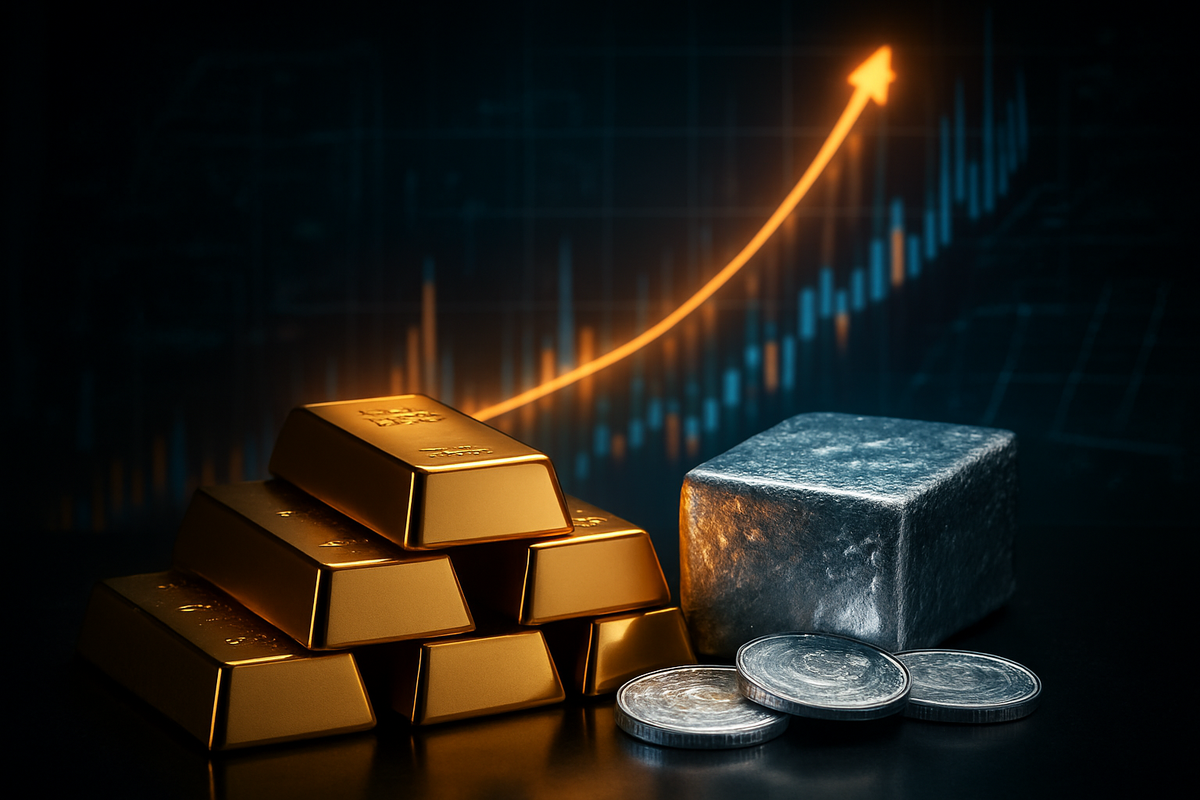
As the sun rises on January 1, 2026, the global financial landscape finds itself in the grip of a "commodity super-cycle" that few predicted would accelerate with such ferocity. After a 2025 that saw gold and silver prices enter a parabolic ascent, the market is no longer debating whether a "Silver Squeeze" is possible—it is actively managing the fallout of a systemic physical shortage. With gold ending 2025 at a staggering $4,562 per ounce and silver peaking near $84 per ounce, the first trading days of 2026 are marked by extreme volatility and a fundamental decoupling of paper contracts from physical metal.
The immediate implications are profound for both industrial manufacturers and retail investors. A "vault drain" at the COMEX in late December has left registered silver inventories at decade lows, while a new set of export restrictions from China, effective today, threatens to further choke the supply of refined silver used in everything from AI data centers to photovoltaic cells. For the public, the 2026 outlook is one of transition: from the speculative frenzy of last year to a "new normal" where physical scarcity defines the price floor.
The Year of the Parabola: How 2025 Redefined Hard Assets
The road to the current crisis began in early 2025, when gold was trading at a relatively modest $2,100 per ounce. A "perfect storm" of U.S. fiscal instability, a federal government shutdown in October, and aggressive de-dollarization by central banks in China, India, and Turkey pushed gold through the psychological $4,000 barrier in November. By December 26, 2025, gold hit its all-time high of $4,562, representing a 74% annual gain. However, it was silver that stole the spotlight, posting a year-to-date return of 175% and compressing the gold-to-silver ratio from over 100:1 to roughly 75:1.
The "Silver Squeeze" reached a fever pitch in the final weeks of 2025. Unlike the retail-driven "WallStreetSilver" movement of years past, this squeeze was characterized by a genuine physical deficit. Industrial demand from the green energy transition and a massive build-out of AI hardware consumed nearly 60% of the total silver supply. In December, the COMEX faced an unprecedented "physical drain," with over 60% of registered silver inventory—approximately 47.6 million ounces—claimed for delivery in just four trading days. This led to extreme backwardation, where spot prices traded at a massive premium over future contracts, signaling a broken price-discovery mechanism.
Key players in this drama included retail "stackers" and high-profile influencers. A viral post by Elon Musk in late December 2025, noting that "Silver is needed in many industrial processes... this is not good," acted as a final catalyst for the year-end surge. In response to the chaos, the CME Group issued Advisory 25-393, raising margin requirements for silver futures to $25,000 per contract to prevent a total market collapse. As we enter 2026, the industry is watching to see if these regulatory "speed bumps" can stabilize a market that appears to be running out of physical product.
Winners and Losers: Coeur Mining and the New Hierarchy of Producers
In this environment, primary silver producers have seen their valuations explode. Coeur Mining (NYSE: CDE) emerged as the undisputed winner of 2025, delivering a 229% stock return. The company’s success was driven by the timely completion of its Rochester mine expansion in Nevada, which reached full capacity just as prices began their parabolic move. The expansion resulted in a 70% increase in silver production and a 20% reduction in operating costs, making Coeur the largest source of domestically refined silver in the United States.
Coeur Mining is not resting on its laurels. As of January 1, 2026, the company is moving toward a transformative acquisition of New Gold Inc. (NYSE: NGD), with a shareholder vote scheduled for January 27. If the merger is approved, the combined entity is projected to have a market capitalization of $20 billion and generate $2 billion in free cash flow in 2026. This move would position Coeur as a diversified powerhouse, adding significant gold and copper production to its silver-heavy portfolio. Other winners include Pan American Silver (NYSE: PAAS) and First Majestic Silver (NYSE: AG), both of which have benefitted from the widening spread between mining costs and spot prices.
Conversely, the "losers" in this scenario are the industrial end-users who failed to secure long-term supply contracts. Solar panel manufacturers and EV battery producers are now facing "silver-flation," where the rising cost of the metal is eating into profit margins and forcing price hikes on consumers. Companies like Tesla (NASDAQ: TSLA) and major solar firms are reportedly exploring "silver-thrifting" technologies, but these transitions take years to implement, leaving them vulnerable to the current price spike.
A Systemic Shift: De-dollarization and the AI Appetite
The 2026 outlook is not just about a temporary price spike; it reflects a structural shift in the global economy. The wider significance of the 2025 precious metals rally lies in the accelerating trend of de-dollarization. Central banks are no longer just hedging against inflation; they are actively building "hard asset" reserves to insulate themselves from U.S. dollar volatility. This has created a permanent "bid" under the gold market that prevents the deep corrections seen in previous cycles.
Furthermore, the intersection of precious metals and the AI revolution has changed the demand profile for silver. While silver has always been an industrial metal, its role in high-conductivity AI data center hardware has created a new, price-insensitive buyer. Unlike jewelry buyers, tech companies cannot easily substitute silver when building high-performance chips. This industrial "floor" is being reinforced today, January 1, 2026, by China’s new export restrictions on refined silver, a move many analysts interpret as a strategic effort to hoard the metal for its own domestic high-tech manufacturing.
Regulatory implications are also looming. In the United States, there is growing political pressure to allow gold and silver exposure in 401(k) retirement plans. A policy deadline in February 2026 could unlock a portion of the $9 trillion held in these accounts, potentially funneling billions of dollars into physically-backed ETFs and mining stocks. This would represent a historical precedent, moving precious metals from the "alternative" category into the mainstream of American retirement planning.
The 2026 Roadmap: Short-Term Pain vs. Long-Term Gain
Looking ahead, the short-term challenge for the market will be navigating the margin-induced pullbacks that often follow parabolic moves. While silver hit $84 in December, it has started 2026 in the $72–$75 range as traders grapple with higher borrowing costs. However, most analysts at firms like Goldman Sachs (NYSE: GS) and Citigroup (NYSE: C) view this as a healthy consolidation. Citigroup has recently revised its 2026 silver target to $110 per ounce, citing the ongoing supply deficit and the "China factor."
For gold, the consensus remains bullish. UBS (NYSE: UBS) and JP Morgan (NYSE: JPM) have set base-case targets for gold between $4,800 and $5,055 per ounce by the end of 2026. The primary strategic pivot for investors will be moving away from "paper" silver—ETFs that may not be fully backed by metal—toward physical holdings and "tier-one" miners with proven reserves. The risk of a "force majeure" event on the COMEX remains a tail-risk that could send prices into another vertical spike if a major exchange fails to deliver physical metal to a commercial buyer.
Final Thoughts: The New Era of Scarcity
The precious metals market of 2026 is a far cry from the stagnant environment of the early 2020s. The key takeaway for the start of this year is that the "Silver Squeeze" has evolved from a social media meme into a fundamental reality of the global supply chain. The parabolic gains of 2025 were not a fluke but a repricing of assets that have been undervalued relative to the expanding global money supply and the shrinking supply of high-grade ore.
As we move forward into 2026, investors should keep a close eye on the Coeur Mining-New Gold merger and the implementation of China's export quotas. These events will serve as bellwethers for the industry's health. While the "easy money" of the 2025 surge may be in the past, the era of physical scarcity is just beginning. In a world of digital abundance and fiscal uncertainty, the market's return to "real" money appears to be the defining story of the decade.
This content is intended for informational purposes only and is not financial advice.