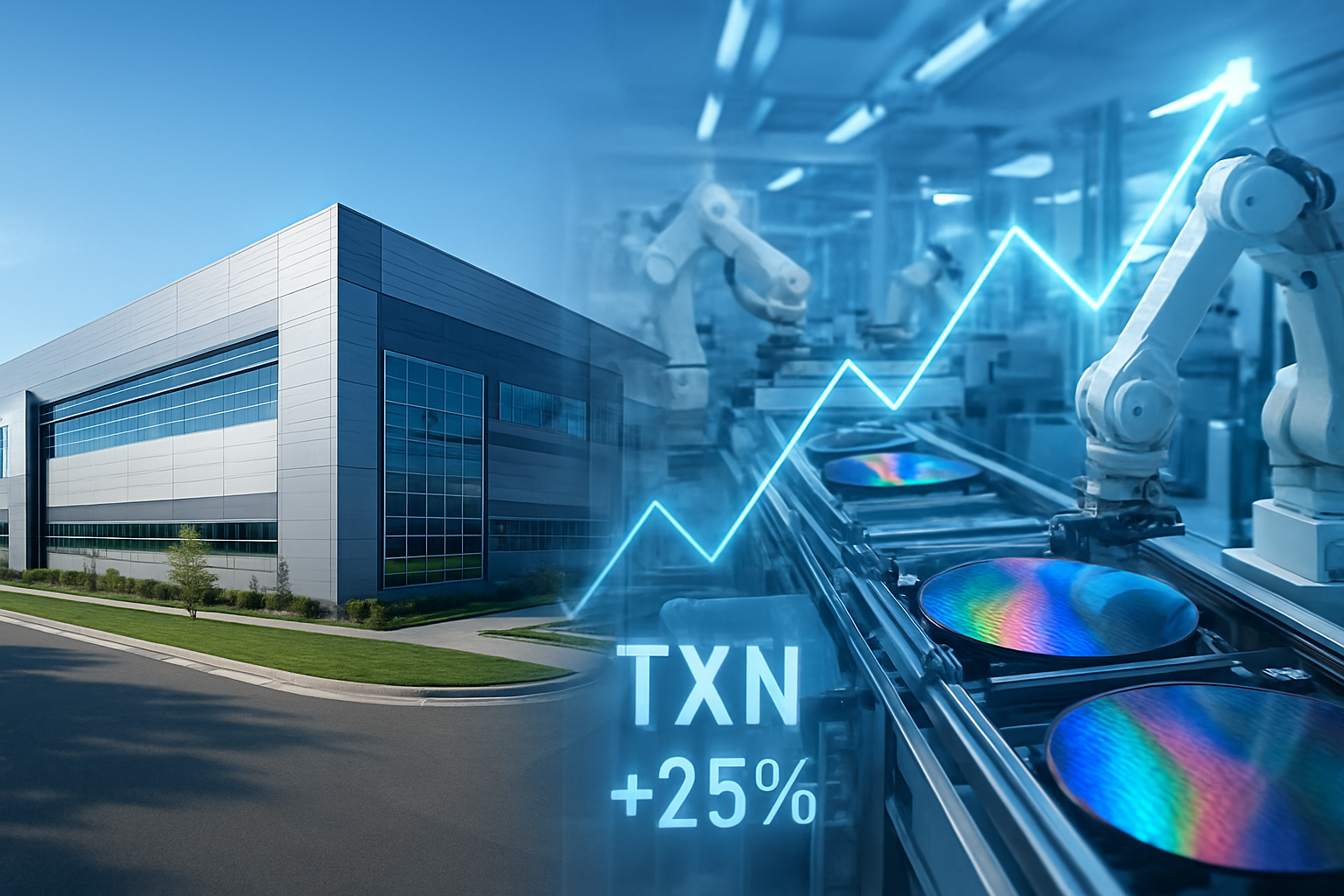
As the calendar turns to 2026, the semiconductor landscape is witnessing a massive tectonic shift in capital allocation. Texas Instruments (NASDAQ: TXN), the stalwart of the analog chip world, has emerged as the clear favorite for institutional heavyweights. Following a turbulent two-year period of aggressive infrastructure spending, recent filings reveal a staggering 25% increase in positions held by key institutional investors. This surge in confidence signals that Wall Street believes the company’s controversial "big bet" on internal manufacturing is finally ready to pay dividends.
The immediate implication of this institutional influx is a newfound stability for TXN’s stock price, which had previously been weighed down by concerns over high capital expenditures. With major funds like GMO Capital and Jennison Associates significantly increasing their stakes, and activist pressure from Elliott Investment Management bearing fruit, Texas Instruments is entering 2026 not just as a dividend-paying value stock, but as a high-yield manufacturing powerhouse. The market is now pricing in the "harvest phase" of the company’s massive investment in 300mm wafer capacity.
The Road to Sherman: How TXN Won Back the Street
The story of Texas Instruments’ current dominance began in 2022 with a bold, multi-year plan to invest up to $5 billion annually in domestic manufacturing. For years, investors were skeptical, fearing that the high depreciation costs would erode free cash flow. However, the timeline of events leading into January 2026 has validated the strategy. In May 2025, the company completed construction of its SM1 fab in Sherman, Texas, and as of December 2025, the facility has officially transitioned to high-volume production. This milestone was the primary catalyst for the recent 25% surge in institutional buying, as it proved the company could execute its massive "mega-site" vision on schedule.
Key players in this turnaround include Elliott Investment Management, which took a $2.5 billion stake in mid-2024. Elliott’s involvement forced a strategic pivot toward "dynamic capacity management," a move that replaced rigid spending targets with a more flexible $2 billion to $5 billion annual range. This shift, combined with the successful rollout of the Lehi, Utah (LFAB2) facility in early 2026, has convinced stakeholders that TXN can scale its production to meet demand without overextending its balance sheet. Initial market reactions in the first trading sessions of 2026 have been overwhelmingly positive, with analysts highlighting the company’s projected free cash flow of $8 to $12 per share.
Winners and Losers in the Analog Resurgence
The primary winner in this scenario is undoubtedly Texas Instruments (NASDAQ: TXN) itself. By moving toward a goal of producing over 95% of its wafers internally by 2030, the company has insulated itself from the supply chain shocks that plagued the industry earlier this decade. Their 300mm wafer technology provides a 40% cost advantage over the 200mm wafers used by many of their peers, allowing TXN to maintain industry-leading margins even in a competitive pricing environment.
Conversely, competitors who rely heavily on external foundries may find themselves at a disadvantage. Analog Devices (NASDAQ: ADI) remains a formidable "quality leader" with high-margin custom chips, but its hybrid manufacturing model leaves it more exposed to the pricing whims of third-party manufacturers like TSMC (NYSE: TSM). Similarly, Microchip Technology (NASDAQ: MCHP) is viewed by many as a "recovery play" with significant upside, yet it lacks the sheer scale and vertical integration that TXN has now achieved. For automotive and industrial customers, the "winner" is the end-user, who now benefits from TXN’s massive inventory levels—deliberately maintained at over 200 days—ensuring that the chip shortages of the past remain a distant memory.
A New Blueprint for the Semiconductor Industry
This event is more than just a corporate success story; it represents a broader trend of "onshoring" and vertical integration within the tech sector. Texas Instruments’ strategy aligns perfectly with the goals of the U.S. CHIPS and Science Act, from which the company secured $1.6 billion in direct funding and $3 billion in loans. This government backing has created a blueprint for how legacy semiconductor firms can reinvent themselves as modern manufacturing titans. The ripple effects are already being felt, as competitors are forced to reconsider their own "fab-lite" models in favor of more resilient, internally controlled supply chains.
Historically, the analog chip market has been cyclical, often leading the broader economy. The institutional bet on TXN suggests a belief in a long-term "super-cycle" driven by the electrification of everything—from vehicles to factory floors. With the Automotive and Industrial segments now making up 70% of TXN's revenue, the company has become a proxy for global industrial health. This shift mirrors the historical precedents of the early 2000s, but with a modern twist: the competitive moat is no longer just about chip design, but about the sheer physical capacity to produce them at the lowest possible cost.
Navigating the 2026 Roadmap
Looking ahead, the short-term focus for Texas Instruments will be the ramp-up of its second Sherman fab, SM2. While the shell of the building is complete, the company’s new "dynamic" approach means equipment installation will only happen as market demand dictates. This flexibility is a strategic pivot that allows TXN to avoid the "overcapacity" traps that have historically plagued the semiconductor industry. In the long term, the market will be watching to see if TXN can hit its ambitious 2026 revenue targets of $20 billion to $26 billion.
Potential challenges remain, particularly in the form of high depreciation costs associated with the new fabs, which could temporarily weigh on GAAP earnings even as free cash flow surges. Furthermore, as the company achieves its internal manufacturing goals, it may face increased regulatory scrutiny regarding its market-dominant position in the analog space. However, the opportunities in AI-driven power management and the continued expansion of the EV market provide a robust tailwind that likely outweighs these risks.
Final Thoughts: The Institutional Verdict
The 25% increase in institutional positions is a clear vote of confidence in Texas Instruments’ long-term vision. By successfully transitioning from a period of heavy investment to a period of high-volume production, TXN has positioned itself as the "economic boomerang" of the 2026 market—ready to catch the full force of the cyclical upturn. The company has effectively silenced critics who argued that its capital-intensive strategy was a relic of the past, proving instead that in the modern geopolitical climate, owning the factory is just as important as owning the IP.
For investors, the coming months will be defined by execution. The key metrics to watch will be the yield rates from the Sherman SM1 facility and the management’s commentary on the next phase of the Lehi expansion. As Texas Instruments begins to "harvest" the fruits of its multi-billion dollar labor, it stands as a testament to the power of long-term strategic planning in an era often dominated by short-term thinking. Moving forward, TXN is no longer just a safe-haven dividend stock; it is a fundamental pillar of the global technological infrastructure.
This content is intended for informational purposes only and is not financial advice