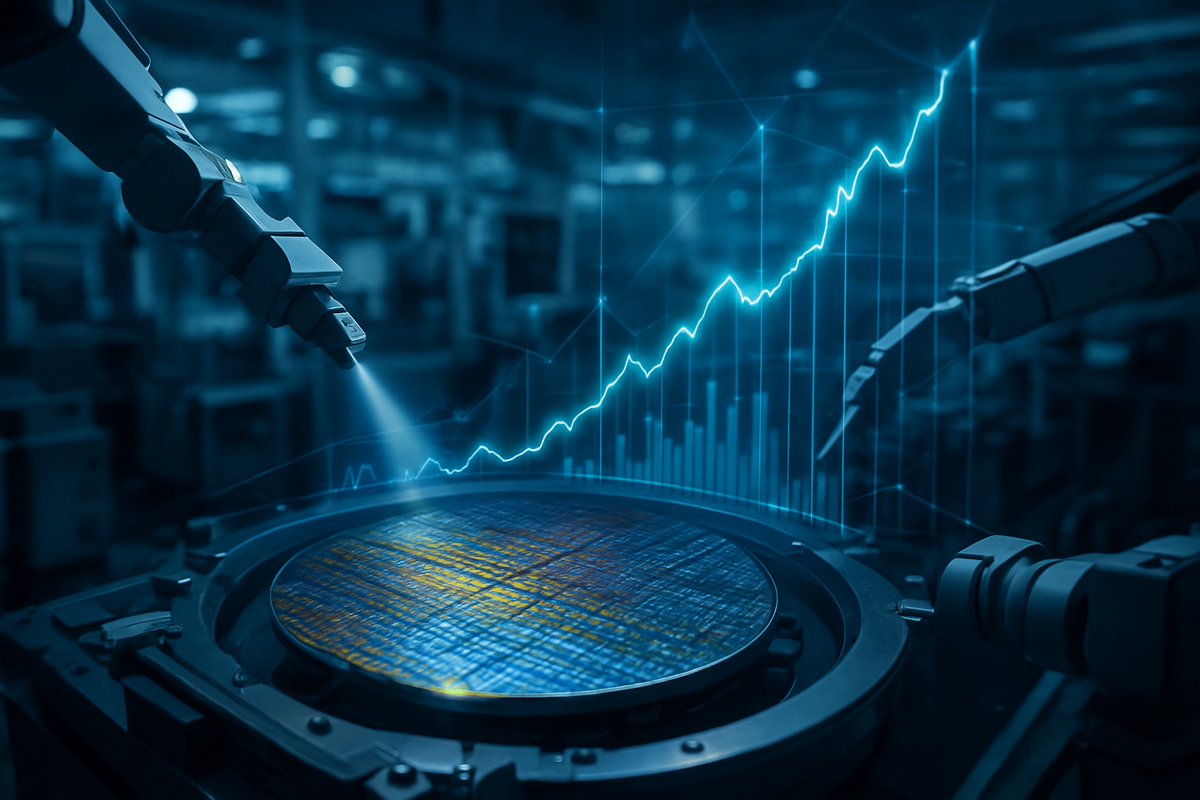
On January 5, 2026, Taiwan Semiconductor Manufacturing Co. (NYSE: TSM; TWSE: 2330) saw its shares surge to an all-time high, marking a historic milestone for the global semiconductor industry. The rally was ignited by a comprehensive price target upgrade from Goldman Sachs (NYSE: GS), which characterized the current artificial intelligence (AI) boom not as a fleeting trend, but as a sustained, multi-year growth engine. As the Taipei-listed shares climbed nearly 7% to reach NT$1,695, the company’s market capitalization solidified its position well above the $1 trillion threshold, reflecting investor confidence in TSMC’s role as the indispensable gatekeeper of the digital age.
The immediate implications of this surge are profound, signaling a robust start to 2026 for the broader technology sector. With TSMC officially confirming the commencement of mass production for its next-generation 2-nanometer (2nm) chips, the industry is entering a new era of performance and efficiency. This development has sent ripples through global markets, pushing Taiwan’s benchmark Taiex index past the psychological 30,000 level for the first time in history. For investors, the message from Wall Street is clear: the demand for high-performance silicon is outstripping supply, and TSMC is the primary beneficiary of this scarcity.
The Catalyst: Goldman’s 'Street-High' Forecast and the 2nm Milestone
The primary driver behind the January 5 rally was a high-conviction report from Goldman Sachs analyst Bruce Lu. The firm raised its price target for TSMC’s Taipei-listed shares to a "Street-high" of NT$2,330—a staggering 35% increase from previous estimates—and set a target of $466 for its New York-listed ADRs. Goldman’s bullishness is rooted in the belief that "token consumption" in AI models is growing exponentially, requiring a level of compute power that only TSMC’s most advanced nodes can provide. The report projected revenue growth of 30% for 2026, significantly higher than previous market consensus.
This financial optimism is backed by a major technical achievement: the successful ramp-up of 2nm (N2) mass production at TSMC’s facilities in Baoshan and Hsinchu. Unlike previous generations, the 2nm node introduces Gate-All-Around (GAA) nanosheet transistors, a radical architectural shift that offers a 15% performance boost or a 30% reduction in power consumption compared to the 3nm process. This transition has been years in the making, involving billions of dollars in research and development and a projected $150 billion in capital expenditures through 2028.
The market reaction was swift and decisive. Beyond the surge in TSMC's own shares, the news triggered a "fear of missing out" (FOMO) rally across the semiconductor supply chain. Investors, who had been cautious toward the end of 2025 due to geopolitical tensions, pivoted back to hardware leaders. The sheer scale of TSMC’s 2nm overbooking—reportedly sold out through 2026—has confirmed that the AI infrastructure cycle is far from peaking, providing a solid floor for the company's valuation.
Winners and Losers: A Two-Tiered Semiconductor Landscape
The emergence of 2nm technology has effectively split the semiconductor market into "haves" and "have-nots." Among the clear winners is Apple (NASDAQ: AAPL), which has reportedly secured over 50% of TSMC’s initial 2nm capacity for its upcoming iPhone 18 series and M6 chips. While the high cost of these wafers—estimated at $30,000 each—may lead to higher consumer prices, Apple’s early access ensures its devices will maintain a significant performance lead over competitors. Similarly, Nvidia (NASDAQ: NVDA) remains a dominant force, with plans to utilize TSMC’s refined nodes for its next-generation "Feynman" GPUs, ensuring its AI accelerators remain the industry standard.
Advanced Micro Devices (NASDAQ: AMD) and Qualcomm (NASDAQ: QCOM) are also positioned to win, leveraging TSMC’s N2 and N2P (refined 2nm) nodes to challenge incumbents in the server and mobile markets. AMD’s Zen 6 "Venice" CPUs, expected in late 2026, are designed to capitalize on the efficiency gains of the new node to gain further share from Intel (NASDAQ: INTC). Meanwhile, Qualcomm is using TSMC’s capacity to power its Snapdragon 8 Elite Gen 6, targeting the high-end Android flagship market with unprecedented clock speeds.
Conversely, the "losers" or challengers in this scenario are those struggling to match TSMC’s yield and scale. Intel, despite making strides with its 18A node, continues to face yield rates that trail TSMC, leading major fabless clients to remain loyal to the Taiwanese foundry. Samsung Electronics (KRX: 005930) also faces an uphill battle; while it has secured niche wins, such as a localized AI chip line for Tesla in Texas, its overall 2nm yield rates have lagged, preventing it from capturing the high-volume contracts that define the market.
Wider Significance: AI as a Global Utility and the 'Silicon Desert'
The surge in TSMC’s valuation reflects a broader shift in how the market views the semiconductor industry. Chips are no longer seen as cyclical commodities but as a global utility—the "oil" of the 21st century. This event highlights the deepening reliance of the world's largest economies on a single company’s manufacturing prowess. As AI models become more complex, the hardware required to run them has become a matter of national security and economic sovereignty, leading to the "Silicon Sovereignty" trends we see today.
This event also underscores the progress of the U.S. CHIPS Act. By early 2026, TSMC’s Phoenix, Arizona, facility has reached full capacity on its 4nm line, with equipment installation for 3nm and 2nm production underway. This "Silicon Desert" strategy is a direct response to geopolitical risks in the Taiwan Strait. While a "Pax Silica" or temporary truce on export controls has provided some stability, the industry is aggressively hedging by onshoring advanced packaging and fabrication to the United States and Europe.
Furthermore, the TSMC record high serves as a benchmark for the entire AI ecosystem. It suggests that the "AI bubble" talk of 2024 was premature, as the physical infrastructure—the fabs, the power delivery, and the advanced packaging like CoWoS (Chip-on-Wafer-on-Substrate)—is only now catching up to the software demand. The ripple effects are being felt in the energy sector as well, where the massive power requirements of 2nm-equipped data centers are driving a new wave of investment in nuclear and renewable energy.
What Comes Next: The Road to 1.6nm and Strategic Pivots
Looking ahead, the focus will shift from the launch of 2nm to the "execution" of the ramp-up. The short-term challenge for TSMC will be managing the immense capital intensity of its expansion while maintaining its 60% gross margin target. Investors will be closely watching the yield improvements of the N2 node throughout 2026. Any delay in reaching target yields could provide a window of opportunity for Samsung or Intel to regain lost ground.
In the long term, the industry is already looking toward the 1.6nm (A16) node, which TSMC expects to debut in late 2026 or early 2027. This will involve even more complex manufacturing techniques, such as backside power delivery, which could further widen the gap between TSMC and its rivals. Strategic pivots are also expected from major clients; we may see a shift toward "Global Wafers, Domestic Packaging," where companies like Nvidia use TSMC for silicon but partner with Intel or Amkor Technology (NASDAQ: AMKR) for domestic U.S. packaging to satisfy regulatory requirements.
The potential for market volatility remains, particularly if consumer demand for high-priced AI hardware fails to meet expectations. However, the structural demand from hyperscalers like Microsoft (NASDAQ: MSFT) and Amazon (NASDAQ: AMZN) for their own custom silicon suggests that the floor for TSMC’s services remains exceptionally high.
Summary and Investor Outlook
TSMC’s record-breaking start to 2026 is a testament to the company’s unparalleled execution and the insatiable global appetite for AI. The Goldman Sachs upgrade has served as a powerful validation of the "multi-year" growth thesis, moving the goalposts for what is possible in the semiconductor sector. Key takeaways include the successful transition to 2nm GAA technology, the widening gap between TSMC and its foundry competitors, and the continued dominance of the "AI Five"—Apple, Nvidia, AMD, Broadcom, and Qualcomm—who have secured the lion's share of advanced capacity.
Moving forward, the market will likely see continued rotation into hardware leaders that can demonstrate tangible earnings growth from AI infrastructure. For investors, the critical metrics to watch in the coming months will be TSMC’s monthly revenue reports, yield progress on the 2nm node, and any shifts in the geopolitical landscape that could affect the "Silicon Shield." While the path to NT$2,330 is steep, the current momentum suggests that TSMC is not just riding the AI wave—it is the wave itself.
This content is intended for informational purposes only and is not financial advice.