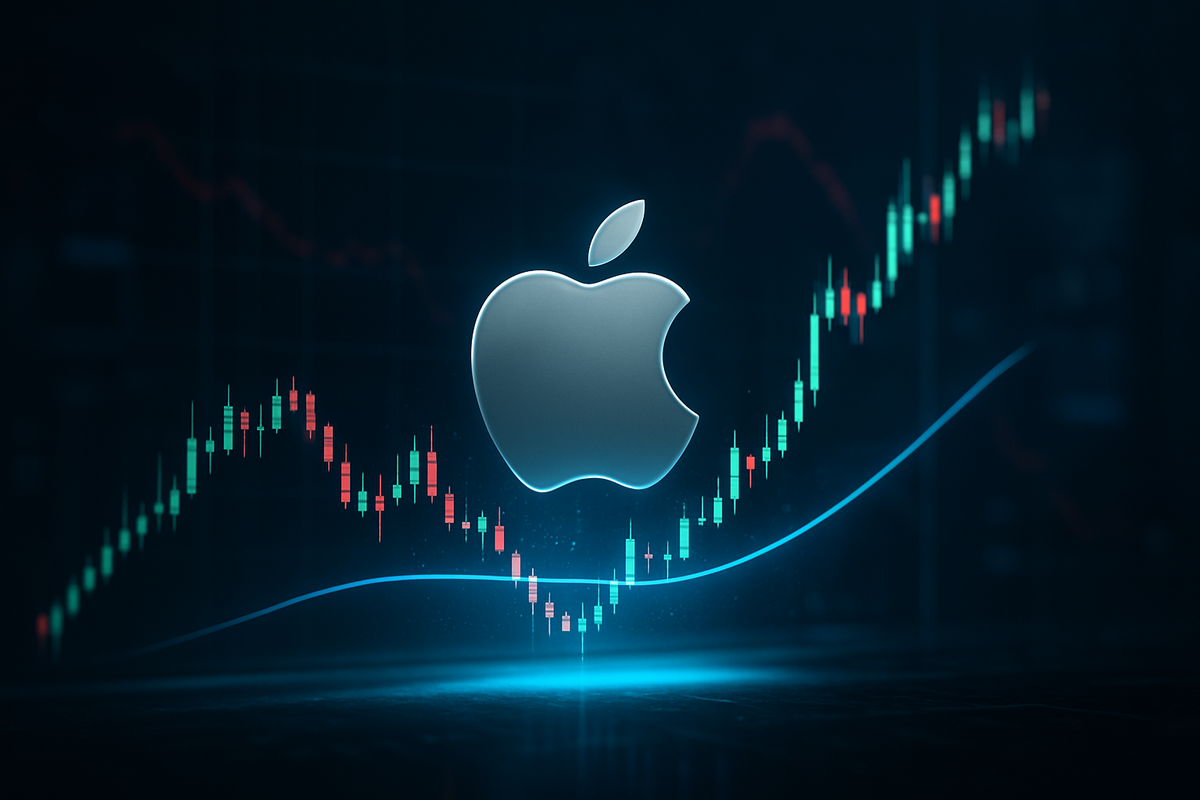
In a week defined by heightened volatility and a broad retreat across the technology sector, Apple Inc. (NASDAQ: AAPL) has emerged as a rare beacon of stability. While the tech-heavy Nasdaq Composite and the S&P 500 have struggled under the weight of persistent inflation data and geopolitical jitters, Apple’s stock has demonstrated remarkable technical resilience. On March 27, 2026, the Cupertino-based giant successfully defended a critical support zone, bouncing off its 200-day moving average and a well-defined "double-bottom" chart pattern.
This display of strength comes at a precarious moment for the broader markets. The Nasdaq has officially entered correction territory, down 5.6% year-to-date, as investors grapple with the "higher-for-longer" interest rate environment and a perceived plateau in the initial AI hype cycle. However, Apple’s ability to hold the line at the $246 level suggests that despite its slower top-line growth compared to infrastructure peers, the market still views it as the ultimate "flight-to-quality" destination in the consumer electronics space.
A Line in the Sand: The 200-Day Defense
The technical narrative for Apple began to shift in early March 2026, following a "beat and sell" reaction to its record-breaking Fiscal Q1 earnings. Despite reporting $143.8 billion in revenue and a staggering 75.4% margin in its Services segment, the stock fell victim to a wider sector rotation. Shares tumbled from their December 2025 highs of $288.37, eventually descending toward the $246.45 mark—the site of its 200-day Simple Moving Average (SMA). For long-term institutional investors, this level has historically acted as a "line in the sand," separating a healthy correction from a long-term bear trend.
Compounding this technical importance was the formation of a "double-bottom" support structure between $243 and $247. This pattern occurs when a stock tests a low, rallies slightly, and then returns to that same low before rebounding again, signaling that selling pressure has been exhausted. Throughout the third week of March, Apple shares briefly dipped toward $243.21 before aggressive buying interest drove the price back above the 200-day SMA. Market analysts note that the 14-day Relative Strength Index (RSI) touched an oversold reading of 32 during this period, providing the "coiled spring" effect necessary for the current relief rally.
Key stakeholders, including major institutional holders like Berkshire Hathaway and Vanguard, have remained largely steadfast during this drawdown. The initial market reaction to this week’s bounce has been one of cautious optimism; while the stock still faces overhead resistance at its 50-day SMA (~$261), the successful defense of the 200-day average has mitigated fears of a deeper slide toward the $220 secondary support zone.
Winners and Losers in the AI Reshuffle
Apple’s resilience provides a stark contrast to the fortunes of other "Magnificent Seven" members. While Apple (NASDAQ: AAPL) has found its floor, NVIDIA Corp (NASDAQ: NVDA) and Alphabet Inc (NASDAQ: GOOGL) have recently overtaken it in total market capitalization. Nvidia, now valued at $4.34 trillion, has benefited from the transition to its "Vera Rubin" platform, effectively becoming the world’s most valuable company. Alphabet has also surged, with its integrated AI stack and custom TPUs allowing it to surpass Apple’s $3.71 trillion valuation for the first time in several years.
Conversely, Samsung Electronics (LSE:SMSN) continues to face margin pressure despite leading in total unit shipments with a 19% market share. Samsung’s aggressive $70 billion investment in High-Bandwidth Memory (HBM) to compete in the AI data center market has weighed on its short-term profitability, making Apple’s 75% services margin look increasingly attractive to defensive-minded investors. Meanwhile, Microsoft Corp (NASDAQ: MSFT) has seen its free cash flow projections slightly tempered by the massive $200 billion industry-wide capital expenditure requirements for AI infrastructure.
The supply chain is also seeing a shift in power dynamics. Taiwan Semiconductor Manufacturing Co. (NYSE: TSM) now identifies Nvidia as its largest customer, accounting for 22% of its revenue—a spot long held by Apple. This "Consumer Chip Winter" means that while Apple remains a dominant force, it is now competing fiercely for advanced node capacity against the titans of the data center world. Companies that provide the physical infrastructure for AI, such as Micron Technology (NASDAQ: MU), are emerging as winners in this "Stage 2" of the AI cycle, while software firms are being forced to prove immediate monetization.
The Broader Significance: On-Device vs. Infrastructure AI
The recent price action in Apple highlights a growing divergence in how the market values artificial intelligence. While the "Infrastructure Era" dominated 2024 and 2025, the narrative in 2026 is shifting toward "On-Device AI." Apple’s strategy, dubbed "Invisible AI," focuses on embedding large language models directly into the silicon of its M5 and A19 Pro chips. This allows for high-performance AI tasks to be performed locally, ensuring user privacy and reducing the massive cloud-compute costs that are currently eroding the margins of competitors like Microsoft and Google.
This event also takes place against a backdrop of increasing regulatory scrutiny. The European Union's AI Act is entering its critical enforcement phase in 2026, with high-risk system compliance deadlines approaching in August. Apple’s privacy-first, on-device approach is seen by many as a strategic hedge against these regulations. If Apple can successfully deploy its "Siri 2.0" (codenamed Campo) at WWDC 2026 as a truly agentic assistant that remains within the bounds of EU law, it could regain the lead in the consumer AI race.
Historically, Apple has often lagged behind in "hype" phases only to dominate during the "execution" phase. Similar to the transition from 3G to LTE, or the shift to ARM-based silicon with the M1 chip, Apple’s current technical floor at the 200-day average suggests that the market is waiting for the next major catalyst—the "AI Supercycle"—to fully take hold in the second half of 2026.
Looking Ahead: The Road to $288
In the short term, Apple must clear the psychological and technical hurdle of $261 to confirm that the downtrend has officially reversed. Analysts will be closely watching the upcoming Worldwide Developers Conference (WWDC) in June 2026, where the "Siri 2.0" launch is expected to be the centerpiece. A successful demonstration of "hybrid intelligence"—integrating local processing with specialized cloud modules for complex reasoning—could provide the momentum needed to retest all-time highs near $288.
Looking further into 2026, the potential launch of the "iPhone Fold" in September alongside the iPhone 18 series remains the biggest wild card. Supply chain checks in March indicate that the device is in late-stage development. If Apple can pair a new form factor with its superior on-device AI capabilities, it may spark the massive upgrade cycle that investors have been anticipating. However, challenges remain: NAND and DRAM shortages are expected to cause price hikes across the industry through the end of the year, potentially testing consumer elasticity.
Final Thoughts: The Defensive Tech Play
The bounce off the 200-day moving average and the double-bottom support level confirms that Apple remains the bedrock of the technology sector, even as newer rivals capture the headlines with astronomical valuation leaps. While the broader market may remain volatile in the face of macroeconomic uncertainty, Apple’s technical resilience provides a clear signal that institutional appetite for the stock remains robust at these valuations.
Moving forward, investors should watch for any breach of the $243 level, which would invalidate the current bullish thesis and suggest a deeper correction. Conversely, a sustained move above $268 would likely signal a run back toward record territory. As the "AI Supercycle" moves from infrastructure to the pockets of billions of consumers, Apple’s defensive-yet-innovative positioning makes it a critical barometer for the health of the global tech economy.
This content is intended for informational purposes only and is not financial advice