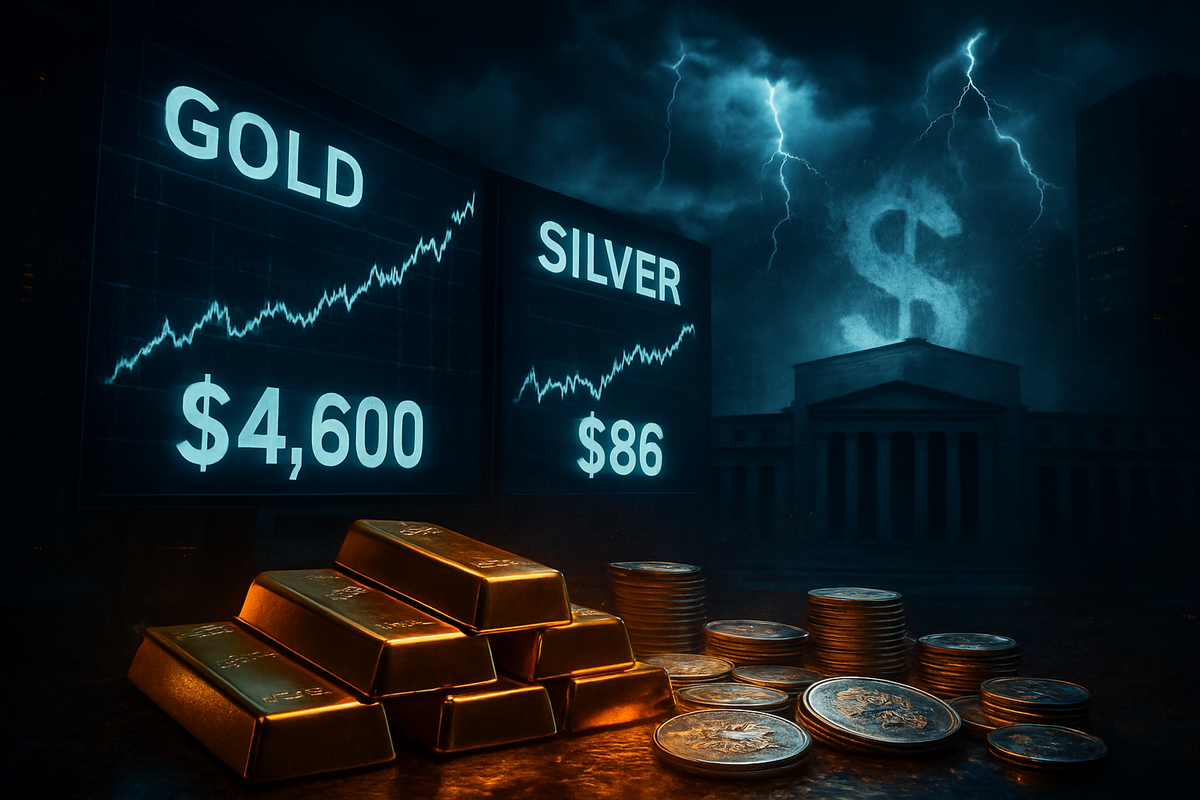
In the opening weeks of 2026, the global financial landscape underwent a seismic shift that few traditional analysts deemed possible just eighteen months ago. Gold, the perennial "safe haven," shattered all historical precedents to reach a staggering $4,600 per ounce in early January, while its more volatile sibling, silver, surged to a peak of $86 per ounce. This explosive rally has fundamentally altered the perception of the U.S. dollar as the world’s primary reserve asset, as a "perfect storm" of geopolitical maneuvering and domestic political chaos converged on the New York and London trading floors.
The immediate implications are profound. The surge in precious metals has triggered a massive capital rotation out of U.S. Treasuries and into physical commodities, leaving the Federal Reserve in a precarious position. With inflation remaining stubborn and the credibility of the U.S. central bank under fire, the "Midas Shock" of January 2026 is no longer just a market anomaly; it is a clear signal from the international community that the era of uncontested dollar hegemony may be nearing a chaotic conclusion.
The Powell Probe and the Central Bank Storm
The ascent to $4,600 gold was not a sudden spike but the culmination of a two-year structural shift. Throughout 2024 and 2025, central banks across the "Global South" and the BRICS+ bloc engaged in the most aggressive gold accumulation phase since the end of the Bretton Woods era. Led by the People’s Bank of China and the Central Bank of the Russian Federation, these institutions added over 1,900 tonnes of gold to their reserves in a coordinated effort to "de-dollarize" their national balance sheets. By the time 2026 dawned, gold had overtaken U.S. Treasuries as the largest reserve component for several major emerging economies, creating a supply-demand imbalance that left Western paper markets reeling.
However, the primary catalyst that turned a steady climb into a parabolic moonshot was the bombshell announcement from the U.S. Justice Department in early January. In an unprecedented move, the DOJ launched a formal criminal investigation into Federal Reserve Chair Jerome Powell. The probe, centered on alleged financial irregularities and $2.5 billion in cost overruns related to the massive renovation of the Federal Reserve’s Washington D.C. headquarters, sent shockwaves through the global banking system. The sight of the world’s most powerful central banker facing criminal scrutiny sparked immediate fears regarding the independence and future stability of the Federal Reserve itself.
As rumors of Powell’s potential resignation or forced removal circulated, the U.S. dollar index (DXY) plummeted, losing 4% of its value in a single forty-eight-hour window. This domestic instability provided the final spark for the January peaks. Markets began pricing in a "governance premium" for gold, viewing it as the only asset free from the legal and political entanglements currently paralyzing the U.S. financial leadership.
The New Gold Rush: Winners and Losers
The primary beneficiaries of this price explosion have been the major precious metal producers, who are now operating at margins previously unimaginable. Newmont Corporation (NYSE: NEM), the world’s largest gold miner, saw its stock price nearly double in the first quarter of 2026 as it successfully leveraged its Tier 1 assets to capture the $4,600/oz pricing. Similarly, Barrick Gold Corporation (NYSE: GOLD) and Agnico Eagle Mines Limited (NYSE: AEM) have reported record-breaking quarterly earnings, leading to a wave of special dividends that have drawn income investors away from traditional tech stocks.
In the silver sector, the $86/oz peak has transformed the balance sheets of companies like Pan American Silver Corp. (NYSE: PAAS) and First Majestic Silver Corp. (NYSE: AG). These companies, which struggled during the low-price environment of the early 2020s, are now flush with cash, sparking a new wave of exploration and acquisition. Wheaton Precious Metals Corp. (NYSE: WPM), as a streaming company, has perhaps seen the cleanest gains, benefiting from the price surge without the direct inflationary pressure on mining operational costs. Investors seeking direct exposure have also flooded into the SPDR Gold Shares (NYSEARCA: GLD) and iShares Silver Trust (NYSEARCA: SLV), which have seen record-high inflows and now face questions regarding the availability of physical bullion to back their expanding share counts.
Conversely, the "losers" in this scenario include major commercial banks with large short positions in the futures markets. Institutions like JPMorgan Chase & Co. (NYSE: JPM) and Goldman Sachs Group, Inc. (NYSE: GS) have had to navigate significant margin calls and counterparty risks as the rapid price appreciation forced a "short squeeze" of historic proportions. Furthermore, the broader U.S. consumer is beginning to feel the sting, as the weakened dollar and high silver prices drive up the cost of everything from electronics to solar panels.
De-dollarization and Historical Precedents
The events of early 2026 are frequently compared to the 1970s "Stagflation" era, but the modern context is significantly more complex. In 1971, when President Nixon closed the gold window, the U.S. remained the undisputed industrial powerhouse of the world. Today, the move toward $4,600 gold is occurring as the BRICS+ nations actively build a parallel financial architecture. This "Golden Shield" strategy—aimed at insulating non-Western economies from U.S. sanctions—has effectively removed the "safety" from U.S. debt instruments, forcing a re-evaluation of gold as the ultimate neutral reserve asset.
The DOJ investigation into Chair Powell has only accelerated this trend. When the central bank of the world's reserve currency is embroiled in a domestic criminal probe, it erodes the "rule of law" premium that has supported the dollar for eighty years. Regulatory experts note that this event may mark the transition from a "rules-based" international order to a "commodity-based" order, where tangible assets like gold and silver dictate the terms of trade rather than central bank policy dictates.
The Path to 2027: Strategic Pivots Ahead
As we look toward the remainder of 2026, the market faces a period of extreme uncertainty. The immediate focus remains on the Federal Reserve’s leadership. President Trump’s nominee for the next chair, Kevin Warsh, remains stalled in the Senate Banking Committee as Senator Thom Tillis (R-N.C.) and others maintain a hold on all nominees until the "legal cloud" over Powell is cleared. This leadership vacuum at the Fed could lead to a further "strategic pivot" by institutional investors, who may begin treating precious metals not just as a hedge, but as a core portfolio component.
In the short term, a correction from the $4,600 peak is possible as profit-taking occurs, but the structural floors for both gold and silver appear to have moved permanently higher. The market opportunities in the coming months will likely lie in the "junior" mining sector, where smaller exploration companies may become prime acquisition targets for the cash-rich majors. However, the primary challenge for the market will be liquidity; if central banks continue to hoard physical supply, the "paper" markets (Comex and LBMA) may face a delivery crisis that could push prices even higher in 2027.
A New Era for Global Reserves
The historic peaks reached by gold and silver in early January 2026 will be remembered as the moment the market’s faith in the "unipolar" dollar system finally fractured. The combination of relentless central bank accumulation and the unprecedented criminal probe into Jerome Powell created a crisis of confidence that transformed gold from a relic of the past into the cornerstone of the future financial system.
For investors, the key takeaway is that the "Midas Shock" is not a temporary spike, but a permanent recalibration of value. Moving forward, the market will be watching the DOJ's next moves and the Senate's handling of the Fed leadership crisis with bated breath. The age of "monetary exceptionalism" for the U.S. dollar has ended, and in its place, the world has returned to the oldest and most reliable form of money: gold.
This content is intended for informational purposes only and is not financial advice