High-Rate Manufacturing, Thermoplastic Innovation, and Early Supplier Qualification Redefine Competitive Dynamics in Next-Gen Aircraft Structures
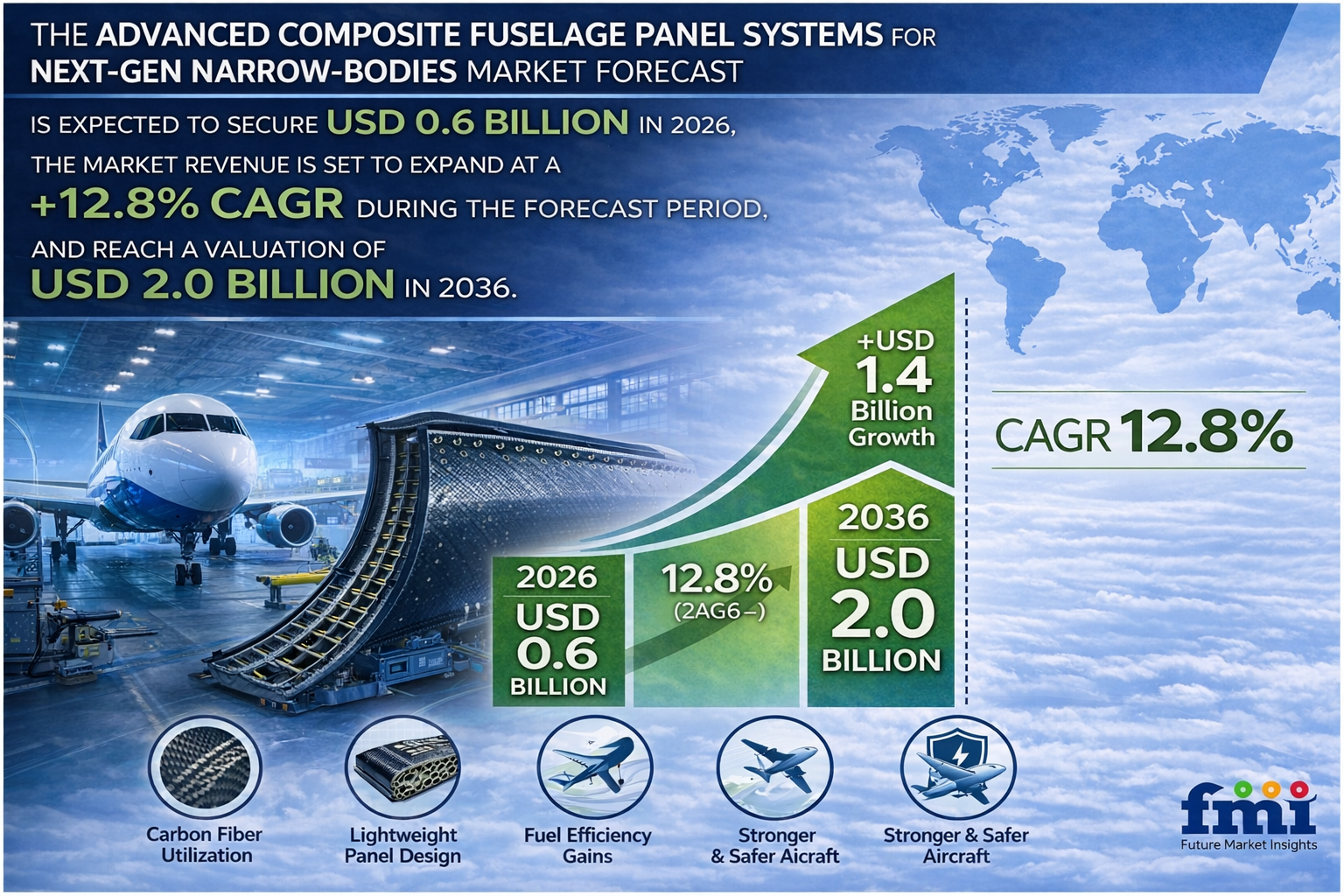
NEWARK, DE / ACCESS Newswire / April 13, 2026 / According to the latest analysis by Future Market Insights, the global advanced composite fuselage panel systems for next-gen narrow-bodies market is entering a high-acceleration growth phase as aerospace manufacturers scale up production of next-generation single-aisle aircraft. Valued at USD 0.5 billion in 2025, the market is projected to reach USD 0.6 billion in 2026 and expand significantly to USD 2.0 billion by 2036, registering a CAGR of 12.8% during the forecast period.
This growth reflects a structural transformation in commercial aircraft manufacturing, where composite fuselage systems are transitioning from selective applications to core structural elements. Increasing demand for lightweight, fuel-efficient aircraft, combined with aggressive production targets, is forcing OEMs and Tier-1 suppliers to adopt scalable composite manufacturing technologies and secure early-stage program participation.
Get detailed market forecasts, competitive benchmarking, and pricing trends:
https://www.futuremarketinsights.com/reports/sample/rep-gb-32630
Market Value Analysis: Production Scale Becomes the Primary Competitive Lever
Between 2026 and 2030, adoption of advanced composite fuselage panel systems is expected to accelerate as aircraft manufacturers push toward higher narrow-body production rates. The need to achieve output levels exceeding 60 aircraft per month is fundamentally reshaping material selection, manufacturing processes, and supplier qualification strategies.
Organizations are increasingly prioritizing:
High-rate capable composite manufacturing systems such as automated fiber placement (AFP)
Early-stage qualification participation to secure long-term production contracts
Transition strategies between thermoset and thermoplastic material systems
Integration of composite panels into full fuselage assembly architectures
Synchronization between material suppliers, fabricators, and OEM production lines
Failure to demonstrate rate-capable manufacturing at scale can exclude suppliers from multi-decade aircraft programs, making early investment decisions critical for long-term revenue security.
From 2030 to 2036, growth will be driven by certification of out-of-autoclave processes, expansion of thermoplastic welding technologies, and increasing alignment between composite production rates and traditional metallic assembly speeds.
Technology Evolution: Thermoplastics and Automation Redefine Production Efficiency
The evolution of composite fuselage panel systems is being shaped by advancements in material science, automation, and high-speed manufacturing techniques. As production targets rise, the industry is shifting focus from prototype performance to scalable industrialization.
Key innovations include:
Thermoplastic composite systems enabling faster production cycles
Automated fiber placement (AFP) for precision and repeatability
Out-of-autoclave curing processes reducing infrastructure constraints
Induction and resistance welding for composite panel assembly
Integrated inspection systems for real-time quality assurance
A key challenge lies in balancing certification requirements with manufacturing speed. While thermoplastics offer significant throughput advantages, regulatory approval and long-term performance validation remain critical hurdles.
An industry analyst notes:
"Composite fuselage innovation is no longer just about weight reduction-it is about achieving industrial-scale production without compromising certification integrity. Rate capability is now the defining metric."
Composite Panels Become Core to Aircraft Efficiency and Scalability
As airlines demand higher fuel efficiency and lower emissions, composite fuselage systems are becoming essential to modern aircraft design. These systems enable weight reduction, improved aerodynamics, and integration of advanced structural features.
Core capabilities include:
Structural weight reduction for improved fuel efficiency
Enhanced fatigue resistance and durability
Integration of large, complex fuselage sections
Compatibility with high-rate automated assembly lines
Support for advanced aerodynamic configurations
This shift is positioning composite fuselage panels as foundational elements in next-generation aircraft platforms, directly influencing performance, cost efficiency, and environmental compliance.
Speak to Analyst: Customize insights for your business strategy:
https://www.futuremarketinsights.com/customization-available/rep-gb-32630
Segment Spotlight
Aft Fuselage Panels Lead by Panel Type (34.0%)
Established designs and easier certification pathways support early adoption.
Thermoset CFRP Dominates Material Segment (55.0%)
Proven performance and certification history maintain strong market position.
AFP/ATL Manufacturing Leads (35.0%)
Automation ensures repeatability and supports high-rate production targets.
Bridge-to-Next-Gen Programs Lead (43.0%)
Demonstrator platforms enable supplier qualification for future aircraft.
OEM Line-Fit Shipsets Dominate End Use (88.0%)
Direct integration into aircraft assembly lines drives demand concentration.
Regional Insights: Aerospace Manufacturing Hubs Drive Growth
Country |
CAGR (2026-2036) |
Key Growth Drivers |
|---|---|---|
China |
13.9% |
Rapid development of domestic narrow-body aircraft programs |
Canada |
13.6% |
Strong production base for next-gen platforms like A220 |
United States |
13.3% |
High investment in automation and composite innovation |
France |
13.1% |
Centralized aerospace manufacturing and integration hubs |
Germany |
12.7% |
Leadership in thermoplastic welding technologies |
United Kingdom |
12.5% |
Government-backed demonstrator programs |
Japan |
12.1% |
Advanced material science and carbon fiber expertise |
Regional growth is driven by production scale, certification capabilities, and investment in advanced composite technologies.
Opportunities: Industrialization and Material Innovation Unlock Growth
Key opportunities shaping the market include:
Standardization of thermoplastic welding for primary structures
Deployment of automated inline inspection systems
Development of out-of-autoclave resin technologies
Integration of digital twins for composite manufacturing optimization
Expansion of hybrid composite-metal structural solutions
These opportunities are enabling suppliers to move beyond prototype development toward full-scale industrial production capabilities.
Competitive Landscape: Scale, Certification, and Data Define Leadership
The market remains highly competitive, with strong barriers to entry driven by certification complexity, capital-intensive manufacturing, and the need for proven production performance.
Leading companies include:
Airbus Atlantic
Spirit AeroSystems
GKN Aerospace
Daher
Hexcel
Toray Advanced Composites
Syensqo
Competitive differentiation is driven by:
Demonstrated high-rate manufacturing capability
Depth of certification data and regulatory expertise
Integration with OEM production ecosystems
Advanced material development and processing technologies
Ability to scale from prototype to serial production
Future Outlook: Composite Fuselage Systems Become Industry Standard
Looking ahead to 2036, advanced composite fuselage panel systems will play a central role in shaping the future of commercial aviation.
Key trends include:
Expansion of high-rate composite manufacturing technologies
Transition toward thermoplastic materials for faster production
Integration of automated inspection and digital manufacturing systems
Increasing reliance on composite structures for full fuselage sections
Alignment of production processes with next-gen aircraft scalability requirements
As narrow-body aircraft production intensifies, advanced composite fuselage panel systems will evolve from specialized components to core structural solutions-enabling higher efficiency, faster production, and long-term competitiveness in the global aerospace industry.
Unlock 360° insights for strategic decision making and investment planning:
https://www.futuremarketinsights.com/checkout/32630
Browse More Automotive Industry Reports:
Automotive Tensioner Market - https://www.futuremarketinsights.com/reports/automotive-tensioner-market
Automotive Radar Sensors Market - https://www.futuremarketinsights.com/reports/automotive-radar-sensors-market
Manifold Absolute Pressure Sensor Market - https://www.futuremarketinsights.com/reports/manifold-absolute-pressure-sensor-market
Fuel Cell Powertrain Market - https://www.futuremarketinsights.com/reports/fuel-cell-powertrain-market
Heavy-Duty Truck LED Headlamps and Signal Lamps Market - https://www.futuremarketinsights.com/reports/heavy-duty-truck-led-headlamps-and-signal-lamps-market
About Future Market Insights (FMI)
Future Market Insights (FMI) is a leading provider of market intelligence and consulting services, serving clients in over 150 countries. Headquartered in Delaware, USA, with a global delivery center in India and offices in the UK and UAE, FMI delivers actionable insights to businesses across industries including automotive, technology, consumer products, manufacturing, energy, and chemicals.
An ESOMAR-certified research organization, FMI provides custom and syndicated market reports and consulting services, supporting both Fortune 1,000 companies and SMEs. Its team of 300+ experienced analysts ensures credible, data-driven insights to help clients navigate global markets and identify growth opportunities.
For Press & Corporate Inquiries
Rahul Singh
AVP - Marketing and Growth Strategy
Future Market Insights, Inc.
+91 8600020075
For Sales - sales@futuremarketinsights.com
For Media - Rahul.singh@futuremarketinsights.com
For web - https://www.futuremarketinsights.com/
SOURCE: Future Market Insights, Inc.
View the original press release on ACCESS Newswire