Europe's cotton textile recycling market is growing steadily, driven by sustainability regulations, circular production, and rising demand for high-quality recycled fibers.
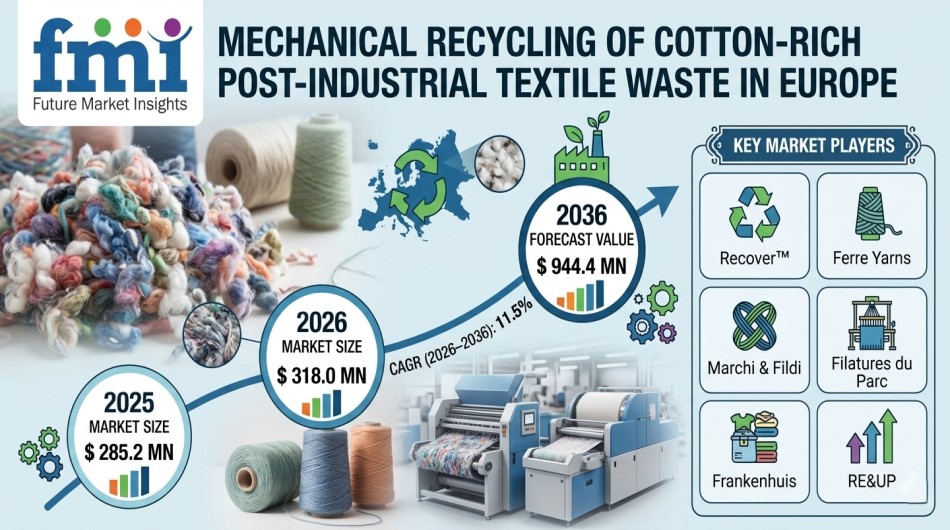
NEWARK, DE / ACCESS Newswire / April 13, 2026 / According to the latest analysis by Future Market Insights, the mechanical recycling of cotton-rich post-industrial textile waste in Europe industry is witnessing accelerated growth, driven by regulatory shifts, supply chain circularity, and increasing demand for sustainable textile inputs. The market is valued at USD 318.0 millionin 2026 and is projected to reach USD 944.4 million by 2036, registering a CAGR of 11.5% over the forecast period.
This expansion reflects a structural transition toward circular textile systems, where pre-consumer cotton waste is increasingly reintegrated into yarn production through efficient mechanical recycling processes.
Market Snapshot: Mechanical Recycling of Cotton-Rich Post-Industrial Textile Waste in Europe
Market Size (2025): USD 285.2 Million
Market Size (2026): USD 318.0 Million
Forecast Value (2036): USD 944.4 Million
CAGR (2026-2036): 11.5%
Leading Waste Segment: Cutting scraps & offcuts (38.0% share)
Dominant Cotton Content: 100% cotton waste (34.0%)
Top Recycling Route: Fiber regeneration for respinning (37.0%)
Leading Output Form: Recycled staple fiber (41.0%)
Key Players: Recover™, Ferre Yarns, Marchi & Fildi, Filatures du Parc, Frankenhuis, RE&UP
Get detailed market forecasts, competitive benchmarking, and pricing trends: https://www.futuremarketinsights.com/reports/sample/rep-gb-32578
Growth Dynamics and Demand Drivers
The market is experiencing strong momentum as textile manufacturers shift toward circular production models. Increasing regulatory pressure across Europe is compelling companies to divert post-industrial textile waste into recycling streams rather than disposal.
A major growth driver is the implementation of textile waste separation policies and revisions to the Waste Framework Directive, which mandate structured collection and recycling from 2025 onward. These policies are reshaping sourcing strategies across spinning mills and garment manufacturers.
Mechanical recycling is gaining preference due to its compatibility with cotton-rich waste streams. Compared to blended or post-consumer textiles, pre-consumer cotton waste offers cleaner, more consistent feedstock, improving processing efficiency and output quality.
At the same time, fast-fashion brands are driving demand by enforcing minimum recycled content requirements in apparel production, pushing mills to secure reliable secondary cotton feedstock.
Segment Insights
By Waste Form
Cutting scraps and offcuts lead with 38.0% share due to:
High purity and traceability
Easier segregation by composition and color
Reduced processing complexity
By Cotton Content
100% cotton waste dominates (34.0%) due to:
Better compatibility with mechanical recycling
Higher fiber quality retention
Simplified dyeing and processing
By Recycling Route
Fiber regeneration for respinning holds 37.0% share
Preferred for producing yarn-grade recycled fibers
Supports apparel and textile manufacturing demand
By Output Form
Recycled staple fiber leads with 41.0% share
Standardized input for spinning mills
Enables blending with virgin cotton
By End Use
Apparel yarn spinning dominates with 36.0% share
Driven by sustainability commitments from fashion brands
High demand for recycled fibers in denim and knitwear
Supply Chain and Industry Structure
The supply chain is evolving toward a highly specialized and partnership-driven model. It includes:
Feedstock suppliers: Garment manufacturers generating cutting scraps and offcuts
Recyclers: Processing waste through shredding, defibration, and carding
Spinning mills: Converting recycled fibers into yarns
End users: Apparel, home textiles, and industrial applications
Efficiency improvements are being driven by investments in automated sorting technologies, including optical and spectroscopic systems that enhance material purity and throughput.
However, challenges remain in fiber shortening, contamination (especially elastane), and maintaining consistent feedstock quality.
Pricing and Value Trends
The market is transitioning toward a performance- and quality-based pricing model. Key factors influencing pricing include:
Fiber length retention
Color sorting quality
Contamination levels
Bale density and moisture control
Premium pricing is typically achieved for clean, white, and well-segregated cotton waste, which reduces downstream processing requirements and improves yarn quality.
Speak to Analyst: Customize insights for your business strategy: https://www.futuremarketinsights.com/customization-available/rep-gb-32578
Competitive Landscape
The industry remains fragmented and highly specialized, with key players focusing on different stages of the value chain.
Leading companies include:
Recover™
Ferre Yarns
Marchi & Fildi
Filatures du Parc
Frankenhuis
RE&UP
Competition is centered on:
Fiber quality and consistency
Process efficiency
Long-term supply agreements with spinning mills
Established recyclers maintain an advantage through operational expertise and process optimization, while new entrants are investing in advanced sorting technologies to improve competitiveness.
Regional Analysis
Southern Europe (High Growth Hub)
Spain (12.8% CAGR): Leading market due to integrated textile ecosystem
Portugal (12.4% CAGR): Strong demand from home textiles sector
Italy (12.1% CAGR): Driven by luxury brands and closed-loop systems
Western Europe
France (11.6%): Policy-driven growth and infrastructure investment
Netherlands (11.2%): Logistics hub for textile waste aggregation
Germany (10.9%): Focus on nonwoven and industrial applications
Eastern Europe
Poland (10.4%): Growth constrained by legacy spinning infrastructure
Future Outlook and Opportunities
The market is expected to remain one of the fastest-growing segments within the European textile recycling industry. Growth will be driven by:
Expansion of automated sorting and processing capacity
Increased integration with garment manufacturing hubs
Rising demand for traceable and certified recycled fibers
Key opportunities include:
Advanced elastane detection technologies
Closed-loop recycling systems for apparel brands
Direct integration of recycling systems within garment factories
Buy Full Report: Unlock 360° insights for strategic decision making and investment planning: https://www.futuremarketinsights.com/checkout/32578
Explore More Related Studies Published by FMI Research:
Aircraft Lubricant Market: https://www.futuremarketinsights.com/reports/aircraft-lubricant-market
Polyisocyanurate Insulation Market: https://www.futuremarketinsights.com/reports/polyisocyanurate-insulation-market
Compressor Oil Market: https://www.futuremarketinsights.com/reports/compressor-oil-market
Precious Metal Plating Chemicals Market: https://www.futuremarketinsights.com/reports/precious-metal-plating-chemicals-market
Coil Coatings Market: https://www.futuremarketinsights.com/reports/coil-coatings-market
About Future Market Insights (FMI)
Future Market Insights (FMI) is a leading provider of market intelligence and consulting services, serving clients in over 150 countries. Headquartered in Delaware, USA, with a global delivery center in India and offices in the UK and UAE, FMI delivers actionable insights to businesses across industries including automotive, technology, consumer products, manufacturing, energy, and chemicals.
An ESOMAR-certified research organization, FMI provides custom and syndicated market reports and consulting services, supporting both Fortune 1,000 companies and SMEs. Its team of 300+ experienced analysts ensures credible, data-driven insights to help clients navigate global markets and identify growth opportunities.
For Press & Corporate Inquiries
Rahul Singh
AVP - Marketing and Growth Strategy
Future Market Insights, Inc.
+91 8600020075
For Sales - sales@futuremarketinsights.com
For Media - Rahul.singh@futuremarketinsights.com
For web - https://www.futuremarketinsights.com/
SOURCE: Future Market Insights, Inc.
View the original press release on ACCESS Newswire