Black cumin seed oil market grows steadily as demand rises for standardized, clean-label botanical ingredients across nutraceutical, wellness, and personal care applications.
NEWARK, DE / ACCESS Newswire / April 17, 2026 / According to the latest analysis by Future Market Insights, the global black cumin seed oil market is witnessing steady expansion as nutraceutical brands, personal care companies, and botanical ingredient suppliers increasingly prioritize standardized formulations, traceability, and clinically supported plant-based solutions. The market, valued at USD 23.9 million in 2025, is projected to reach USD 25.5 million in 2026 and expand to USD 47.9 million by 2036, registering a CAGR of 6.5% over the forecast period.
This growth reflects a structural shift from traditional, bulk botanical oil usage toward specification-driven procurement, where active compound consistency-particularly thymoquinone-plays a critical role in product positioning and regulatory acceptance.
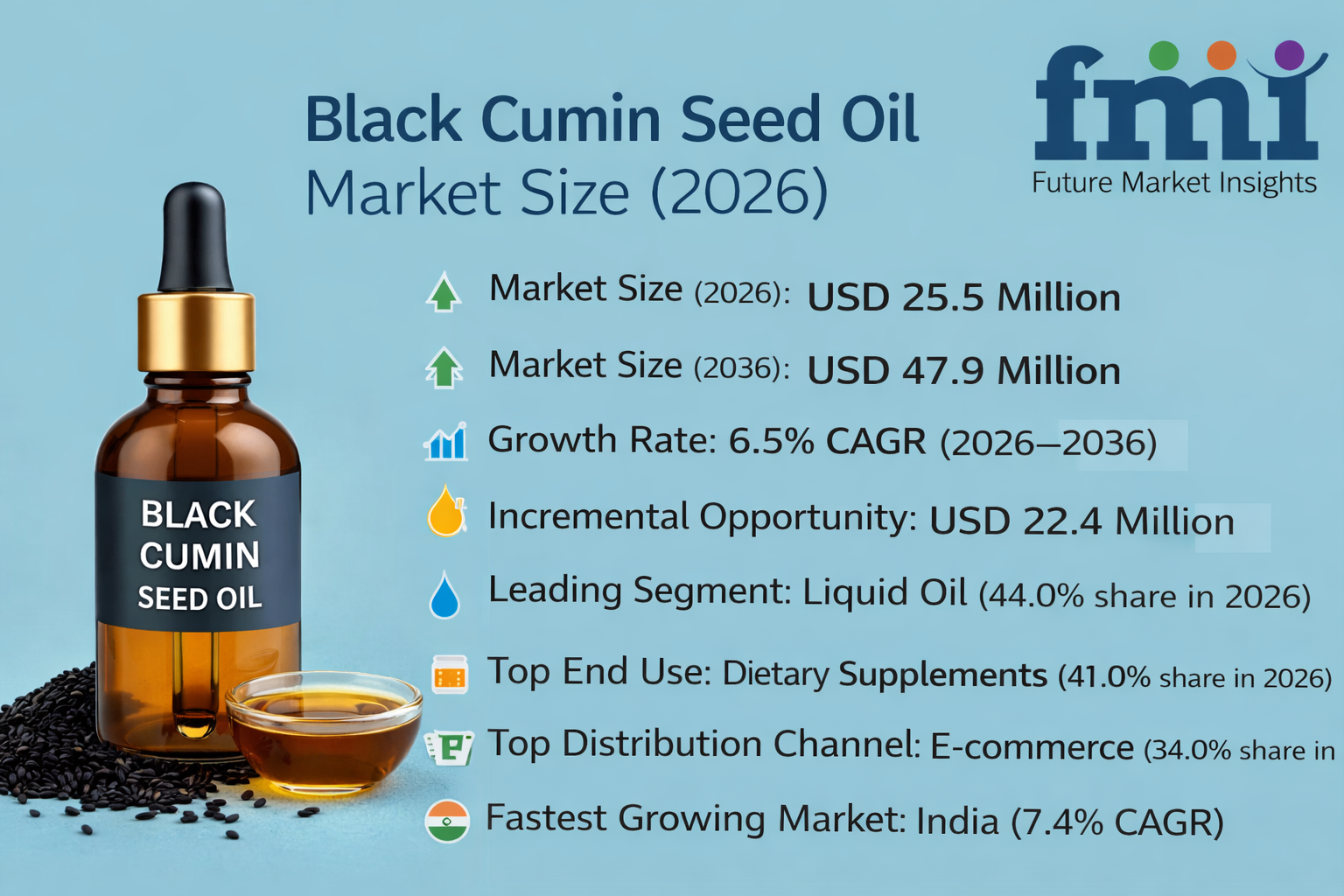
Quick Stats: Black Cumin Seed Oil Market
Market Size (2025): USD 23.9 Million
Market Size (2026): USD 25.5 Million
Market Size (2036): USD 47.9 Million
Growth Rate: 6.5% CAGR (2026-2036)
Incremental Opportunity: USD 22.4 Million
Leading Segment: Liquid Oil (44.0% share in 2026)
Top End Use: Dietary Supplements (41.0% share in 2026)
Top Distribution Channel: E-commerce (34.0% share in 2026)
Fastest Growing Market: India (7.4% CAGR)
Request Sample Report: Get detailed market forecasts, competitive benchmarking, and pricing trends: https://www.futuremarketinsights.com/reports/sample/rep-gb-32672
Specification-Led Demand and Functional Wellness Trends Driving Growth
A primary driver of the black cumin seed oil market is the increasing demand for functional wellness solutions and preventive healthcare. Rich in bioactive compounds such as thymoquinone, black seed oil is gaining traction in:
Nutraceutical supplements (capsules, softgels, liquid formulations)
Functional wellness products
Herbal medicinal applications
Premium personal care and dermatological formulations
Unlike traditional botanical oils, demand is shifting toward standardized products with verified active compound content. This is particularly important in premium markets where formulation consistency, clinical validation, and regulatory compliance are essential.
Supply Chain Evolution and Quality Standardization Reshaping Procurement
Procurement strategies in the market are undergoing a transformation, with buyers prioritizing long-term supply contracts that ensure consistent oil quality across production cycles. Variability in active compounds due to agricultural conditions and extraction methods presents a key challenge, making traceability and batch-level verification increasingly critical.
Manufacturers are investing in:
Cold-pressed extraction systems to preserve active compounds
Nitrogen-controlled storage to prevent oxidation
Analytical testing for compound consistency
Transparent sourcing models with origin traceability
As pharmacy-grade and high-specification retail channels adopt stricter quality benchmarks, suppliers lacking verifiable documentation may face limited access to premium segments.
Segmental Insights: Liquid Format and Supplements Lead Market Demand
Liquid oil remains the dominant format, accounting for 44.0% of the market in 2026. Its flexibility in dosage and ease of formulation make it attractive for early-stage product development and bulk applications. However, it requires stringent packaging controls to maintain stability and shelf life.
Dietary supplements continue to lead the end-use segment with a 41.0% share, supported by:
Standardized dosing requirements
Taste masking through encapsulation
Strong consumer demand for preventive health products
Cold-pressed extraction dominates with a 68.0% share, driven by clean-label preferences and the need to preserve the oil's native lipid profile. Meanwhile, conventional-grade oil accounts for 62.0% of supply due to its scalability and cost efficiency, although quality verification standards are tightening.
E-commerce Expansion Strengthening Market Accessibility
E-commerce is emerging as the leading distribution channel, capturing 34.0% of the market in 2026. Digital platforms allow brands to:
Reach niche health-conscious consumers
Maintain better margins by avoiding retail intermediaries
Control product messaging and positioning
However, logistics challenges such as temperature-sensitive shipping and packaging stability remain critical for maintaining product integrity during transit.
Speak to Analyst: Customize insights for your business strategy@ https://www.futuremarketinsights.com/customization-available/rep-gb-32672
Regional Growth Dynamics Highlight Emerging and Mature Markets
The market demonstrates varied growth patterns across regions, driven by regulatory environments, consumer awareness, and supply chain maturity:
India: Leads with 7.4% CAGR, supported by strong domestic production and growing wellness demand
Germany: 7.1% CAGR driven by stringent quality standards and clean-label requirements
Netherlands: 6.9% CAGR as a key European trade and certification hub
United Kingdom: 6.7% CAGR fueled by retail expansion and vegan product demand
United States: 6.5% CAGR supported by established supplement markets
Türkiye: 6.3% CAGR backed by local production capabilities
France: 6.1% CAGR driven by dermatological and cosmetic applications
Asia and South Asia remain key sourcing regions, while Europe and North America drive premium consumption.
Market Challenges and Opportunities: Balancing Consistency and Scale
Despite growth potential, the market faces challenges related to:
Variability in thymoquinone concentration across harvests
Limited availability of standardized, clinical-grade oil
Supply chain fragmentation and traceability gaps
However, emerging opportunities are reshaping the competitive landscape:
Standardization technologies enabling consistent active compound levels
Microencapsulation innovations improving taste and expanding product formats
Topical applications in high-end skincare and dermatology
Pharmaceutical-grade formulations supported by clinical validation
Competitive Landscape: Focus on Quality, Traceability, and Innovation
The black cumin seed oil market is moderately competitive, with companies focusing on enhancing extraction capabilities, ensuring supply consistency, and meeting regulatory requirements.
Key players include:
Amazing Herbs
TriNutra
HealthAid
Nature In Bottle
Heess Oils
Market participants are investing in advanced processing infrastructure, in-house testing capabilities, and direct sourcing partnerships to strengthen their competitive positioning. The ability to maintain consistent active compound profiles is becoming a critical differentiator, particularly in premium nutraceutical and pharmaceutical segments.
Future Outlook: Transition Toward Standardized Botanical Ingredient Systems
The black cumin seed oil market is evolving from a traditional botanical oil category into a high-value, standardized ingredient system. As consumer demand for clean-label, plant-based, and clinically supported products continues to grow, the market is expected to see sustained expansion through 2036.
With increasing emphasis on quality, traceability, and functional efficacy, black cumin seed oil is set to play a more prominent role across nutraceuticals, personal care, and therapeutic applications-driven by innovation, regulatory alignment, and global adoption.
Unlock 360° insights for strategic decision making and investment planning@ https://www.futuremarketinsights.com/checkout/32672
Related Reports:
Black Seed Oil Market Share Analysis: https://www.futuremarketinsights.com/reports/black-seed-oil-market-share-analysis
Blackcurrant Seed Oil Market: https://www.futuremarketinsights.com/reports/blackcurrant-seed-oil-market
Linseed Oil Market: https://www.futuremarketinsights.com/reports/linseed-oil-market
Rapeseed Oil Market: https://www.futuremarketinsights.com/reports/rapeseed-oil-market
Hemp Seed Oil Market: https://www.futuremarketinsights.com/reports/hemp-seed-oil-market
About Future Market Insights (FMI)
Future Market Insights (FMI) stands out by delivering actionable, decision-maker-focused research, not just data. Unlike traditional reports that focus only on market size and forecasts, FMI provides:
Deep pricing analysis and cost benchmarking across ingredients and technologies
Installed base and consumption insights to predict real demand
Procurement and buyer behavior analysis across industries
Supply chain intelligence including sourcing and distribution trends
Technology and formulation insights across functional and fortified food segments
FMI follows a bottom-up research approach, combining real industry inputs from procurement heads, technical experts, and supply chain leaders to deliver practical, validated, and business-ready insights.
For Press & Corporate Inquiries
Rahul Singh
AVP - Marketing and Growth Strategy
Future Market Insights, Inc.
+91 8600020075
For Sales - sales@futuremarketinsights.com
For Media - Rahul.Singh@futuremarketinsights.com
For web - https://www.futuremarketinsights.com/
SOURCE: Future Market Insights, Inc.
View the original press release on ACCESS Newswire