As of March 10, 2026, Walmart Inc. (NYSE: WMT) stands at a historic crossroads. The retail behemoth, once synonymous with rural American discount stores, recently crossed the $1 trillion market capitalization threshold, solidifying its transformation from a legacy brick-and-mortar operator into a "tech-powered omnichannel ecosystem." This milestone comes at a time of significant leadership transition and strategic evolution. While the global economy continues to grapple with the tailwinds of sticky inflation and shifting consumer behaviors, Walmart has emerged as a preferred destination not just for its traditional price-conscious base, but for high-income households seeking value and convenience. This research feature delves into the mechanics of Walmart’s current dominance and the challenges it faces in justifying a premium valuation in a rapidly automating retail landscape.
Historical Background
The Walmart narrative began on July 2, 1962, when Sam Walton opened the first Wal-Mart Discount City in Rogers, Arkansas. Walton’s foundational philosophy—Every Day Low Prices (EDLP)—was radical at the time, predicated on the idea that lower margins would drive higher volume. The company went public in 1970 (NYSE: WMT) and by the 1980s, had revolutionized logistics through the deployment of the largest private satellite communication system in the U.S.
The 1988 opening of the first Supercenter in Washington, Missouri, marked a key transformation, combining general merchandise with a full-scale supermarket. This "one-stop shop" model became the company's engine of growth for decades. In 2016, realizing the existential threat posed by Amazon (NASDAQ: AMZN), Walmart acquired Jet.com for $3.3 billion, a move that brought in tech talent like Marc Lore and kickstarted a decade-long digital overhaul. Most recently, in February 2024, the company executed a 3-for-1 stock split to keep shares accessible for its 2.1 million associates, a move that signaled confidence in its long-term trajectory.
Business Model
Walmart’s business model has evolved into a multi-layered "flywheel." It operates through three primary segments:
- Walmart U.S. (approx. 68% of Revenue): The core business, which has successfully captured over 25% of the U.S. grocery market. It leverages its 4,700+ stores as fulfillment centers for both in-person and digital orders.
- Walmart International: Focused on high-growth digital markets, specifically Flipkart in India, Walmex in Mexico and Central America, and a robust e-commerce presence in China.
- Sam’s Club: A membership-only warehouse segment that has seen a resurgence by targeting younger, tech-savvy demographics through its "Scan & Go" technology.
Beyond retail, the company is scaling high-margin "service" revenue streams, including Walmart Connect (its advertising arm), fulfillment services for third-party marketplace sellers, and data ventures. These services are designed to decouple profit growth from the thin margins of traditional grocery retail.
Stock Performance Overview
As of March 2026, Walmart’s stock performance reflects a "flight to quality" and success in digital transformation:
- 1-Year Performance: +32.1%, significantly outperforming the broader retail sector.
- 5-Year Performance: +210.9% (Total Return), driven by the successful integration of e-commerce and store automation.
- 10-Year Performance: +556.4% (Total Return).
The 2024 3-for-1 stock split effectively lowered the entry price from approximately $175 to $58 per share. Since then, the stock has trended steadily upward, reaching all-time highs above $134 (post-split) in early 2026. The split not only increased retail investor participation by an estimated 20% but also served as a psychological booster for associate-owners.
Financial Performance
For the full fiscal year 2026 (ended January 31, 2026), Walmart reported robust results that exceeded consensus expectations:
- Total Revenue: Approximately $713.2 billion, a 4.7% increase year-over-year.
- Adjusted Earnings Per Share (EPS): $2.64.
- E-commerce Growth: Global e-commerce sales grew by 24% in the final quarter, marking two full years of 20%+ growth.
- Margins: Operating margins have shown resilience, as the high-margin advertising business (Walmart Connect) grew by 37%, helping to offset rising labor costs.
The company maintains a strong balance sheet with a disciplined capital allocation strategy, prioritizing investments in automation while continuing to grow dividends. However, its forward Price-to-Earnings (P/E) ratio has expanded significantly, now sitting near 45x, which reflects high expectations for its tech-driven future.
Leadership and Management
A major era concluded on February 1, 2026, when Doug McMillon retired after 12 years as CEO. McMillon is credited with the "Amazon-proofing" of Walmart and its elevation into the tech era. The baton has passed to John Furner, the former head of Walmart U.S., who assumed the role of President and CEO of Walmart Inc.
Furner is supported by a battle-tested leadership team, including David Guggina (CEO of Walmart U.S.) and Chris Nicholas (International). The new leadership's "People-Led, Tech-Powered" strategy emphasizes "Agentic Commerce"—the use of advanced AI to anticipate and fulfill customer needs autonomously. The Board of Directors continues to maintain a strong focus on governance, recently updating its sustainability and labor compliance frameworks to meet evolving ESG standards.
Products, Services, and Innovations
Walmart is currently transitioning from a retailer to a logistics and AI powerhouse:
- Automation: By early 2026, roughly 65% of Walmart stores are serviced by automated distribution centers. This investment has drastically reduced the cost per unit and improved inventory accuracy.
- AI Integration: The company has rolled out "Wally," an AI-driven merchant tool, and "Sparky," a customer-facing AI that handles complex, intent-based queries (e.g., "Plan a week of keto meals for a family of four for under $150").
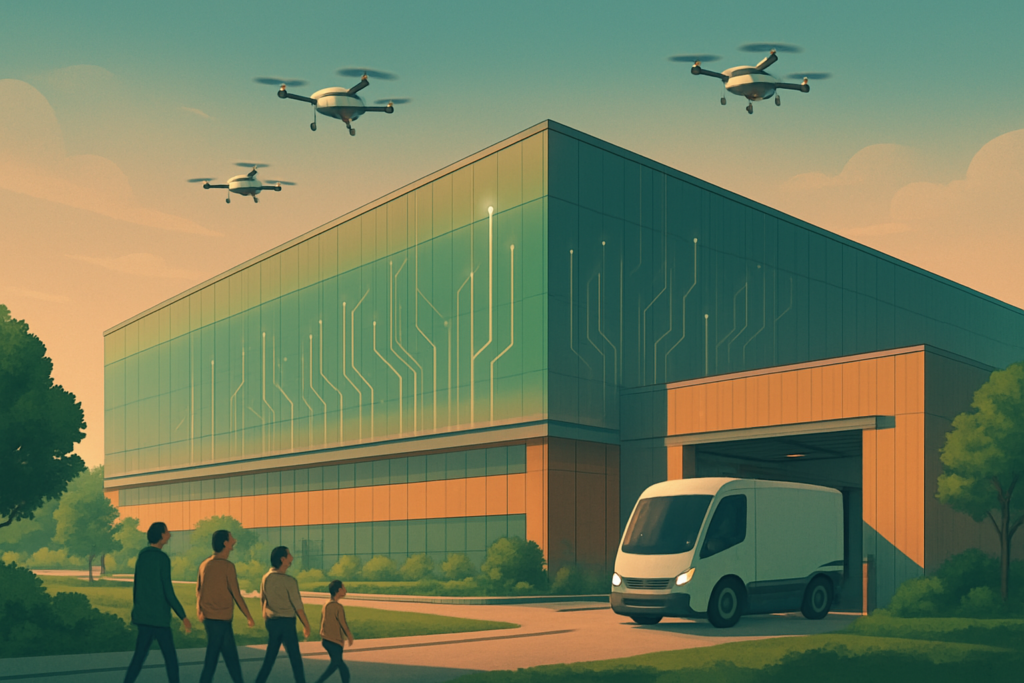
- Drone Delivery: Following regulatory approvals in 2025, Walmart now offers 30-minute drone delivery to over 15 million households in 10 states.
- Health & Wellness: Walmart has expanded its footprint in clinical trials and primary care, leveraging its massive physical presence to offer healthcare services in underserved regions.
Competitive Landscape
Walmart remains in a fierce rivalry with Amazon (NASDAQ: AMZN), but its competitive moat has deepened. While Amazon leads in pure e-commerce volume, Walmart’s "physical moat"—with 90% of Americans living within 10 miles of a store—gives it an advantage in fresh grocery and last-mile efficiency.
Against Target (NYSE: TGT), Walmart has widened its lead by capturing "trade-down" shoppers—families earning over $100,000 who have migrated to Walmart for its price advantage in essential goods. Meanwhile, Sam’s Club is closing the tech gap with Costco (NASDAQ: COST), utilizing digital-first features like "Scan & Go" that appeal to a younger demographic.
Industry and Market Trends
The retail sector in 2026 is defined by three macro drivers:
- Automation of Labor: With labor costs rising globally, retailers are racing to automate back-end logistics. Walmart’s early lead here provides a significant margin advantage.
- The "Convenience Economy": Customers are increasingly prioritizing time over price, driving the growth of delivery-as-a-service and subscription models like Walmart+.
- High-Income Migration: Persistent inflation in non-discretionary categories has structurally changed shopper demographics, as higher-income households make Walmart their primary grocery destination.
Risks and Challenges
Despite its dominance, Walmart faces several headwinds:
- Valuation Premium: Trading at 45x forward earnings, the stock is "priced for perfection." Any slowdown in digital growth or margin contraction could lead to a sharp correction.
- Regulatory Friction: The company recently settled a $100 million dispute regarding its Spark Driver delivery program, highlighting the ongoing legal risks associated with the "gig economy" workforce.
- Macroeconomic Volatility: Sticky inflation in general merchandise continues to squeeze the "paycheck-to-paycheck" consumer, who still forms a large part of Walmart’s core base.
- Leadership Transition Risk: While John Furner is a veteran, a change at the top always brings execution risks, especially during a period of massive technological shift.
Opportunities and Catalysts
Two major catalysts are on the horizon for 2026:
- Tariff Refunds: A landmark Supreme Court ruling in February 2026 regarding the International Emergency Economic Powers Act (IEEPA) could potentially lead to billions of dollars in duty refunds for Walmart, providing a massive one-time cash windfall.
- International IPOs: Continued speculation surrounds the potential public listing of Flipkart or PhonePe in India, which could unlock significant shareholder value for Walmart, the majority owner.
- Advertising Scale: Walmart Connect is on track to become a double-digit contributor to operating income by 2027, transforming the company’s profit profile.
Investor Sentiment and Analyst Coverage
Wall Street remains cautiously bullish on Walmart. Out of 43 major analysts, 31 maintain "Buy" or "Strong Buy" ratings. The consensus view is that Walmart is the ultimate "defensive growth" play. However, a growing minority of analysts have moved to "Hold," citing the historic valuation levels and the difficulty of maintaining 20%+ e-commerce growth rates as the business scales. Institutional ownership remains high, with major funds seeing Walmart as a staple in a volatile macroeconomic environment.
Regulatory, Policy, and Geopolitical Factors
Walmart's global operations are sensitive to trade policy. The 2026 Supreme Court ruling on tariffs has been a major tailwind, but ongoing geopolitical tensions between the U.S. and China remain a risk for the company’s sourcing and its retail operations in the Chinese market. Domestically, the company is under constant scrutiny regarding labor practices and antitrust concerns, particularly as its marketplace grows to rival that of Amazon. Compliance with "gig worker" regulations remains a primary focus for its Spark logistics network.
Conclusion
As of March 10, 2026, Walmart Inc. is no longer just a "big box" retailer; it is a technology and logistics powerhouse with a $1 trillion market cap. The company’s ability to successfully navigate the transition from Doug McMillon to John Furner, while simultaneously scaling high-margin advertising and AI-driven commerce, is a testament to its operational excellence. For investors, the central question is whether the current 45x P/E valuation is a fair price for a company that has successfully "cracked the code" of omnichannel retail, or if the stock is reaching a cyclical peak. In the near term, the potential for tariff refunds and international spinoffs provides compelling catalysts. However, long-term success will depend on Walmart’s ability to maintain its price leadership while successfully automating its way through a high-cost labor environment.
This content is intended for informational purposes only and is not financial advice.