March 10, 2026
Introduction
In the rapidly evolving landscape of global technology, few companies have managed to reinvent themselves as successfully or as dramatically as Dell Technologies (NYSE: DELL). Once pigeonholed as a legacy personal computer manufacturer, Dell has emerged in early 2026 as a central pillar of the generative AI revolution. As organizations worldwide scramble to build out the infrastructure required for large language models and sovereign AI initiatives, Dell has positioned itself not just as a hardware provider, but as the architect of the "AI Factory." Today, the company stands at a crossroads of historic financial performance and a total internal transformation, making it one of the most watched entities on Wall Street.
Historical Background
The story of Dell Technologies is inextricably linked to its founder, Michael Dell, who famously started the company in 1984 from his University of Texas dorm room with just $1,000. Dell’s initial "direct-to-consumer" model bypassed retail middlemen, allowing for customized PCs at lower costs—a move that revolutionized the industry.
However, the path to its current $96 billion market capitalization was not linear. After going public in 1988, the company faced the decline of the PC market in the 2000s. In 2013, Michael Dell and Silver Lake Partners took the company private in a $24.4 billion deal, the largest leveraged buyout since the 2008 financial crisis. This move allowed Dell to restructure away from the quarterly scrutiny of the public markets, leading to the massive $67 billion acquisition of EMC Corporation in 2016. Dell returned to the public markets in December 2018, and since then, it has systematically simplified its structure, including the 2021 spinoff of VMware, to focus on its core infrastructure and client businesses.
Business Model
Dell operates through two primary segments that have become increasingly integrated in the AI era:
- Infrastructure Solutions Group (ISG): This is the high-growth engine of the company, encompassing servers, storage, and networking. Specifically, Dell’s AI-optimized servers (like the PowerEdge XE series) have become the gold standard for deploying NVIDIA (NASDAQ: NVDA) and AMD (NASDAQ: AMD) GPUs in enterprise environments.
- Client Solutions Group (CSG): While traditionally the "PC business," CSG has been rebranded as of 2025 to focus on "AI PCs." This segment includes commercial and consumer notebooks, desktops, and peripherals.
The company has also shifted toward a recurring revenue model via Dell APEX, a multi-cloud and "as-a-service" platform that allows customers to scale their hardware and software needs on a consumption basis rather than through massive upfront capital expenditures.
Stock Performance Overview
Dell’s stock performance over the last decade tells a tale of value realization.
- 10-Year View: Since the 2018 re-listing (and accounting for the privatization era), Dell has significantly outperformed the S&P 500, driven by aggressive debt paydown and strategic focus.
- 5-Year View: The stock saw steady growth during the pandemic-era PC boom, followed by a correction in 2022.
- 1-Year View: As of March 10, 2026, Dell shares have been trading in the $146–$153 range. While off its mid-2024 highs of $174 due to margin concerns in the AI server sector, the stock is still up over 200% from its early 2023 lows. The total return has been bolstered by a consistent dividend, which was recently raised by 20% in early 2026.
Financial Performance
For the fiscal year 2026 (ended January 30, 2026), Dell posted record-breaking results that solidified its status as an AI winner:
- Revenue: A record $113.5 billion, representing a 19% year-over-year increase.
- Earnings: Record diluted EPS of $8.68 and non-GAAP EPS of $10.30.
- Backlog: Most impressively, Dell entered the current fiscal year with a $43 billion AI server backlog, suggesting sustained demand for the foreseeable future.
- Cash Flow: The company generated a record $11.2 billion in operating cash flow, allowing it to authorize an additional $10 billion for share repurchases.
Leadership and Management
Michael Dell remains the Chairman and CEO, providing a level of founder-led stability rare in the tech sector. Alongside him, COO Jeff Clarke is widely credited with the operational execution of the AI pivot. The management team’s reputation has shifted from "efficient supply chain managers" to "visionary architects."
A major internal project currently underway is the "One Dell Way" initiative, set for a full launch on May 3, 2026. This strategy aims to unify the company's disparate legacy systems into a single enterprise platform, breaking down the traditional silos between the server (ISG) and PC (CSG) divisions to offer a more cohesive customer experience.
Products, Services, and Innovations
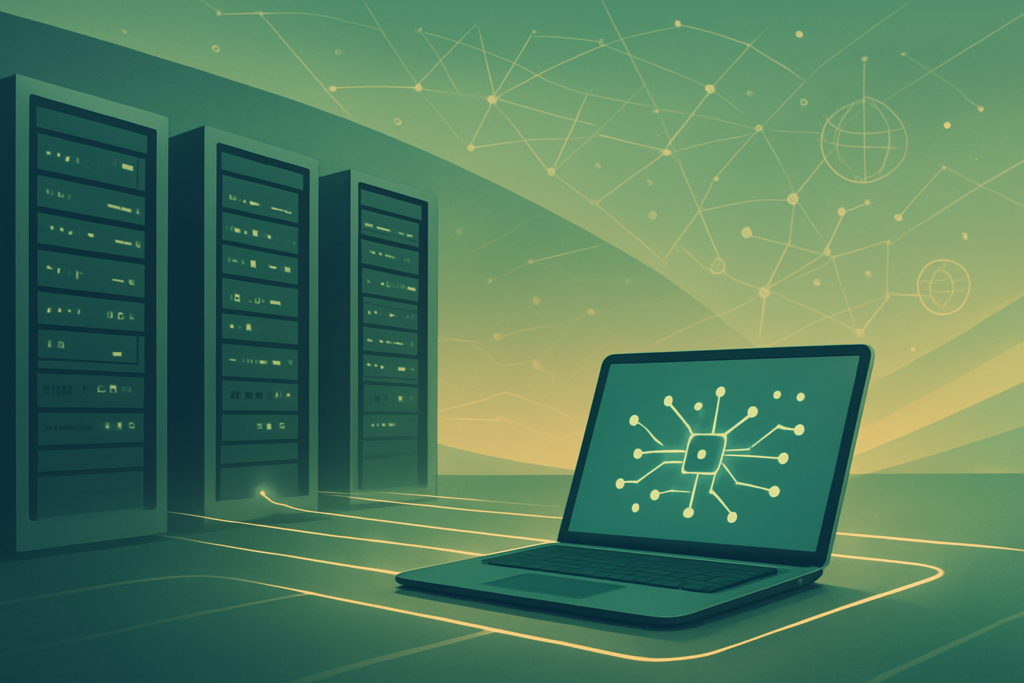
Dell’s innovation pipeline is currently dominated by the "AI Factory"—a full-stack solution including liquid-cooled servers, high-speed storage (PowerScale), and networking.
- AI PCs: In early 2025, Dell simplified its PC branding into three tiers: Dell, Dell Pro, and Dell Pro Max. By early 2026, these "Copilot+ PCs," equipped with Neural Processing Units (NPUs) for local AI tasks, accounted for 55% of all Dell laptop shipments.
- Liquid Cooling: Dell has taken a lead in Direct Liquid Cooling (DLC) technologies, essential for the latest generation of power-hungry GPUs like NVIDIA’s Blackwell architecture.
Competitive Landscape
Dell faces a "war of the giants" in the data center and PC markets:
- Super Micro Computer (NASDAQ: SMCI): While SMCI is often faster to integrate the newest chips, Dell wins on global service and support capabilities, which are critical for large-scale enterprise deployments.
- Hewlett Packard Enterprise (NYSE: HPE): HPE’s acquisition of Juniper has made it a formidable networking rival, but Dell currently maintains a higher market share in AI-optimized server shipments (estimated at 20%).
- Lenovo (HKG: 0992): Lenovo remains the chief rival in the global PC market and is growing its server footprint, particularly in the Asia-Pacific region.
Industry and Market Trends
Three primary trends are driving Dell’s current trajectory:
- Sovereign AI: Nations are increasingly building their own localized AI infrastructure to ensure data privacy and domestic capability, creating a massive new customer class for Dell.
- Windows 10 End-of-Life: With support for Windows 10 ending, a massive corporate refresh cycle is underway, fueling the adoption of Dell’s new AI-capable hardware.
- Cloud Repatriation: As cloud costs spiral, more enterprises are moving workloads back to "on-premise" or "hybrid" environments, where Dell’s hardware excels.
Risks and Challenges
Despite the growth, Dell faces significant headwinds:
- Margin Compression: AI servers, while high in revenue, often carry lower gross margins than traditional servers because of the high cost of third-party GPUs and memory.
- Commodity Volatility: The skyrocketing price of High Bandwidth Memory (HBM) and DDR5 memory can squeeze profits if Dell cannot pass those costs to consumers.
- Supply Chain Concentration: Dell remains heavily dependent on a few key suppliers, notably NVIDIA, for the chips that drive its most profitable segments.
Opportunities and Catalysts
- The Edge: As AI moves from training in data centers to "inference" at the edge (in factories, retail stores, etc.), Dell’s ruggedized edge servers represent a massive untapped market.
- Services Expansion: Dell is aggressively growing its consulting arm to help businesses figure out how to use AI, not just what hardware to buy.
- Efficiency Gains: The "One Dell Way" initiative is expected to drive significant operational efficiencies starting in late 2026, potentially boosting operating margins by 100-150 basis points.
Investor Sentiment and Analyst Coverage
Investor sentiment remains overwhelmingly bullish, with approximately 93% of Wall Street analysts holding "Buy" or "Strong Buy" ratings as of March 2026. Institutional ownership is high at 81%, with Vanguard and BlackRock holding the largest stakes. The consensus view is that Dell is the "blue-chip" way to play the AI infrastructure boom—offering more stability than SMCI and more growth than traditional PC makers.
Regulatory, Policy, and Geopolitical Factors
Geopolitics is perhaps Dell’s most complex challenge.
- The China Exit: Dell has committed to phasing out all "made in China" chips by the end of 2026. This is a massive logistical undertaking aimed at de-risking the supply chain from potential U.S. sanctions or Chinese retaliatory actions.
- Export Controls: U.S. restrictions on high-end AI chips to China have effectively limited Dell’s addressable market in the region, though the company has successfully pivoted to meet surging demand in North America, Europe, and the Middle East.
Conclusion
As of March 10, 2026, Dell Technologies is no longer the company that simply sold you a desktop in the 1990s. It has successfully navigated the most significant technological shift of the decade, transforming into an essential provider of AI infrastructure. While risks regarding hardware margins and geopolitical tensions persist, Dell’s massive $43 billion backlog and its leadership in the AI PC transition provide a formidable "moat." For investors, Dell represents a balanced play: a legacy giant with a founder’s vision, currently operating at the absolute epicenter of the AI revolution.
This content is intended for informational purposes only and is not financial advice.