Today’s Date: March 30, 2026
Introduction
As the global economy navigates a complex transition toward automation and sustainable productivity, few companies embody the intersection of heavy industry and high technology quite like Deere & Co (NYSE: DE). Known colloquially as "John Deere," the company is currently at a critical juncture. While the broader agricultural sector is weathering a cyclical "trough" in 2026, Deere’s strategic pivot toward a software-centric business model has decoupled its valuation from traditional equipment manufacturers. This feature explores how Deere is positioning itself against its primary rival, Caterpillar (NYSE: CAT), and why its "Smart Industrial" strategy is redefining what it means to be an industrial powerhouse in the late 2020s.
Historical Background
The story of Deere & Co begins in 1837 with a single blacksmith, John Deere, who invented the self-scouring steel plow. This innovation solved the "sticky soil" problem of the American Midwest and laid the foundation for a reputation of reliability. For nearly a century, Deere was defined by iron and steel. However, the company’s history is a series of well-timed transformations. In 1918, it entered the motorized era by acquiring the Waterloo Gasoline Engine Company, producing the iconic "Waterloo Boy" tractor.
By the mid-20th century, Deere diversified into construction and forestry, providing a vital hedge against agricultural volatility. The most profound shift, however, began in the 2010s with the acquisition of Blue River Technology. This marked the transition from a manufacturer of "dumb iron" to a provider of "smart machines," effectively turning tractors into mobile data centers capable of seeing, thinking, and acting autonomously.
Business Model
Deere operates through four primary segments, each playing a specific role in its "Smart Industrial" ecosystem:
- Production & Precision Ag: The flagship segment focusing on large-scale grain, cotton, and sugar farmers. It is the primary engine for Deere’s high-margin technology integration.
- Small Ag & Turf: Serves mid-sized farms, dairy/livestock producers, and the professional landscaping/residential market.
- Construction & Forestry: A global provider of earthmoving, roadbuilding, and timber harvesting equipment. This segment frequently competes with Caterpillar and Komatsu (OTC: KMTUY).
- Financial Services: Primarily finances sales and leases of Deere equipment, providing a stable stream of interest income and fostering customer loyalty.
Deere’s revenue model is increasingly shifting toward "Lifecycle Solutions," aiming for 10% of total revenue to be recurring by 2030 through software subscriptions and data services.
Stock Performance Overview
As of late March 2026, Deere’s stock performance tells a tale of two cycles. Over the 10-year horizon, Deere has delivered an annualized total return of approximately 23.9%, comfortably outperforming the S&P 500’s 13.5%. However, over the 1-year horizon, Deere’s 21.8% return has lagged significantly behind Caterpillar’s triple-digit surge (108.9%).
The disparity is driven by sector exposure: Caterpillar has benefited immensely from the AI-driven data center boom, which spiked demand for large-scale power generators and construction equipment. Conversely, Deere has been managing a downturn in the agricultural cycle as lower commodity prices (corn and soybeans) temporarily dampened farmer demand for high-horsepower machinery.
Financial Performance
In its latest Q1 2026 earnings report (ended February 1, 2026), Deere reported revenue of $9.61 billion. While this was a 13% increase year-over-year, net income fell to $656 million ($2.42 per share) due to higher manufacturing costs and a mix shift toward lower-margin small equipment.
Compared to Caterpillar, Deere maintains a superior Gross Margin (32.6% vs CAT’s 28.6%), reflecting its ability to command premium pricing for its integrated technology. However, Deere carries a higher Debt-to-Equity ratio of 2.38, largely due to its massive financial services arm, compared to Caterpillar’s 2.03. Deere’s Return on Equity (ROE) of 20.5% remains healthy, though it currently trails Caterpillar’s ROE of ~45.8%, which has been boosted by the infrastructure and energy supercycle.
Leadership and Management
Under CEO John May, who took the helm in 2019, Deere has doubled down on its "Smart Industrial" operating model. May’s strategy focuses on "Leap Ambitions"—linking financial targets to sustainable outcomes. His leadership team has restructured the company around "Production Systems" rather than individual product lines, forcing engineers to think about the entire farm ecosystem. This approach has earned May a reputation as a visionary leader who is willing to disrupt Deere’s own traditional manufacturing culture to win the software race.
Products, Services, and Innovations
Innovation is Deere’s primary competitive moat. Key offerings in 2026 include:
- See & Spray
 Ultimate: Using computer vision and AI to distinguish weeds from crops, allowing for targeted herbicide application that reduces chemical usage by up to 90%.
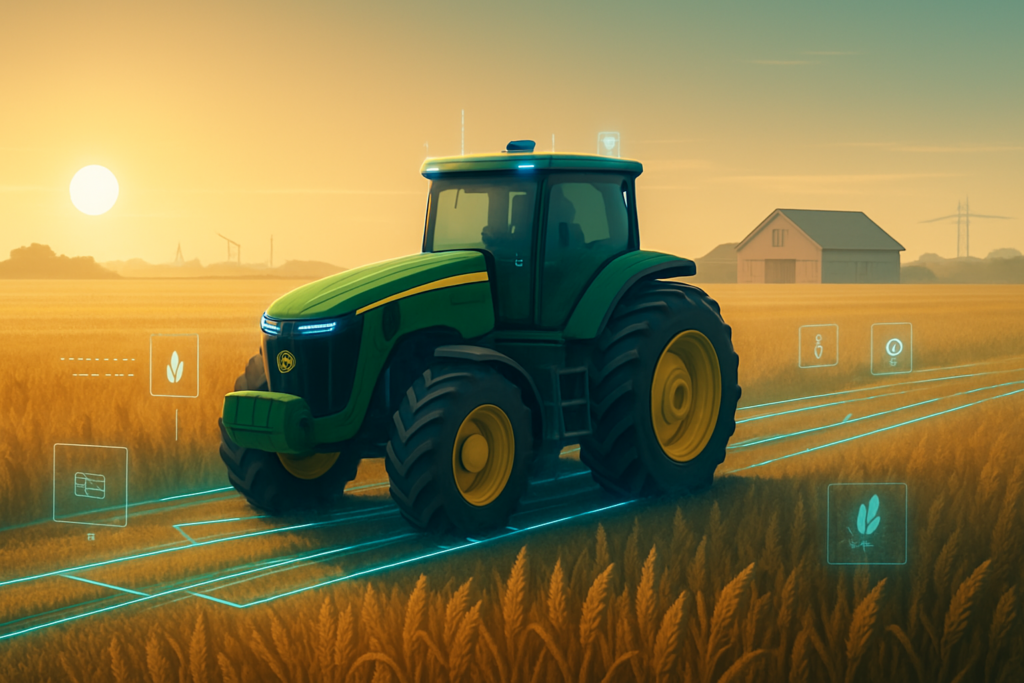
 - Autonomous 8R Tractor: A fully autonomous machine that allows farmers to monitor field operations from a smartphone, addressing chronic labor shortages in the agricultural sector.
- Operations Center: A cloud platform managing over 300 million "engaged acres" globally. This data-rich ecosystem provides farmers with predictive analytics, making the "Deere ecosystem" as sticky as Apple’s iOS.
Competitive Landscape
Deere remains the dominant force in the U.S. large-tractor market with a share exceeding 60%. However, its rivals are pursuing distinct strategies:
- CNH Industrial (NYSE: CNHI): Pursues an "Open Platform" strategy, allowing its technology (via Raven Industries) to be used on competitors' equipment—a direct contrast to Deere’s "closed" integrated model.
- AGCO Corp (NYSE: AGCO): Focuses on "Retrofit Strategy," selling precision kits that farmers can bolt onto older machines, offering a lower-cost entry point into high-tech farming.
- Komatsu: Remains a formidable challenger in Construction & Forestry, particularly in the mining sector where its autonomous haulage systems are industry-leading.
Industry and Market Trends
The agricultural equipment industry is currently at the "bottom" of a cyclical trough. High interest rates in 2024 and 2025 led to a buildup of used equipment inventory. However, analysts believe the replacement cycle is nearing its start. Furthermore, the "Precision Ag" trend is no longer optional; as input costs (seeds, fertilizer, fuel) remain volatile, farmers are forced to adopt technology like Deere’s to maintain profitability, making Deere’s tech more "needs-based" than "wants-based."
Risks and Challenges
The most significant headwind for Deere is the ongoing "Right to Repair" movement. In 2025, a federal judge allowed an FTC antitrust lawsuit to proceed, alleging Deere holds a monopoly on repair services. If forced to open its proprietary diagnostic software further, Deere could lose a portion of its high-margin parts and services revenue. Additionally, Deere’s heavy reliance on the U.S. agricultural economy makes it vulnerable to shifts in global grain trade and potential climate-related crop failures.
Opportunities and Catalysts
Looking toward the second half of 2026, the primary catalyst for Deere is the anticipated recovery of the large-ag market. Furthermore, the company’s expansion into autonomous construction equipment offers a new growth frontier. If Deere can successfully apply its "See & Spray" vision technology to construction—identifying underground utilities or optimizing earthmoving—it could challenge Caterpillar’s dominance in the "Smart Site" space.
Investor Sentiment and Analyst Coverage
Wall Street remains "cautiously optimistic" on Deere. Roughly 65% of analysts maintain a Buy rating, citing the company’s ability to maintain high margins even during downturns. Institutional ownership remains high at ~75%, with major stakes held by Vanguard, BlackRock, and Bill Gates’ Cascade Investment LLC. The prevailing sentiment is that while Caterpillar is the play for the "Infrastructure/Energy" cycle, Deere is the superior play for the "Automation/AgTech" decade.
Regulatory, Policy, and Geopolitical Factors
Geopolitics play a massive role in Deere’s fortunes. U.S. farm subsidies and trade policies regarding Chinese grain imports directly impact the purchasing power of Deere’s core customers. Furthermore, new EPA guidance issued in February 2026 clarified that manufacturers cannot use the Clean Air Act to prevent farmers from making their own repairs, adding another layer of pressure to Deere’s traditional service model.
Conclusion
Deere & Co is no longer just a tractor company; it is a technology company that happens to paint its products green. While Caterpillar currently enjoys the limelight of the infrastructure and AI-power boom, Deere is quietly building a data moat that may prove more durable over the long term. For investors, the current cyclical bottom in agriculture represents a potential entry point for a company that has successfully combined 19th-century reliability with 21st-century AI. The key watchpoints for the remainder of 2026 will be the outcome of the FTC repair trial and the pace of autonomous fleet adoption.
This content is intended for informational purposes only and is not financial advice.