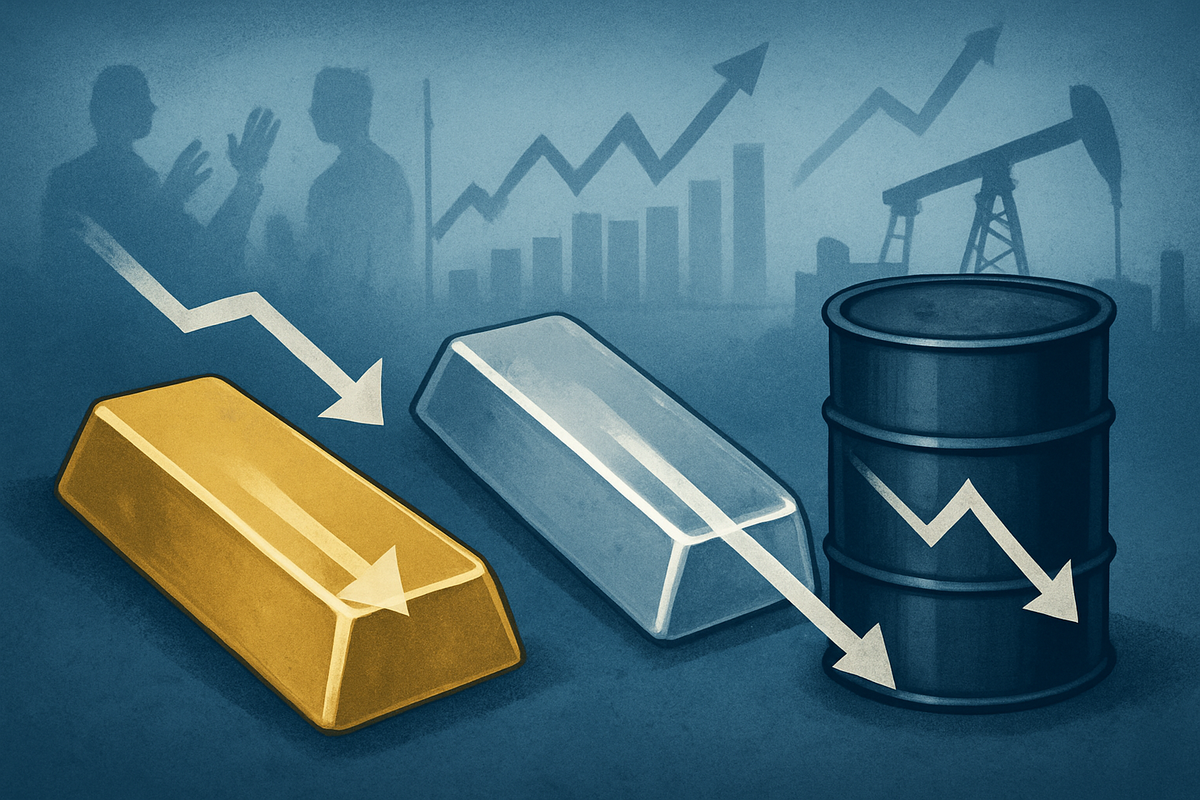
As late 2025 draws to a close, a notable shift has emerged in the global commodity markets, with gold, silver, and oil prices experiencing a significant retreat from their earlier peaks. This downturn is primarily fueled by a potent combination of widespread investor profit-taking after substantial rallies, the increasing allure of rising US Treasury yields, and persistent concerns over an entrenched oversupply in the energy sector. The immediate implication is a rebalancing of these key commodity markets, signaling a potential shift in investor sentiment and a recalibration of supply-demand dynamics that could ripple across various industries.
This correction comes after a period of robust performance for precious metals throughout much of 2025, driven by inflation fears and safe-haven demand, while oil has struggled under the weight of abundant supply. The current environment suggests a cautious outlook for commodity-dependent sectors and a potential easing of inflationary pressures for consumers, though underlying factors continue to present a complex picture for the months ahead.
Unpacking the Commodity Correction: Details, Timeline, and Market Response
The retreat in commodity prices in late 2025 has been multifaceted, with each asset class exhibiting distinct drivers and trajectories. Gold, after touching a remarkable high of $4,530.00 per ounce on October 17, has since eased, hovering around $4,190 to $4,230 per ounce by December 2, 2025. This pullback largely stems from investors cashing in on a year-to-date surge that saw the yellow metal climb by approximately 66% in some markets. Similarly, silver, which reached an all-time record of nearly $59 per troy ounce in early December following an impressive 85% year-over-year gain, also experienced profit-taking, settling into the $57.10 to $57.45 per ounce range. The rising US Treasury yields, which make non-yielding assets like precious metals less attractive, further contributed to this downward pressure.
In the energy market, the retreat has been more sustained and pronounced. Brent crude oil, which traded in the low-to-mid $70s earlier in the year, has fallen to approximately $62.92 to $63.21 per barrel by December 2, reflecting a more than 14% decline year-over-year. West Texas Intermediate (WTI) crude oil mirrored this trend, trading around $59.22 to $59.41 per barrel. The primary culprit for oil's decline is a persistent global oversupply, with the International Energy Agency (IEA) indicating a supply surplus of approximately 2.5 million barrels per day in 2025. Production gains from both OPEC+ nations and non-OPEC producers like the United States, Brazil, and Canada have outpaced modest demand growth, leading to inventories nearing four-year highs.
Key players in this market dynamic include institutional investors engaged in profit-taking, the US Federal Reserve whose monetary policy decisions influence US Treasury yields, and major oil producers (OPEC+ and non-OPEC countries) whose output decisions directly impact global supply. The initial market reaction has been a period of consolidation for precious metals and increased pressure on margins for refining and petrochemical sectors due to lower crude prices. This rebalancing act underscores a shift from earlier inflationary concerns to a more nuanced outlook incorporating supply abundance and central bank policy.
Corporate Fortunes: Winners and Losers in the Commodity Downturn
The retreat in gold, silver, and oil prices in late 2025 creates a clear delineation between companies poised to lose and those that stand to gain, significantly impacting their financial performance and strategic outlook.
Losers in the Commodity Retreat: Mining companies, particularly those focused on precious metals, will feel the direct impact of lower prices. For Newmont Corporation (NYSE: NEM), the world's largest gold producer, and Barrick Gold (NYSE: GOLD), the second-largest, a sustained dip in gold prices would directly compress revenues and profit margins. Similarly, silver-focused miners such as Pan American Silver (NASDAQ: PAAS), First Majestic Silver (NYSE: AG), and Hecla Mining Company (NYSE: HL) would see their cash flows and profitability diminish, despite silver's strong performance earlier in the year. Even precious metals streaming companies like Wheaton Precious Metals Corp. (NYSE: WPM), which offer some insulation, would experience reduced spreads.
The oil and gas sector faces significant headwinds. Exploration and production (E&P) companies like ExxonMobil (NYSE: XOM), Chevron (NYSE: CVX), ConocoPhillips (NYSE: COP), EOG Resources Inc. (NYSE: EOG), and Occidental Petroleum (NYSE: OXY) will contend with lower realized prices for their crude, impacting earnings and potentially leading to reduced capital expenditure and asset writedowns. Oilfield service providers such as Halliburton (NYSE: HAL), Schlumberger (NYSE: SLB), and Baker Hughes (NASDAQ: BKR) will also suffer from decreased drilling activity and project cancellations.
Winners in the Commodity Retreat: Conversely, industries that are significant consumers of these commodities stand to benefit from lower input costs. Airlines, for instance, see a direct boost to their profitability as jet fuel is a major operational expense. Companies like United Airlines Holdings Inc. (NASDAQ: UAL), American Airlines Group Inc. (NASDAQ: AAL), Delta Air Lines, Inc. (NYSE: DAL), and Southwest Airlines Co. (NYSE: LUV) could experience improved margins. Similarly, shipping and freight companies such as FedEx Corp (NYSE: FDX) and United Parcel Service Inc. (NYSE: UPS) will benefit from reduced fuel costs for their extensive fleets.
Consumers of precious metals, such as jewelry retailers like Signet Jewelers (NYSE: SIG) and electronics manufacturers that utilize silver, could see improved profit margins from cheaper raw materials. Furthermore, lower oil prices act as a de facto tax cut for consumers, potentially increasing disposable income and benefiting consumer discretionary sectors, including retail, travel, and hospitality. Integrated oil companies with strong downstream (refining) operations, like Phillips 66 (NYSE: PSX), might also see wider refining margins as crude input costs fall. Midstream companies such as Enbridge (NYSE: ENB) and Kinder Morgan (NYSE: KMI), with their fee-based models, are typically more insulated from price volatility, offering a degree of stability amidst the fluctuating market.
Wider Significance: Trends, Ripples, and Historical Echoes
The retreat in commodity prices in late 2025 is more than just a market fluctuation; it is a significant event with broader implications for global industry trends, economic stability, and policy decisions. This downturn aligns with a trend of slowing global demand, particularly from major economies, which reduces the need for raw materials. The persistent oversupply in the energy sector, driven by robust production from both OPEC+ and non-OPEC nations, further exacerbates this, suggesting a structural shift rather than just a cyclical dip. Furthermore, the accelerating green energy transition and improved industrial efficiency are contributing to a long-term decline in demand for fossil fuels, placing continuous downward pressure on oil prices.
The ripple effects are extensive. Commodity producers, including mining and energy companies, face reduced profitability, leading to cuts in investment for exploration and development, and potentially job losses. This challenging environment could also spur consolidation and mergers and acquisitions (M&A) as companies seek efficiency and scale. Commodity-exporting nations, heavily reliant on these revenues, will experience weakened trade balances and pressure on government budgets, potentially necessitating austerity measures. Conversely, commodity-importing nations and consumers will benefit from lower inflationary pressures and reduced production costs for goods and services, potentially boosting household consumption and improving trade balances.
Regulatory and policy implications are equally profound. Central banks, like the US Federal Reserve, may find more room to consider interest rate cuts as commodity prices ease inflationary pressures, providing greater flexibility to support economic growth. Governments in commodity-exporting countries might need to adjust fiscal policies, while importing nations could enjoy more fiscal space. Historically, similar commodity price retreats, such as the 2014-2015 oil price crash due to oversupply and weakening demand, and the 2008 financial crisis which saw dramatic oil price drops, serve as precedents. These events underscore the cyclical nature of commodity markets and the critical need for diversification, risk management, and adaptable policy frameworks to navigate such volatility.
The Road Ahead: Navigating Future Scenarios
Looking ahead, the trajectory for gold, silver, and oil prices following their late 2025 retreat presents a landscape of both opportunities and challenges, demanding strategic pivots from companies and investors alike.
For gold, the short-term (2026-2027) outlook suggests continued, albeit slower, price gains. Persistent central bank buying, particularly from emerging markets, coupled with ongoing geopolitical risks and the potential for US Federal Reserve interest rate cuts, will likely provide underlying support. Gold's role as a hedge against inflation, recession, and geopolitical uncertainty remains strong. However, a significant cooling of inflation or unexpectedly high interest rates could temper its appeal. Long-term (2028-2030), gold is largely seen as bullish, with some projections reaching as high as $8,600 to $12,000 per ounce by 2030, driven by its enduring safe-haven status and continued central bank accumulation.
Silver is expected to maintain its bullish momentum into 2026, building on its robust 2025 rally. The primary catalyst is surging industrial demand from green technologies like solar panels and electric vehicles, alongside persistent structural supply deficits. While a global economic slowdown could soften industrial demand in the short term, the long-term outlook (2028-2030) remains highly bullish, with projections of $60-$80, and even potentially $100 per ounce by 2030, fueled by the industrial "super-cycle."
Oil faces a more challenging short-term (2026-2027) future, with Brent crude prices largely forecasted to decline, potentially reaching $52-$60 per barrel. This is due to an expanding global oversupply from OPEC+ unwinding cuts, resilient US shale output, and slowing demand from China and Europe. While geopolitical tensions could cause short-term price spikes, the long-term (2028-2030) outlook suggests stabilization in the $60-$73 range, with the International Energy Agency projecting global fossil fuel demand to peak by 2030, potentially pushing prices lower in more bearish scenarios ($40-$50).
Companies and investors must adapt by prioritizing diversification across asset classes, implementing robust hedging strategies, and integrating macroeconomic analysis into their decision-making. Gold will remain a key inflation and risk hedge, while silver's industrial demand makes it a growth play. For oil, acknowledging the energy transition and managing geopolitical risks will be paramount.
Wrap-Up: Key Takeaways and Future Watchpoints
The recent retreat in gold, silver, and oil prices in late 2025 marks a significant rebalancing in global commodity markets, driven by investor profit-taking, rising US yields, and persistent energy oversupply. While gold and silver experienced strong rallies throughout 2025 before recent corrections, oil has faced a more sustained downturn. This divergence underscores the distinct dynamics at play for each commodity, with precious metals still benefiting from safe-haven demand and industrial applications, while oil grapples with fundamental oversupply issues and the long-term implications of the green energy transition.
Moving forward, the market will remain sensitive to several critical factors. Investors should closely monitor the actions of the US Federal Reserve regarding interest rates, as future cuts could provide renewed support for non-yielding assets like gold and silver. Global economic data, particularly from major economies like China and Europe, will be crucial in assessing demand for industrial commodities and oil. Additionally, decisions from OPEC+ regarding production levels will continue to heavily influence crude oil prices. Geopolitical developments, particularly those impacting energy supply routes or global stability, will also remain a key wildcard.
The lasting impact of this period will likely be a reinforced emphasis on diversified portfolios, strategic hedging, and an acute awareness of the interplay between monetary policy, economic growth, and commodity supply-demand fundamentals. As we move into 2026 and beyond, the ability of companies to adapt to evolving cost structures and for investors to navigate increased volatility will define success in these pivotal markets.
This content is intended for informational purposes only and is not financial advice