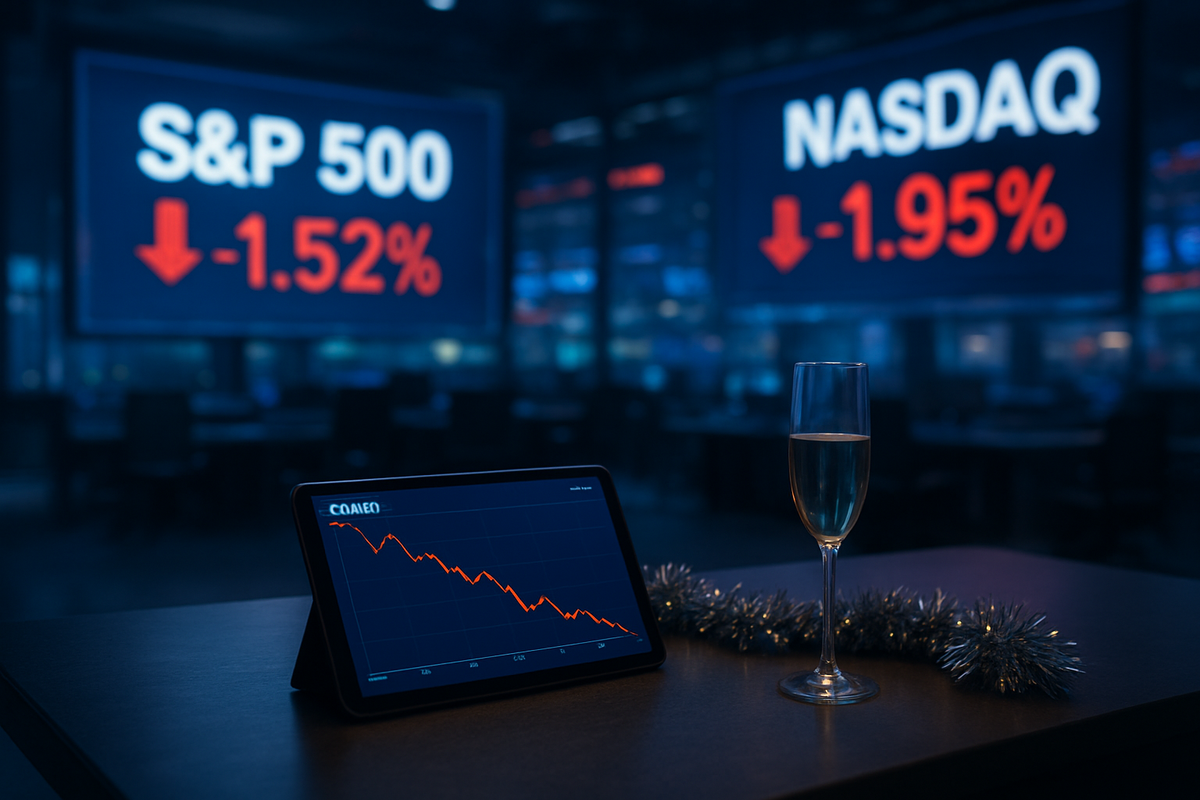
The euphoric "Santa Claus rally" that defined much of December 2025 has hit a wall of exhaustion as the trading year draws to a close. For three consecutive sessions, the S&P 500 and the Nasdaq Composite have drifted lower, retreating from record highs as a "holiday hangover" takes hold of the New York Stock Exchange. On Tuesday, December 30, 2025, the indices extended their slide, driven by light trading volumes and a collective sigh from investors who appear ready to lock in substantial year-to-date gains rather than push for a final-hour surge.
This late-December pullback, while statistically modest, signals a shift in market sentiment from aggressive "fear of missing out" (FOMO) to a more disciplined strategic rebalancing. With institutional desks largely unmanned and retail activity dominating the tape, the thin liquidity has amplified minor sell-offs, leaving the broader market in a state of suspended animation as it prepares for the transition into 2026.
The Anatomy of a Holiday Hangover
The current three-day losing streak began on Friday, December 26, shortly after the S&P 500 (INDEXSP: .INX) reached a historic peak of 6,932.05. The momentum stalled as the market reopened from the Christmas holiday, with the index slipping through Monday and Tuesday to settle near the 6,900 mark. The Nasdaq Composite (INDEXNASDAQ: .IXIC) followed a similar trajectory, closing Tuesday near 23,438. While these declines represent a pullback of less than 1% from the highs, the optics of a three-day slide have dampened the celebratory mood on Wall Street.
The primary culprit behind the erratic price action is the lack of liquidity. Trading volumes on major U.S. exchanges have plummeted to approximately 7 to 10 billion shares daily—nearly 40% below the 20-day average. In such a "thin" market, even small sell orders from automated programs or retail traders can cause outsized movements in price. Without the stabilizing presence of institutional "big money" to provide a floor, the indices have been susceptible to gravity after a year that saw the S&P 500 climb nearly 19%.
The timeline of the slide reflects a classic year-end phenomenon: profit-taking. After a banner year for artificial intelligence and a late-year pivot by the Federal Reserve, many fund managers have already met their performance targets. The final days of 2025 are being used to "window dress" portfolios, selling off winners to realize gains before the tax year resets. This technical exhaustion was inevitable given the high valuations, with the S&P 500’s forward price-to-earnings (P/E) ratio sitting at 21.8, well above its historical average.
Winners and Losers in the Year-End Shuffle
The tech titans that fueled the 2025 bull market are bearing the brunt of the current pullback. Nvidia (NASDAQ: NVDA), which briefly touched a staggering $5 trillion market capitalization earlier this month, saw its shares dip 0.6% on Tuesday. While the company remains the undisputed champion of the year with a 42% YTD gain, it has become a primary target for investors looking to harvest profits. Similarly, Microsoft (NASDAQ: MSFT) has seen its shares mirror the broader market’s cooling, as the initial frenzy over Azure’s AI integration transitions into a "show me the money" phase for 2026 earnings.
On the other side of the ledger, Apple (NASDAQ: AAPL) has had a more complicated year. Lagging the S&P 500 for much of 2025 due to a perceived delay in its generative AI ecosystem, the stock has found a minor bid during this three-day slide as a "defensive" tech play. Investors are rotating into companies with massive cash piles and stable dividends as a hedge against potential early-year volatility.
Defensive sectors, including Utilities and Consumer Staples, have also shown relative strength during this "hangover" period. Companies like Procter & Gamble (NYSE: PG) and NextEra Energy (NYSE: NEE) have remained largely flat or slightly positive, serving as a sanctuary for capital that is exiting the high-flying semiconductor and software sectors. This rotation suggests that while investors aren't fleeing the market entirely, they are certainly de-risking their portfolios for the new year.
Macroeconomic Significance and the Fed’s Shadow
The market’s year-end stumble cannot be viewed in isolation from the Federal Reserve’s recent maneuvers. The Fed concluded 2025 with its third consecutive 25-basis-point rate cut in December, bringing the federal funds rate down to a range of 3.50%–3.75%. While this easing cycle was the catalyst for the "Santa Claus rally," it has also raised questions about the "sticky" nature of inflation. Core PCE inflation ended the year at 2.8%, higher than the Fed’s 2% target, leading some to wonder if the 2025 rally was perhaps too aggressive in pricing in a "soft landing."
Historically, a year-end pullback after a massive rally is not uncommon. Comparisons are being drawn to the end of 2023 and 2019, where markets took a breather before resuming their upward climb in the first quarter of the following year. However, 2026 carries a unique risk: the expiration of Federal Reserve Chair Jerome Powell’s term in May. The looming leadership change at the central bank is introducing a layer of policy uncertainty that may be contributing to the current cautiousness.
Furthermore, the "tariff tremors" felt earlier in 2025 have left a lasting mark on market psychology. While the immediate impact of those trade policies has stabilized, the long-term effects on global supply chains remain a wildcard for 2026. The current three-day slide is, in many ways, a reflection of a market that has priced in almost all the "good news" and is now waiting for a new catalyst to justify further gains.
Looking Ahead: The 2026 Outlook
As we move into the first week of January, the "January Effect"—where stocks typically rise as new capital enters the market—will be the first major test for the 2026 bull case. Analysts are split on whether the current slide is a temporary blip or the start of a more significant correction. Many expect the market to find support near the 50-day moving average, provided that the upcoming January jobs report and inflation data show continued economic stability.
The strategic pivot for 2026 will likely focus on "quality over growth." With interest rates expected to settle at a terminal rate of 3.25% by mid-year, the era of "easy money" is not returning to its post-pandemic lows. Companies will need to demonstrate actual margin expansion from their AI investments rather than just promising future capabilities. This will likely lead to a widening gap between the leaders and laggards in the tech space.
Potential challenges include the aforementioned Fed leadership transition and the possibility of a "growth scare" if high interest rates finally begin to weigh on consumer spending. Conversely, the opportunity lies in sectors that have been ignored during the AI boom, such as small-cap stocks and mid-market industrials, which could benefit from a broader economic recovery and lower borrowing costs.
Summary and Investor Takeaways
The three-day slide of the S&P 500 and Nasdaq at the end of 2025 is a reminder that even the strongest bull markets require periods of digestion. The "holiday hangover" is a product of thin volume, technical exhaustion, and a natural desire to protect a year of extraordinary gains. While the indices are ending the year on a soft note, the fundamental backdrop remains relatively supportive, anchored by a Fed that is actively easing and an economy that has shown remarkable resilience.
Moving forward, investors should keep a close eye on the 6,800 level for the S&P 500 as a key technical floor. The first quarter of 2026 will likely be defined by the transition in Fed leadership and the initial earnings reports of the new year, which will provide the first real look at how AI expenditures are translating into the bottom line.
In the coming months, the narrative will likely shift from "how high can we go?" to "how sustainable is this growth?" For now, the market is content to drift into the new year, nursing its hangover and waiting for the next chapter of the economic cycle to unfold.
This content is intended for informational purposes only and is not financial advice.