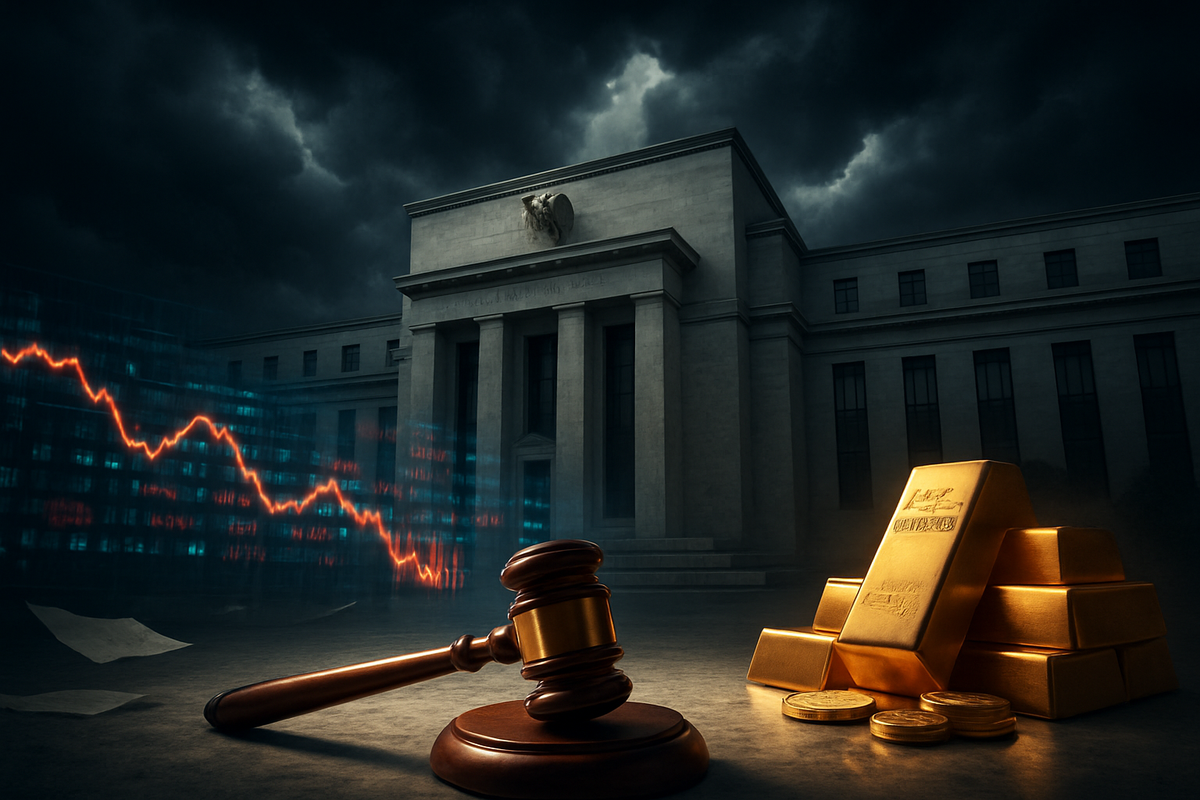
The financial world was rocked this week as the Department of Justice (DOJ) launched an unprecedented criminal investigation into Federal Reserve Chair Jerome Powell. The probe, which centers on allegations of misleading Congress regarding multi-billion dollar renovations at the Fed's Washington headquarters, has sent shockwaves through global markets and sparked a fierce debate over the sanctity of central bank independence. As of January 19, 2026, the investigation is being characterized by legal experts and economists as the most direct challenge to the Federal Reserve’s autonomy in its 113-year history.
The immediate implications have been nothing short of chaotic. On the news of grand jury subpoenas being served to the Federal Reserve on January 9, 2026, and Powell’s subsequent video address on January 11, the "Sell America" trade accelerated. Investors, fearing that the U.S. central bank is being subjected to political retaliation for its interest rate policies, fled toward hard assets. Gold prices shattered records, surging past $4,640 per ounce, while the U.S. dollar dipped as international investors applied what analysts are calling a "politicization discount" to American assets.
The Renovation Probe: Pretext or Prosecution?
The formal investigation, led by Attorney General Pam Bondi and U.S. Attorney for D.C. Jeanine Pirro, stems from Powell’s testimony before the Senate Banking Committee in June 2025. At the heart of the matter is a $2.5 billion renovation of the Eccles Building. Office of Management and Budget (OMB) Director Russell Vought has alleged that the project’s budget ballooned from an initial $1.9 billion due to "lavish" and "ostentatious" additions, including rooftop gardens and VIP dining facilities. The DOJ is investigating whether Powell knowingly made false statements to Congress regarding the necessity and cost of these features, which he defended as essential for modernizing the aging, asbestos-filled structure.
The timeline leading to this confrontation reveals a year of escalating tensions. Following a tour of the renovation site in July 2025, the administration publicly criticized the Fed’s spending, presenting a list of what it termed "fraudulent" expenses. By November 2025, a formal inquiry was approved, culminating in the recent wave of subpoenas. Powell has remained defiant, stating in his January 11 address that the investigation is a "pretext" for the Fed's refusal to succumb to administration demands for aggressive interest rate cuts in 2025. Throughout last year, the Fed maintained a range of 3.5%–3.75%, resisting calls to drop rates to 1% or lower amid persistent inflation concerns.
Initial market reactions reflected deep institutional anxiety. Dow Jones futures plummeted 200 points within hours of the announcement, and the S&P 500 and Nasdaq both saw sharp declines. The move has unified a coalition of former Fed leaders, including Janet Yellen and Ben Bernanke, who issued a rare joint statement warning that "monetary policy is being made a prosecutorial battlefield."
Market Winners and Losers in the Wake of Volatility
The "flight to safety" has created clear winners in the commodities and mining sectors. Newmont Corporation (NYSE: NEM) saw its shares hit record levels of $112.89, as investors treated gold miners as a proxy for the anti-fiat sentiment. Similarly, Barrick Gold Corp (NYSE: GOLD) reached a 52-week high of $49.74, and Agnico Eagle Mines Ltd (NYSE: AEM) outperformed the broader market as a low-cost, safe-haven alternative. The massive surge in silver, which briefly cleared $90 per ounce, has benefited silver producers and ETFs tracking the metal.
Conversely, the traditional banking sector has borne the brunt of the uncertainty. Shares of JPMorgan Chase & Co. (NYSE: JPM), Bank of America Corp (NYSE: BAC), and Citigroup Inc. (NYSE: C) all fell between 2.5% and 4.0% in the days following the subpoena news. Banking executives, including JPMorgan CEO Jamie Dimon, have warned that any erosion of Fed independence will inevitably lead to higher long-term inflation expectations and a permanent increase in interest rates to compensate for political risk.
Interestingly, the technology sector has shown remarkable resilience. Alphabet Inc. (NASDAQ: GOOGL) reached a historic $4 trillion market capitalization in mid-January, and NVIDIA Corp (NASDAQ: NVDA) continued its upward trajectory driven by AI infrastructure spending. While the broader market wavered, these "Magnificent Seven" stocks have acted as a secondary haven for capital, suggesting that investors are decoupling corporate earnings potential from the domestic political drama surrounding the central bank.
A Broader Trend of Institutional Erosion
This conflict represents a significant escalation in a broader trend toward the politicization of economic institutions. Historically, the Federal Reserve has operated at arm's length from the executive branch to ensure that monetary policy decisions are made based on data rather than electoral cycles. The current investigation, however, echoes historical pressures seen during the Nixon administration but takes the unprecedented step of moving into the criminal sphere. Critics argue that the U.S. is beginning to mirror "emerging market" dynamics, where central bank leadership is frequently replaced or investigated following policy disagreements with the ruling party.
The ripple effects are being felt globally. Ten central bank governors, including Christine Lagarde of the European Central Bank and Andrew Bailey of the Bank of England, have issued a statement of solidarity with Powell. This international backlash suggests that the "exorbitant privilege" of the U.S. dollar may be under threat if the Fed loses its reputation for neutrality. Furthermore, the administration’s reported move to establish a "Shadow Fed"—interviewing potential loyalists like Kevin Hassett to replace Powell—suggests a permanent shift in how monetary policy may be conducted moving forward.
Regulatory implications are also looming. A bipartisan group in the Senate, led by Thom Tillis, has threatened to block all future Fed appointments until the "legal harassment" of the Chair is resolved. This could leave the Fed Board of Governors understaffed at a critical juncture in the economic cycle, potentially paralyzing the FOMC just as it navigates a cooling but still inflationary economy.
The Path Forward: A Mid-2026 Standoff
In the short term, markets will likely remain in a state of "headline volatility," reacting to every leak from the DOJ and every counter-move from the Fed's legal team. Powell has indicated he intends to serve until his term as Chair expires on May 15, 2026, and may even choose to remain on the Board of Governors until 2028 to protect the institution’s autonomy. This sets the stage for a dramatic constitutional showdown in the spring, where the administration may attempt a "for cause" removal that would likely wind up in the Supreme Court.
Strategic pivots are already occurring within institutional portfolios. Wealth managers are increasingly recommending an "overweight" position in precious metals and international equities to hedge against a potential "dollar crisis" if the Fed’s credibility is irrevocably damaged. If the investigation leads to a forced resignation, market participants expect a massive yield spike in the 10-year Treasury as investors demand a higher premium for U.S. sovereign debt.
Conclusion and Investor Takeaways
The DOJ’s criminal investigation into Jerome Powell is far more than a dispute over building costs; it is a fundamental test of the U.S. financial system's structural integrity. The key takeaway for investors is that the "Fed Put"—the idea that the central bank can always step in to stabilize markets—is now complicated by a "Political Discount." The independence that once anchored the U.S. dollar and Treasury markets is currently under fire.
Moving forward, the market will be watching the Senate’s reaction and the progress of the grand jury proceedings with eagle eyes. Investors should remain vigilant, watching for signals of a "Shadow Fed" policy being articulated by the Treasury Department. In the coming months, the most critical indicators of market health will not just be the Consumer Price Index (CPI) or employment reports, but rather the legal filings and political maneuvers surrounding the 20th floor of the Eccles Building.
This content is intended for informational purposes only and is not financial advice.