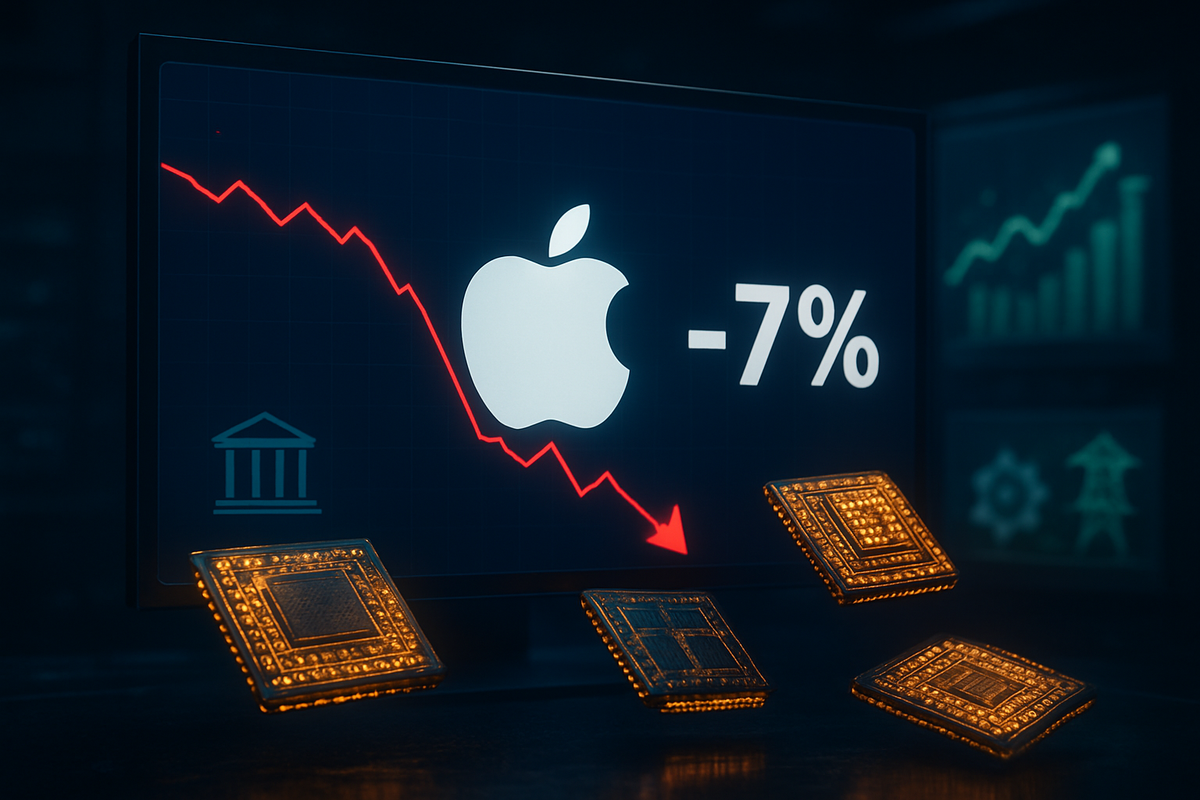
The start of 2026 has brought a cold front to Silicon Valley as Apple Inc. (NASDAQ: AAPL) shares retreated 7% from their December all-time highs. This downturn, which has wiped out over $200 billion in market capitalization in just over a month, marks a significant shift in investor sentiment. The decline is being driven by a dual-threat environment: a massive spike in memory component costs that threatens hardware margins and a broad institutional "rotation" out of mega-cap technology stocks in favor of cyclical and value-oriented sectors.
As of January 8, 2026, the tech giant’s stock is trading in the $260–$267 range, a sharp departure from the record $288.62 reached in early December 2025. While the "iPhone 17 supercycle" initially propelled the stock to new heights, the reality of a tightening supply chain and a changing macroeconomic landscape has forced a re-evaluation of the company's near-term growth trajectory.
The Perfect Storm: Component Spikes and Market Exhaustion
The primary catalyst for the recent slide is a "cost storm" brewing in the semiconductor industry. As artificial intelligence (AI) data centers continue to expand at a breakneck pace, memory manufacturers have shifted their production capacity toward High Bandwidth Memory (HBM) and server-grade DRAM. This pivot has left consumer electronics manufacturers scrambling for supply. Industry reports indicate that DRAM contract prices are projected to surge between 40% and 70% in the first quarter of 2026 alone, while NAND flash prices are expected to climb by as much as 38%.
For Apple, these figures are particularly concerning. Analysts estimate that memory components now account for roughly 10.4% of the total Bill of Materials (BOM) for the iPhone 17 Pro Max. This inflationary pressure is expected to result in a nearly 5% hit to Apple’s hardware gross margins if the company does not pass these costs on to consumers. The timeline of this retreat began in late December 2025, when institutional desks began reporting "valuation exhaustion." With Apple’s forward price-to-earnings (P/E) ratio stretching past 33x, the surge in component costs provided the necessary spark for a significant sell-off.
The retreat was further solidified during the first trading week of January 2026, when Apple briefly ceded its position as the world’s second-most valuable company to Alphabet Inc. (NASDAQ: GOOGL). This symbolic shift underscored a broader skepticism toward high-valuation tech names that had dominated the market throughout 2025. Key stakeholders, including major hedge funds and pension funds, have reportedly been trimming their "Magnificent Seven" exposure to lock in gains from the previous year.
Winners and Losers in the New Capital Regime
The current market volatility has created a stark divide between those who control the supply chain and those who rely on it. The clear winners in this environment are the memory chipmakers. Micron Technology, Inc. (NASDAQ: MU) has seen its stock rise 17% year-to-date as of early January, with profits projected to quintuple as it commands record-high prices for its chips. Similarly, global giants like Samsung Electronics (KRX:005930) and SK Hynix are benefiting from the supply-demand imbalance, prioritizing high-margin AI server components over the lower-margin needs of smartphone vendors.
On the losing side, Apple finds itself accompanied by other hardware-heavy competitors. Chinese manufacturers such as Xiaomi and Oppo are facing even tighter margin pressure, with some reportedly downgrading device specifications—such as camera sensors and audio components—to offset the rising cost of memory. Meanwhile, the "Great Rotation" has seen capital flee the tech-heavy Nasdaq-100 (NASDAQ: QQQ) in favor of traditional sectors. Financial giants like JPMorgan Chase & Co. (NYSE: JPM) and The Goldman Sachs Group, Inc. (NYSE: GS) have emerged as beneficiaries of this shift, as clarity on interest rates has improved the outlook for bank earnings.
The energy and industrial sectors are also seeing a resurgence. Utilities like NextEra Energy, Inc. (NYSE: NEE) and Exelon Corporation (NASDAQ: EXC) are attracting investors who are betting on the massive power demands required to fuel the AI revolution. Even the healthcare sector has seen a change in leadership, with Eli Lilly and Company (NYSE: LLY) becoming the first healthcare firm to surpass a $1 trillion market cap in early 2026, further illustrating the market's appetite for non-tech growth stories.
A Structural Shift in the AI Economy
This event is more than just a temporary dip; it represents a fundamental shift in how the market views the AI economy. In 2024 and 2025, the focus was largely on "AI hype"—the potential for software and services to transform industries. In 2026, the narrative has shifted toward "AI efficiency" and the physical constraints of the technology. The shortage of DRAM and NAND flash memory caused by AI server demand is a ripple effect that few predicted would hit consumer electronics this hard, this fast.
Historically, Apple has been able to use its massive scale to negotiate favorable long-term contracts with suppliers like Taiwan Semiconductor Manufacturing Company (NYSE: TSM). However, the memory market is notoriously cyclical and fragmented. While Apple has managed to lock in some NAND supply through partners like Kioxia, the DRAM market remains volatile. This mirrors the supply chain disruptions of 2021, but with a new twist: the competition for silicon is no longer just between phone makers, but between consumer devices and the infrastructure of the global AI cloud.
Regulatory and policy implications are also beginning to surface. As component costs rise, there is growing concern that the "digital divide" could widen if premium smartphones become significantly more expensive. Furthermore, the rotation into utilities and industrials reflects a broader national trend toward infrastructure modernization, supported by government incentives for domestic manufacturing and green energy. This shift suggests that the era of "easy growth" for big tech may be giving way to a more complex period of high input costs and intense competition for resources.
Navigating the Path to the iPhone 18
Looking ahead, Apple faces several strategic pivots. The most immediate challenge is the upcoming January 29, 2026, earnings call. Investors will be listening closely for guidance on how the company plans to navigate the remainder of the fiscal year. Apple may be forced to choose between two difficult paths: absorbing the higher component costs and allowing its world-class margins to compress, or raising the retail price of the upcoming iPhone 18 lineup, which could risk dampening demand in an already mature smartphone market.
In the short term, Apple may lean more heavily into its Services segment to buoy its bottom line. High-margin revenue from the App Store, iCloud, and Apple Intelligence subscriptions could provide a necessary cushion against hardware headwinds. Long-term, this period of volatility may accelerate Apple's efforts to bring more of its component design in-house, potentially exploring proprietary memory architectures or deeper vertical integration to avoid the boom-and-bust cycles of the commodity memory market.
Conclusion: A New Reality for Investors
The 7% retreat in Apple shares is a sobering reminder that even the world’s most successful companies are not immune to the laws of supply and demand. The combination of surging memory costs and a broad sector rotation suggests that the market is entering a new phase of the post-AI-surge cycle—one where fundamental costs and valuation discipline matter as much as innovation and branding.
Investors should watch the January 29 earnings report as a bellwether for the entire hardware sector. If Apple can demonstrate a clear path to maintaining margins through service growth or supply chain ingenuity, the stock may find a floor. However, if the "Great Rotation" continues to gain momentum, the leadership of the market may continue to shift toward the banks, utilities, and industrial giants that are powering the next phase of the global economy. For now, the message from the market is clear: the tech-heavy trade of the last decade is facing its sternest test yet.
This content is intended for informational purposes only and is not financial advice.