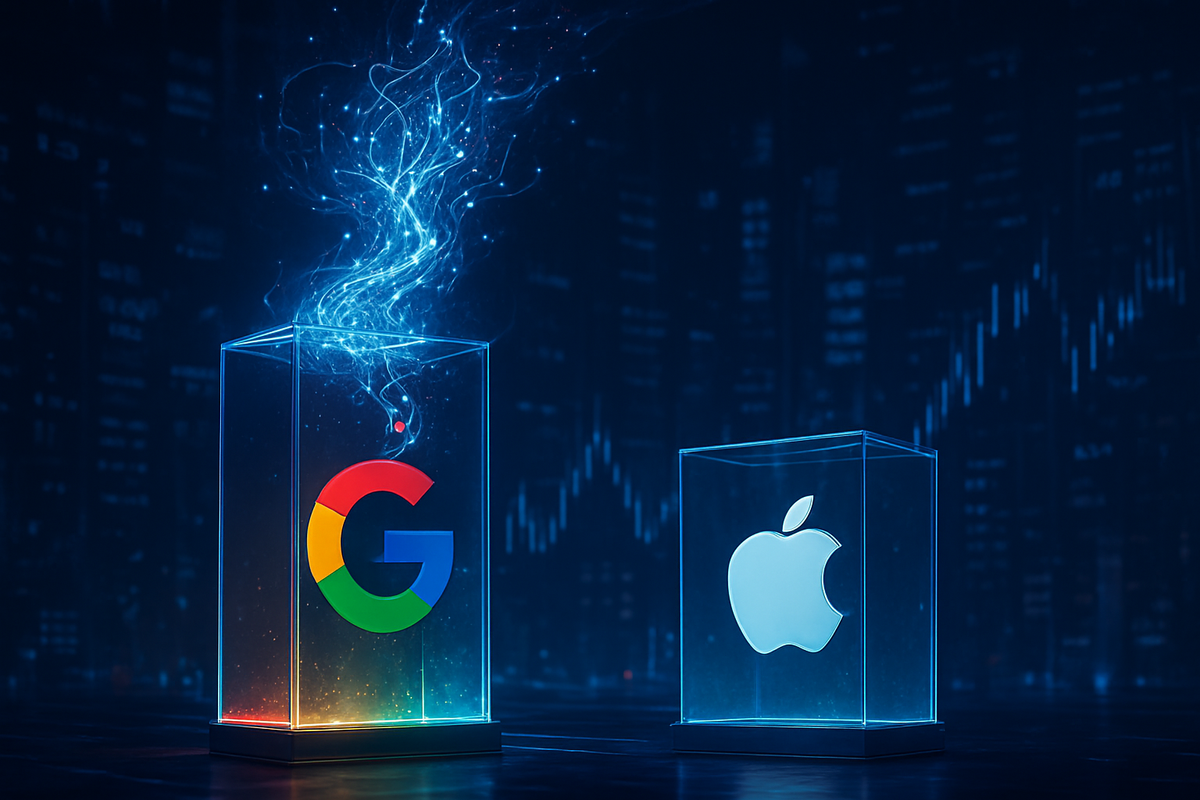
In a watershed moment for the technology sector, Alphabet Inc. (NASDAQ: GOOGL) briefly surpassed Apple Inc. (NASDAQ: AAPL) in market capitalization on January 7, 2026. The shift, while narrow, represents a symbolic and financial realignment of the "Magnificent Seven" hierarchy, signaling that the market's appetite has moved decisively from hardware dominance toward proven artificial intelligence monetization. As of the market close on Wednesday, Alphabet’s valuation stood at approximately $3.89 trillion, edging past Apple’s $3.85 trillion, making the Google parent the second-most valuable company in the world behind only the semiconductor titan NVIDIA (NASDAQ: NVDA).
This transition marks the first time Alphabet has held a higher valuation than Apple since early 2019. The reversal of fortunes highlights a growing divergence in how investors view the two tech giants: Alphabet is increasingly seen as a high-growth AI powerhouse with diversified revenue streams across search and cloud, while Apple is grappling with a "hardware plateau" and a slower-than-expected rollout of its generative AI suite, Apple Intelligence.
The Day the Search Giant Topped the iPhone Maker
The historic flip occurred during mid-week trading following a series of bullish analyst reports regarding Alphabet’s Gemini 3 integration. Alphabet’s stock rose 2.4% to close at $321.98, while Apple shares slipped 0.8% to $260.33. The catalyst for the surge was a leaked internal memo from Alphabet’s cloud division suggesting that AI-related contracts had reached a record run rate of $15.2 billion per quarter. This data, combined with the successful deployment of the 7th-generation TPU "Ironwood"—Alphabet’s custom AI chip—convinced investors that the company had successfully insulated itself from the high costs of third-party hardware.
The timeline leading to this moment began in late 2024, when Alphabet pivoted its entire product roadmap toward its Gemini models. Throughout 2025, while competitors struggled with "AI fatigue," Alphabet demonstrated that its AI Overviews and new "AI Mode" in search actually increased ad click-through rates rather than cannibalizing them. In contrast, Apple’s 2025 was defined by the "Autumn Chill," a period of stagnation where the iPhone 17 saw flat year-over-year unit growth and the highly anticipated "Siri 2.0" was pushed back into 2026. By the time the markets opened in the first week of January 2026, the momentum was clearly on the side of Mountain View.
Winners and Losers in the New AI Hierarchy
The primary winner in this valuation shift is undoubtedly Alphabet, which has managed to shed its image as a legacy search company to become a "full-stack" AI leader. By controlling everything from the silicon (TPU Ironwood) to the model (Gemini) and the distribution (Search and Android), Alphabet has achieved margins that are now rivaling Apple’s legendary hardware spreads. Another major winner is NVIDIA (NASDAQ: NVDA), which remains the undisputed king of the market at a $4.6 trillion valuation; Alphabet’s success validates the massive infrastructure spending that fuels Nvidia’s data center business.
On the losing end, Apple finds itself in an uncharacteristic defensive crouch. The company’s reliance on hardware cycles is being tested as consumers hold onto their iPhones longer, waiting for a "killer app" for AI that has yet to arrive in a polished form. Microsoft (NASDAQ: MSFT) has also felt the pressure, slipping to the fourth spot in market cap as investors worry that its heavy reliance on OpenAI’s models may limit its long-term margin potential compared to Alphabet’s in-house vertical integration. For the public, the "winner" is the consumer who is seeing a rapid acceleration in high-utility AI tools, though this comes at the cost of increased data harvesting and a more concentrated power structure within Big Tech.
A Fundamental Shift in Market Sentiment
This event is more than just a fluctuation in stock prices; it represents a fundamental shift in how the market values technology companies. For over a decade, Apple’s "walled garden" and hardware-services flywheel were the gold standard. However, the 2026 market is prioritizing "AI Utility" and "Compute Efficiency." Analysts from firms like Jefferies have noted that the market is re-rating Alphabet as a platform play rather than a media play, recognizing that AI-driven search is more resilient and scalable than physical device sales in a saturated global market.
The shift also mirrors historical precedents, such as when Microsoft overtook General Electric in the late 1990s, signaling the move from the industrial age to the software age. Today, we are witnessing the move from the mobile age to the agentic AI age. Regulatory pressures have also played a role in this rebalancing; while Alphabet has faced its share of antitrust scrutiny, Apple is currently staring down a $7 billion consumer class action trial and intensifying pressure from the European Union over its App Store policies, creating a "regulatory discount" on its stock that Alphabet has managed to partially navigate through its more open Android ecosystem.
The Road Ahead: Can Apple Reclaim the Crown?
Looking forward, the battle for the top spot is far from over. Apple is expected to launch a full version of "Siri 2.0" in the second quarter of 2026, a move that could trigger a massive upgrade cycle if the AI features are perceived as indispensable. Furthermore, Apple’s rumored $9.99/month "Apple Intelligence Pro" subscription could provide the high-margin recurring revenue stream that investors are currently missing. If Apple can prove that it can monetize AI through services rather than just selling more glass and aluminum, a rebound is highly likely.
Alphabet, meanwhile, must maintain its current pace of innovation without drawing further ire from antitrust regulators. The challenge for CEO Sundar Pichai will be to ensure that Gemini 3 remains the preferred choice for both developers and consumers as Microsoft and Amazon (NASDAQ: AMZN) ramp up their own competing models. The "AI monetization race" is entering its second phase—moving from infrastructure building to consumer adoption—and any slip-up in model accuracy or user privacy could quickly reverse Alphabet's gains.
Final Reflections for the 2026 Investor
The brief crowning of Alphabet as the more valuable entity than Apple serves as a definitive signal that the AI revolution has reached financial maturity. The key takeaway for investors is that the "hardware premium" is evaporating in favor of "intelligence-as-a-service." While Apple remains a cash-flow behemoth, its lack of a dominant, proprietary AI model that users interact with daily has created a vacuum that Alphabet was all too happy to fill.
As we move through 2026, the market will be watching two things: the adoption rates of Apple’s premium AI subscriptions and Alphabet’s ability to defend its search margins against a new generation of AI-native competitors. For now, the "Magnificent Seven" has a new order, and the message is clear: in the modern economy, the company that best organizes and monetizes the world’s information through AI will hold the keys to the kingdom.
This content is intended for informational purposes only and is not financial advice.