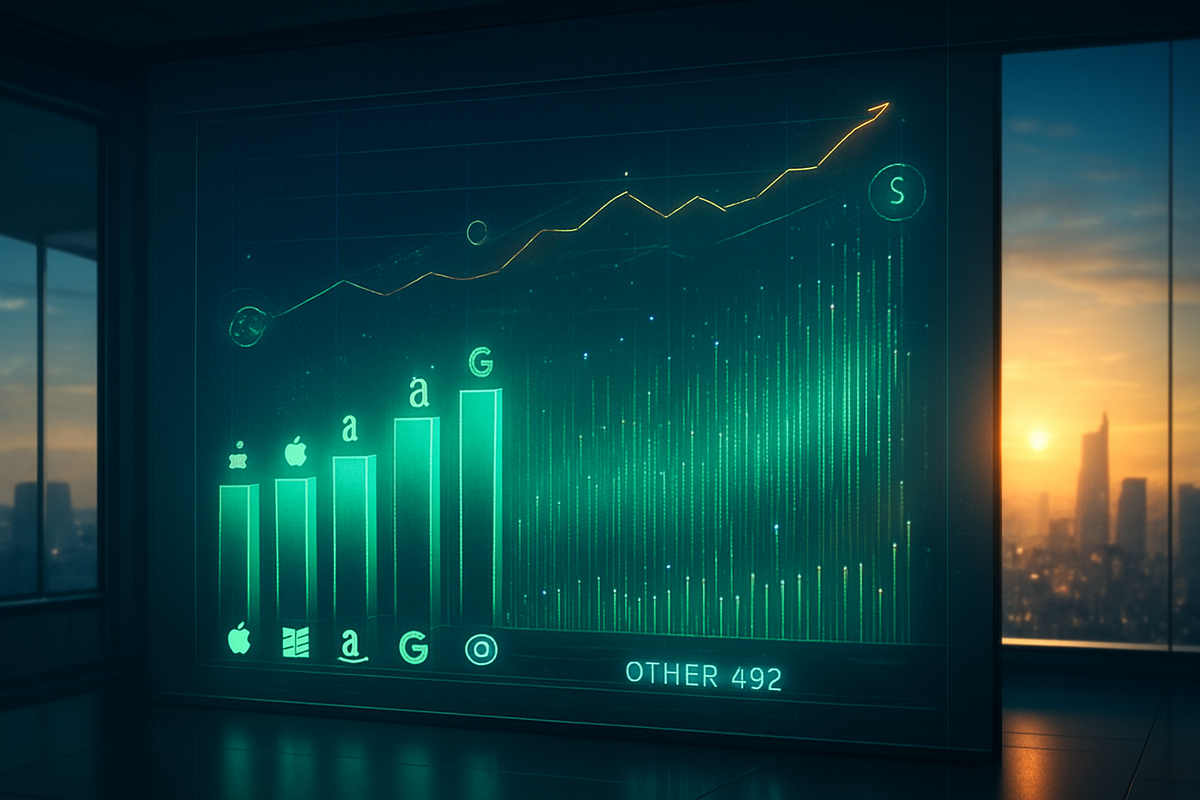
As of February 23, 2026, the long-awaited "Great Convergence" of the American stock market has officially arrived. For the better part of the last three years, investor focus was almost exclusively tethered to a handful of mega-cap technology titans. However, fresh Q1 2026 data and forward-looking analyst revisions suggest that the "Other 492" stocks in the S&P 500 are finally stepping out of the shadows. This shift marks a transition from a narrow, tech-heavy rally to a "Diffusion Phase," where earnings growth is broadening across industrials, financials, and healthcare, creating what many analysts call the most resilient bull market in a generation.
Wall Street’s leading institutions, including Goldman Sachs and Morgan Stanley, have revised their 2026 outlooks to reflect this new reality. The defining metric of this shift is the narrowing earnings gap: while the "Magnificent 7" led the market with a staggering 30-percentage-point earnings-per-share (EPS) growth advantage over the rest of the index in early 2024, that gap is projected to shrink to just 4 percentage points by the end of 2026. This democratization of profit growth is signaling a new era of market stability, moving away from the "all-or-nothing" volatility often associated with high-concentration portfolios.
The Great Convergence: A Shift in Market Leadership
The road to this diversified bull market was paved by a series of economic shifts throughout 2024 and 2025. Following the aggressive rate-hiking cycle of the early 2020s, the Federal Reserve’s pivot toward a more neutral stance throughout 2025 provided the necessary oxygen for capital-intensive industries to breathe again. By early 2026, borrowing costs have stabilized at levels that allow mid-to-large-cap firms to resume expansion and mergers-and-acquisitions (M&A) activity. This environment has fundamentally altered the performance profile of the S&P 500, which has traditionally relied on names like Nvidia (NASDAQ: NVDA) and Microsoft (NASDAQ: MSFT) to carry the index.
Key players in this transition include institutional heavyweights like JP Morgan Chase & Co. (NYSE: JPM), which has championed the "Blue-Chip Resurgence." The timeline of this event traces back to the 2025 passage of the "One Big Beautiful Bill Act" (OBBBA), a landmark legislative package that permanently extended corporate tax incentives and allowed for immediate R&D expensing. While the tech giants benefited, the real winners were the "Other 492" firms that operate with higher capital expenditures and narrower margins. These companies are now seeing a "bottom-line tailwind" that has pushed their collective EPS growth projections into the low double digits—roughly 13% to 14.5%—doubling their growth pace from just two years ago.
Identifying the Winners: From Rust Belt to Biotech
As the profit growth broadens, specific sectors within the "Other 492" are emerging as the new engines of the S&P 500. Industrials have taken center stage, with Caterpillar (NYSE: CAT) serving as a prime example. As AI infrastructure moves from the "training" phase to the "physical" phase, the demand for power generation and heavy construction equipment has skyrocketed. Analysts now view industrial giants not as cyclical relics, but as the "physical backbone of AI," with the sector expected to lead the index with 15% EPS growth in 2026.
Similarly, the materials sector is reaping the rewards of global electrification. Freeport-McMoRan (NYSE: FCX) has seen its valuation swell as copper and rare earth minerals become the critical currency of the mid-2020s economy. In the financial sector, a steeper yield curve and a revived M&A market have turned the "Other 492" banks into growth stories once again. Meanwhile, the healthcare sector, particularly large-cap pharmaceutical firms, is benefiting from regulatory clarity following the 2024 elections and a surge in biotech acquisitions that typically follow the end of a Fed rate-cutting cycle. While the Magnificent 7 continue to grow at a respectable 20% clip, they no longer stand alone; they are now joined by a chorus of hundreds of other profitable entities.
The AI Diffusion and Historical Precedents
The wider significance of this broadening growth lies in the "Diffusion Phase" of artificial intelligence. If 2023 was about the creation of AI, 2026 is about its application. We are witnessing a trend similar to the late 1990s, but with more sustainable fundamentals. Unlike the dot-com bubble, where growth was purely speculative, the current 2026 market is seeing traditional companies utilize AI to drastically improve operational efficiency. This is creating a "ripple effect" where a regional bank or a manufacturing firm can see margin expansion by automating back-office functions—efficiency gains that were previously the sole domain of big tech.
Historically, this transition mirrors the market of the mid-1950s or the early 1990s, where initial breakthroughs in technology eventually seeped into the broader economy, lifting all boats. From a regulatory standpoint, this diversification is a welcome relief for policymakers who were concerned about the systemic risks posed by an over-concentrated market. A more balanced S&P 500 means that a single earnings miss by a mega-cap tech firm is less likely to trigger a market-wide contagion, as the strength in industrials and financials provides a robust safety net.
The Road Ahead: Targets and Strategic Pivots
Looking toward the end of 2026, market strategists have set ambitious targets for the S&P 500, with Oppenheimer projecting 8,100 and Deutsche Bank eyeing the 8,000 mark. These targets are predicated on the "Other 492" maintaining their current trajectory of margin expansion. In the short term, investors should expect a "rolling recovery" where different sectors take turns leading the weekly gains. However, this shift requires a strategic pivot for asset managers who have spent years in "passive-heavy" tech-weighted strategies. The new challenge will be stock selection within the 492, identifying which firms are truly leveraging new technologies versus those merely riding the wave of monetary easing.
Potential hurdles remain, including the risk of a re-acceleration of inflation or shifting trade policies that could impact the materials and industrial sectors. However, the scenario for a "soft landing" has evolved into a "steady soaring" scenario. The market is now less a collection of "tech and the rest" and more of a unified, high-performing engine. The primary market opportunity over the next 12 months will likely be found in "quality growth" plays—companies with low debt and high cash flow that missed the initial AI surge but are now positioned to dominate their specific niches.
A Resilient Horizon for the S&P 500
The narrative of the 2026 stock market is one of maturation and balance. The dominance of the Magnificent 7 served its purpose, providing a growth engine during a period of global uncertainty, but the baton is now being shared. The "Other 492" have proven that they are not just along for the ride; through a combination of favorable fiscal policy, technological adaptation, and stabilized interest rates, they have become the primary drivers of index resilience.
For investors, the key takeaway is that the "diversified bull market" is no longer a theoretical forecast—it is a tangible reality visible in quarterly earnings reports. Moving forward, the focus should shift toward sector-specific fundamentals and companies that are successfully integrating AI into their core business models. As we navigate the remainder of 2026, the S&P 500 appears better equipped to handle shocks than at any point in the last decade, supported by a broad foundation of profitability that spans the entire American economy.
This content is intended for informational purposes only and is not financial advice.