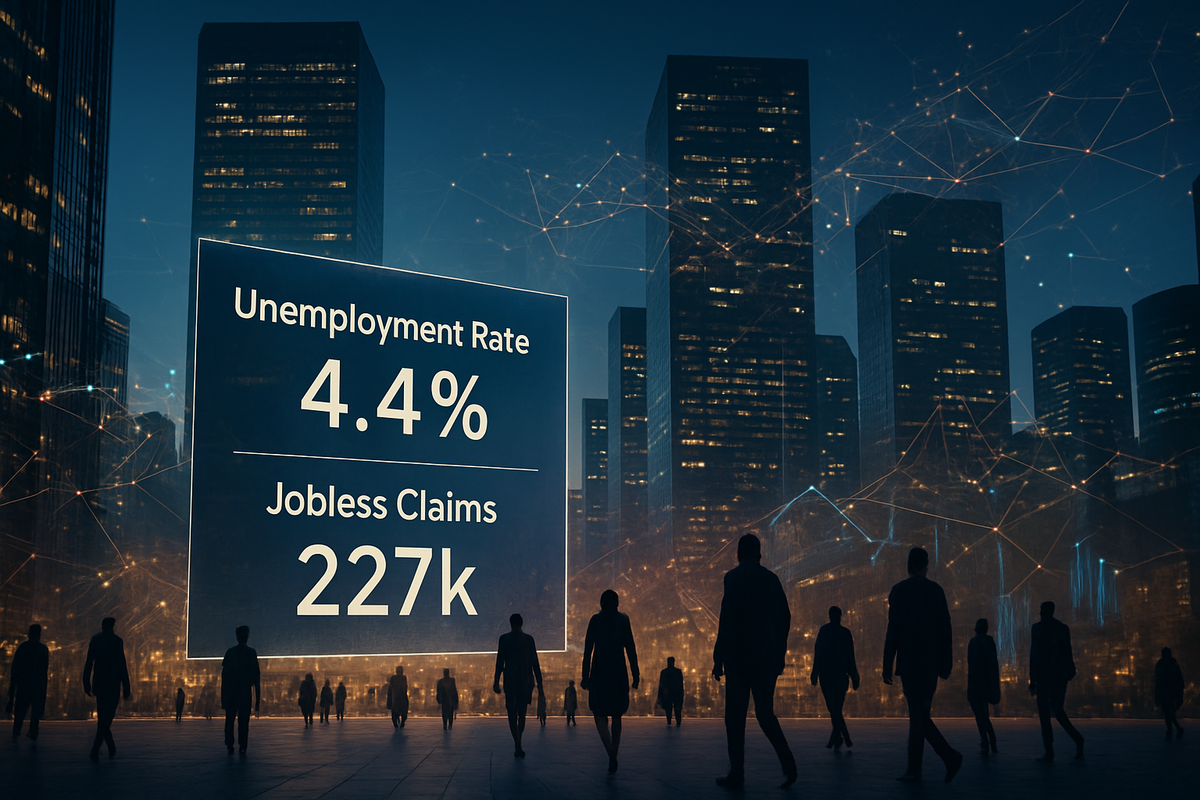
The United States labor market has entered a period of cautious stability in early 2026, characterized by a "low-hire, low-fire" equilibrium that has left economists and investors debating the difference between a successful soft landing and a period of prolonged stagnation. According to the latest data, weekly jobless claims fell to 227,000 for the week ending February 7, 2025—a figure that suggests a resilient floor for the economy even as the white-hot hiring of the previous years fades into the rearview mirror.
While the headline unemployment rate remains historically respectable at 4.4%, the underlying engine of job creation has slowed significantly. The latest payroll report revealed just 50,000 jobs added, a number that would have signaled a crisis five years ago but is now increasingly viewed as the new "breakeven" for a nation grappling with an aging workforce and a sudden, sharp decline in immigration. This tepid growth reflects a broader "macro malaise" where companies are choosing to optimize existing resources through artificial intelligence rather than expanding their human headcount.
Resilience in the Face of a Cooling Economy
The drop in jobless claims to 227,000 for the week ending February 7 indicates that American businesses are largely holding onto their current staff despite high-profile layoffs in specific sectors. This figure sits comfortably below the 250,000 threshold that many analysts at Goldman Sachs Group Inc. (NYSE: GS) and JPMorgan Chase & Co. (NYSE: JPM) consider a recessionary warning sign. However, the data is nuanced; while fewer people are losing their jobs, the "continuing claims" metric has climbed toward 1.86 million, suggesting that those who do find themselves unemployed are facing a significantly longer road back to work as the "hiring door" narrows.
The timeline leading to this moment has been defined by the "One Big Beautiful Bill Act" (OBBBA) passed in late 2025, which provided substantial tax incentives for business investment but has yet to translate into a hiring spree. Throughout the winter of 2025 and into February 2026, the economy has dealt with the aftereffects of a brief government shutdown and shifting global trade policies. The resulting 50,000-job monthly average has become the benchmark of a stabilizing market. Analysts note that with the current demographic shifts in the U.S., the economy now only requires approximately 50,000 to 75,000 new jobs per month to maintain a stable unemployment rate, compared to the 150,000-plus required a decade ago.
Corporate Winners and Losers in the "Low-Hire" Era
The primary winners in this environment appear to be the massive technology firms and financial institutions that have successfully pivoted to AI-driven productivity. Amazon.com, Inc. (NASDAQ: AMZN) exemplifies this transition; while the company recently announced 16,000 layoffs to "cut layers" and increase speed, it simultaneously committed to a massive $200 billion AI infrastructure spend for 2026. By prioritizing capital expenditures on technology over payroll, Amazon aims to boost margins even as consumer spending growth remains flat. Similarly, JPMorgan Chase & Co. (NYSE: JPM) has adopted a strategy of "redeployment over hiring," using AI to automate back-office functions while moving existing employees into direct client-facing roles.
Conversely, companies struggling to adapt to this "jobless growth" model are facing steeper challenges. Block, Inc. (NYSE: SQ) recently made waves by announcing it would cut 4,000 jobs—roughly 40% of its workforce—citing that AI tools have rendered many of its traditional middle-management and operational roles redundant. Even Apple Inc. (NASDAQ: AAPL), long considered a bastion of stability, has trimmed its enterprise sales staff in early 2026, shifting toward AI-driven sales tools and third-party resellers. For these companies, the 4.4% unemployment rate is less a sign of health and more a reflection of a labor market that is structurally shifting away from their legacy business models.
A Wider Significance: The Rise of "Jobless Growth"
This current labor trend fits into a broader historical shift that some are calling the "Great Efficiency Era." Unlike the post-2008 recovery, which was plagued by high unemployment and low productivity, 2026 is seeing the opposite: low unemployment paired with a cautious hiring environment. The broader significance lies in the decoupling of GDP growth from headcount growth. As AI begins to handle more routine cognitive tasks, the U.S. economy is proving it can maintain a 2% to 2.5% GDP growth rate without the massive payroll expansions of the past.
The ripple effects are being felt across the regulatory landscape. Policymakers are now forced to reconcile a "strong" labor market (4.4% unemployment) with rising household debt, which reached a record $18.8 trillion at the start of the year. This creates a "K-shaped" reality where asset owners and those in AI-adjacent fields thrive, while the broader workforce faces wage stagnation. Historical comparisons to the "soft landing" of the mid-1990s are frequent, but today's environment is unique because the constraint is no longer just high interest rates, but a fundamental change in how work is performed.
Looking Ahead: The Road to Mid-2026
In the short term, all eyes will be on the March non-farm payrolls report to see if the 50,000-job baseline holds or if a further decline is imminent. If job gains dip below the 50,000 mark, pressure on the Federal Reserve to cut interest rates will become overwhelming. Market participants are currently pricing in a high probability of a rate cut by June 2026, provided that inflation remains within the target range. The "strategic pivot" for most S&P 500 companies in the coming months will likely remain focused on "efficiency first," meaning that even if the economy picks up steam, a hiring boom is unlikely.
Potential scenarios for the remainder of 2026 include a "productivity-led rebound," where the massive AI investments of late 2025 begin to pay off in the form of higher corporate earnings, or a "consumer-led slowdown," if the 4.4% unemployment rate begins to climb due to continued corporate restructuring. For workers, the challenge will be adaptation; for investors, the opportunity lies in identifying which companies can grow their bottom line without needing to grow their headcount.
Summary and Investor Outlook
The US labor market at the end of February 2026 is a study in contradictions. Jobless claims at 227,000 suggest a sturdy economy, yet the 50,000 monthly job gains point to a significant cooling of the hiring engine. The 4.4% unemployment rate remains the North Star for the Federal Reserve, indicating that while the labor market is no longer "tight," it is far from a state of collapse. The shift toward AI-driven efficiency at firms like Amazon and Block is the defining corporate narrative of the year, signaling that "headcount" is no longer the primary proxy for economic health.
Moving forward, investors should keep a close watch on wage growth and consumer credit data. While the job market is stable, the real test for 2026 will be whether the American consumer can continue to spend in a world where job opportunities are increasingly concentrated in high-skill, AI-integrated sectors. The "Great Equilibrium" may be a comfortable place for now, but it requires a delicate balance of policy support and technological innovation to prevent it from sliding into stagnation.
This content is intended for informational purposes only and is not financial advice.