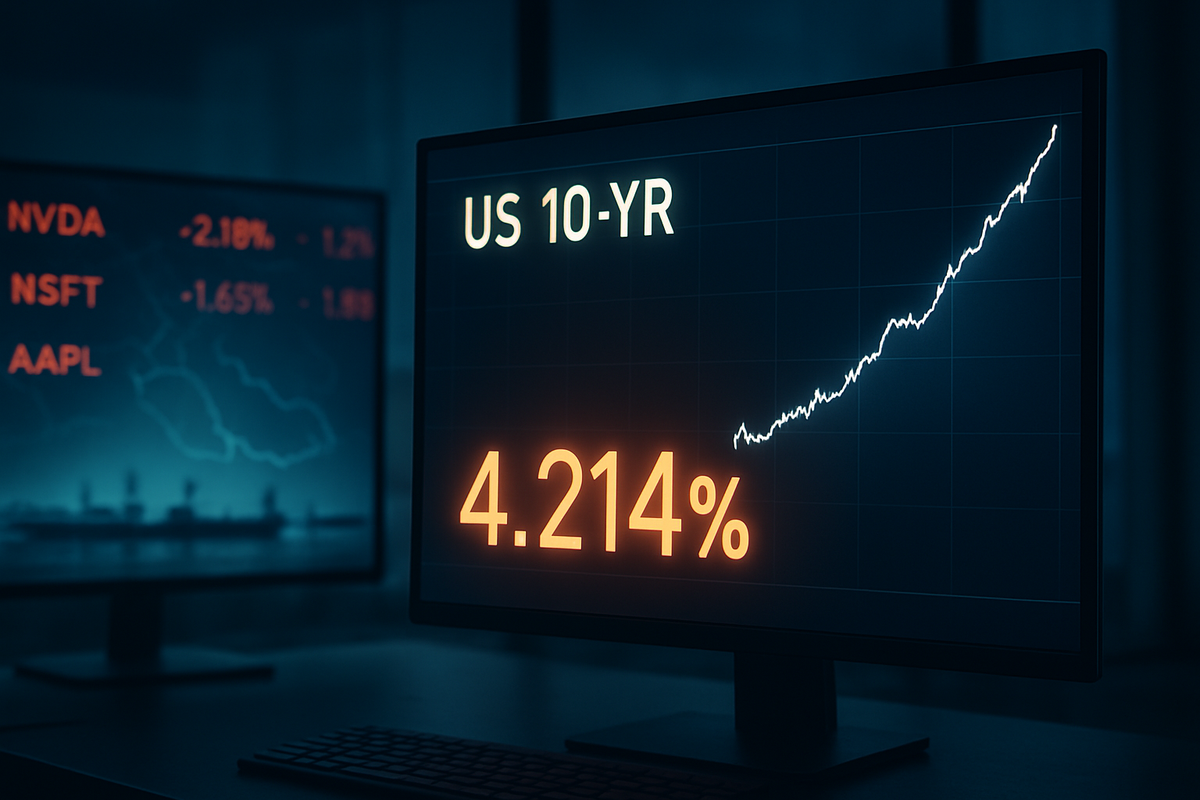
The global bond market underwent a seismic shift on Wednesday, March 11, 2026, as the yield on the benchmark US 10-year Treasury note surged to 4.214%. This rapid ascent, the highest level seen in nearly a year, comes as investors aggressively price in a new era of long-term inflation risk triggered by the escalating military conflict in the Middle East. The "risk-free rate" has suddenly become a significant hurdle for equity markets, casting a long shadow over the valuation of growth-sensitive sectors.
The immediate implications are clear: the cost of capital is rising just as geopolitical instability threatens global energy supplies. With the 10-year yield acting as the foundational discount rate for future corporate earnings, the sudden jump to 4.214% has triggered a massive "multiple compression" event. Growth and technology stocks, which rely heavily on the present value of far-off cash flows, are bearing the brunt of the sell-off as the Nasdaq Composite tumbled more than 2.4% in early trading.
The Catalyst: Conflict in the Gulf and the Death of "Anchored" Yields
The surge to 4.214% was not an isolated technical move but the culmination of a tense two-week period following the commencement of "Operation Epic Fury"—a series of US-led strikes against Iranian military infrastructure that began on February 28, 2026. The conflict led to the immediate and tactical closure of the Strait of Hormuz, a critical maritime chokepoint through which approximately 20% of the world’s petroleum liquid consumption passes. Consequently, Brent Crude oil prices have skyrocketed from $72 to over $118 per barrel in less than ten days.
This energy shock arrived at a vulnerable moment for the US economy. While the February CPI data released this morning showed a headline inflation rate of 2.4%, the bond market is looking ahead, recognizing that the "oil spike" has not yet been reflected in official government statistics. Bond vigilantes, concerned by a US national debt that surpassed $38.6 trillion in February, are demanding a higher term premium. The timeline of this jump saw yields move from a stable 4.05% in mid-February to the current 4.214% peak, as the market abandons the "Great Anchoring" narrative that defined the start of 2026.
Winners and Losers: A Tale of Two Markets
The spike in yields has created a stark divide in the equity markets, separating those who benefit from the physical realities of war and energy from those who depend on cheap liquidity. In the "Losers" column, tech titans such as Nvidia (NASDAQ: NVDA), Microsoft (NASDAQ: MSFT), and Apple (NASDAQ: AAPL) have seen their market capitalizations contract significantly. When the 10-year yield hits 4.214%, the "hurdle rate" for these companies becomes increasingly difficult to clear, forcing analysts to re-rate their forward P/E multiples lower. Mid-cap software providers and AI infrastructure firms are facing even steeper declines as their path to profitability is further elongated by higher borrowing costs.
Conversely, the "Winners" of this regime shift are concentrated in the Defense and Energy sectors. RTX Corporation (NYSE: RTX) and Lockheed Martin (NYSE: LMT) have seen shares rally as the Pentagon ramps up munitions production to replace stockpiles depleted in the Gulf. Northrop Grumman (NYSE: NOC) has also seen positive momentum, driven by its leadership in missile tracking and space systems. In the energy space, domestic giants like ExxonMobil (NYSE: XOM) and Chevron (NYSE: CVX) are acting as "inflation hedges," with their record production in the Permian Basin insulating them from the Strait of Hormuz disruption. Even Occidental Petroleum (NYSE: OXY) has outperformed, as its high sensitivity to oil prices becomes a tactical advantage in a $110+ oil environment.
Historical Echoes and the Specter of Stagflation
The current yield spike is more than a temporary market hiccup; it represents a fundamental shift in the macro landscape that draws parallels to the 1973 Yom Kippur War and the 1979 Iran Crisis. In both historical instances, energy shocks led to prolonged periods of stagflation—a toxic combination of slowing economic growth and high inflation. With the 10-year Treasury yield now firmly above 4.2%, the market is signaling that the era of "low-volatility inflation" is over.
Furthermore, this event highlights a growing concern regarding the "crowding out" effect of US national debt. For the first time, federal interest payments are projected to exceed the total national defense budget in FY2026. As yields rise to 4.214%, the cost of servicing $38.6 trillion in debt increases exponentially, potentially limiting the government's fiscal headroom to respond to the very conflict that is causing the spike. This feedback loop between geopolitical risk, energy inflation, and debt sustainability is a trend that many analysts believe will define the second half of the 2020s.
The Road Ahead: 4.5% on the Horizon?
In the short term, all eyes remain on the Strait of Hormuz. If the maritime blockade persists into April, technical analysts suggest the 10-year yield could quickly test the 4.50% level, a threshold that would likely trigger a broader recessionary signal. The Federal Reserve now finds itself in a "policy straitjacket"; cutting rates to support a slowing economy could fuel energy-driven inflation, while raising rates further to combat inflation could exacerbate the debt servicing crisis.
Strategic pivots are already underway in Silicon Valley and on Wall Street. Companies are expected to prioritize "cash flow today" over "growth tomorrow," leading to a potential wave of consolidation in the tech sector. For investors, the "60/40" portfolio is being re-examined, with a renewed focus on "Real Assets"—commodities, defense, and infrastructure—that can withstand the dual pressures of high interest rates and geopolitical volatility.
Closing Thoughts for the Strategic Investor
The jump to a 4.214% yield is a wake-up call for a market that had perhaps grown too comfortable with the idea of a "soft landing." The convergence of a major military conflict in Iran and a fragile fiscal situation in the US has re-introduced a level of risk that necessitates a defensive posture. The primary takeaway from today's movement is that the "risk-free rate" is no longer a passive variable but an active headwind for valuations.
Moving forward, the market will likely be characterized by heightened volatility as it digests each headline from the Gulf. Investors should closely watch for any signs of de-escalation, which could see yields retreat to the 3.8% range, or conversely, signs of a prolonged "Energy War" that could cement these higher yields as the new normal. For now, the bond market is speaking clearly: the cost of a complicated world is going up.
This content is intended for informational purposes only and is not financial advice.