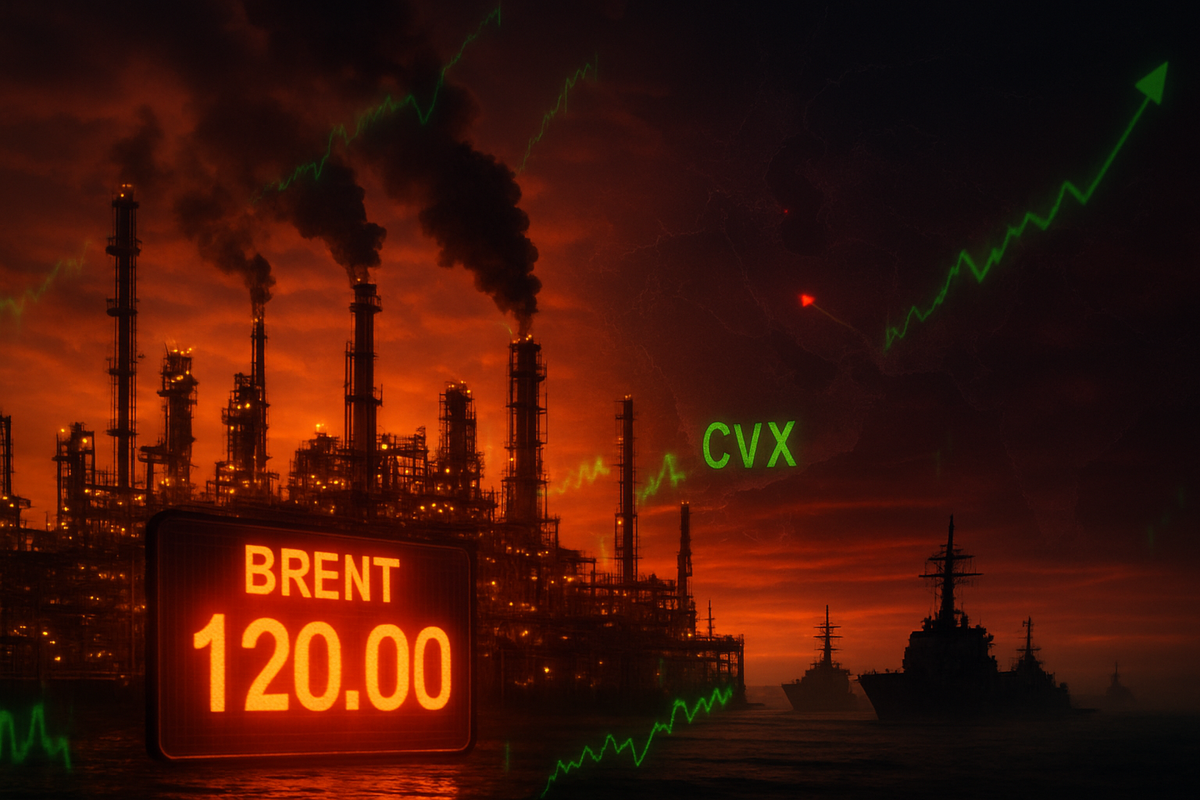
HOUSTON — In a dramatic reversal of the market doldrums that characterized much of the previous year, the S&P 500 Energy Sector (NYSE Arca: XLE) has surged to an all-time record high as of March 12, 2026. The rally comes as global crude oil prices breached the psychologically critical $100-per-barrel threshold, driven by a sharp military escalation between the United States and Iran that has threatened the stability of the world’s most vital energy transit routes.
As the broader S&P 500 index grapples with renewed inflationary fears and a volatile "fear-zone" environment, energy stocks have emerged as the market’s primary engine of growth. While technology and consumer discretionary sectors have faltered under the weight of rising input costs, the energy complex is currently the only major sector in the green for the first quarter of 2026, delivering a year-to-date return of over 27% and fundamentally reshaping investor portfolios for the mid-decade.
A Perfect Storm: The Path to $120 Oil
The current crisis traces its roots to late February 2026, when a series of precision strikes by U.S. and allied forces on Iranian military and nuclear infrastructure triggered a swift and severe response from Tehran. Following the strikes, Iran initiated a functional blockade of the Strait of Hormuz, a narrow waterway through which approximately 20% to 30% of the world’s seaborne crude oil and liquefied natural gas (LNG) passes daily. This "physical supply shock" immediately sent Brent crude and West Texas Intermediate (WTI) prices into a vertical climb, with Brent currently trading between $115 and $119 per barrel.
This geopolitical explosion follows a relatively quiet 2025, where the S&P 500 Energy Sector (NYSE Arca: XLE) gained a modest 7.8% amid concerns of a looming global supply glut and increased U.S. domestic production. However, the sudden removal of Iranian barrels and the threat to regional shipping have erased those bearish projections. Analysts from major investment banks now warn that if the blockade persists beyond the end of March, oil could reach a systemic peak of $140 to $150 per barrel, echoing the supply shocks seen during the early days of the Russia-Ukraine conflict in 2022.
The immediate reaction from the trading floor was one of frantic rotation. Institutional "smart money," which had been heavily overweight in artificial intelligence and growth stocks throughout 2025, began a massive liquidation of those positions in favor of the energy complex. By early March, the "Geopolitical Risk Premium"—the extra cost added to oil due to the threat of supply disruption—was estimated at $25 per barrel, a level not seen in nearly four years.
The Safe Haven Giants: ExxonMobil and Chevron Lead the Charge
In this climate of global instability, blue-chip energy giants have transitioned from value plays to essential hedges. ExxonMobil (NYSE: XOM) and Chevron (NYSE: CVX) have become the go-to shelters for investors looking to protect their capital from the eroding effects of $100 oil. Since the beginning of the year, ExxonMobil (NYSE: XOM) has seen its share price jump 27.15%, while Chevron (NYSE: CVX) has tracked closely behind with a 26% gain.
These companies are uniquely positioned to win in a high-price environment for three key reasons. First, their operational break-even points have been aggressively lowered over the last two years; many of their Permian Basin assets are now profitable even at $40 oil. At $115 oil, these majors are generating "extraordinary" free cash flow that exceeds their 2022 records. Second, both companies have maintained aggressive capital return programs; ExxonMobil (NYSE: XOM) is on track to complete $20 billion in share buybacks through 2026, providing a solid floor for the stock price even during intraday market panics.
Conversely, the losers of this energy spike are becoming increasingly apparent. The transportation and manufacturing sectors are reeling from the "inflationary tax" of high fuel costs. Major carriers like Delta Air Lines (NYSE: DAL) and United Airlines (NASDAQ: UAL) have seen their stock prices tumble by double digits as jet fuel costs eat into margins that were already thin following a cooling travel market in late 2025. For these companies, $100 oil represents a direct threat to the earnings recoveries they spent years building.
Broader Significance: The Return of "Energy is King"
The current surge in the energy sector is more than a temporary reaction to a headline; it represents a significant shift in the broader market narrative. Throughout 2024 and 2025, the prevailing trend was the "Energy Transition," with capital flowing toward renewables and lithium-dependent technology. However, the 2026 crisis has reminded the market of the world’s continued, fundamental dependence on the fossil fuel supply chain. This "energy realism" is forcing a re-evaluation of the pace of the transition, as energy security once again takes precedence over decarbonization goals in national policy discussions.
Furthermore, the rise in oil prices has "reactivated" the inflation channel that central banks thought they had finally tamed. With the CNN Fear & Greed Index currently sitting in the "Fear Zone," the Federal Reserve faces a difficult choice: continue with planned interest rate cuts to support a slowing economy or pause to combat the inflationary pressure of $120 oil. This uncertainty has led to a historical precedent of "stagflationary" trading, where only tangible commodities and the companies that produce them remain viable investments.
The ripple effects are also being felt in the international community. OPEC+ members, led by Saudi Arabia, have so far resisted calls for an immediate production increase, citing the volatility as a "political rather than technical" issue. This stance has only tightened the squeeze on global markets, ensuring that the energy sector remains the dominant beneficiary of the current geopolitical stalemate.
Outlook: The Road Ahead for the XLE
Looking forward to the remainder of 2026, the trajectory of the S&P 500 Energy Sector (NYSE Arca: XLE) will depend entirely on the duration of the conflict in the Middle East. In the short term, technical analysts suggest that the sector is overbought but unlikely to see a significant correction as long as the Strait of Hormuz remains a contested zone. We may see a strategic pivot where energy companies further accelerate their domestic U.S. production to take advantage of the high prices, potentially leading to a new "golden era" for the American shale industry.
However, a long-term challenge looms. The persistent reality of $100 oil may eventually lead to "demand destruction," where consumers and businesses significantly cut back on consumption due to high costs, eventually cooling the very market that energy investors are currently celebrating. Strategic adaptations will be required by late 2026, as companies like Chevron (NYSE: CVX) may need to balance their immediate upstream windfall with investments in long-term supply chain resilience to avoid being caught off-guard by a potential de-escalation and subsequent price collapse.
Market Wrap-Up and Final Thoughts
The record-breaking ascent of the S&P 500 Energy Sector (NYSE Arca: XLE) in March 2026 serves as a stark reminder of how quickly geopolitical events can upend market leadership. The shift in capital toward firms like ExxonMobil (NYSE: XOM) and Chevron (NYSE: CVX) has provided a necessary hedge for investors during one of the most volatile quarters in recent memory.
Moving forward, the market will remain hyper-sensitive to any updates regarding the U.S.-Iran conflict. Key takeaways for the coming months include the importance of maintaining energy exposure in a diversified portfolio and watching for signs of inflationary stickiness that could influence Federal Reserve policy. For now, the "Energy is King" theme remains firmly in place, and the record highs achieved this March may only be the beginning of a prolonged period of dominance for the energy complex.
This content is intended for informational purposes only and is not financial advice.