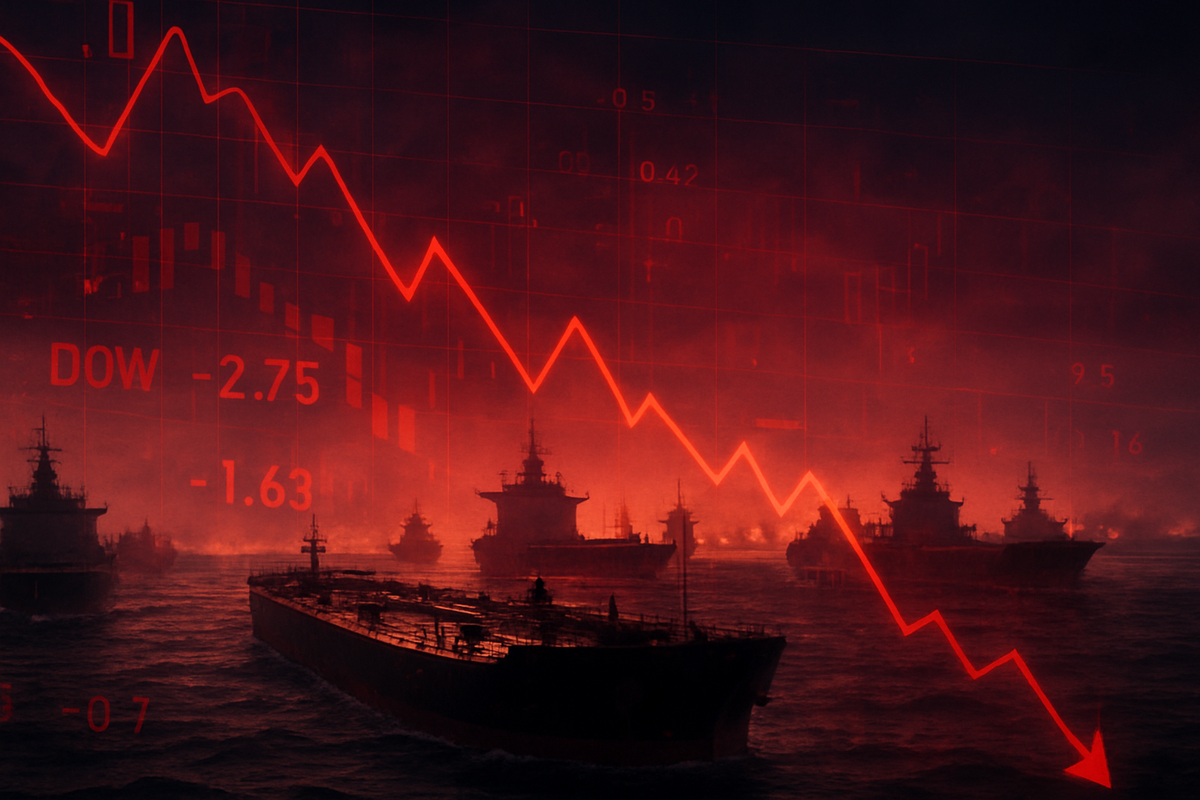
The global economy is facing its most severe energy crisis in decades as the shadow of total war in the Middle East looms over the financial markets. On March 12, 2026, international benchmark Brent crude surged to $101.59 per barrel, while the U.S. West Texas Intermediate (WTI) jumped past the $91 mark. The primary catalyst is the escalating conflict with Iran, which has culminated in the complete closure of the Strait of Hormuz, the world’s most vital oil artery. With roughly 25% of the world’s seaborne oil trade now paralyzed, the shockwaves are being felt directly on the floor of the New York Stock Exchange.
The immediate implications for the United States are staggering. Gasoline prices are projected to hit record highs within days, and the specter of "stagflation"—a toxic mix of stagnant economic growth and runaway inflation—has returned to haunt the Federal Reserve. As the maritime blockade continues, the international community has been forced into emergency mode, with the International Energy Agency (IEA) announcing a desperate attempt to stabilize the market.
The Siege of Hormuz: A Timeline of Escalation
The current crisis did not emerge in a vacuum but is the result of a multi-year spiral of diplomatic failure and military posturing. Following the "Maximum Pressure 2.0" sanctions campaign initiated in late 2024, tensions reached a breaking point in early 2026. On February 28, a joint U.S.-Israeli offensive, dubbed "Operation Epic Fury," targeted Iranian military and nuclear infrastructure. In a devastating retaliatory move on March 4, the Islamic Revolutionary Guard Corps (IRGC) declared the Strait of Hormuz closed, deploying a sophisticated network of sea mines and drone swarms that have effectively halted all commercial traffic.
The chaos intensified over the last 48 hours as Iranian-backed forces launched coordinated attacks on energy infrastructure across the Persian Gulf. Damage was reported at the Ras Tanura refinery in Saudi Arabia, and Qatari LNG exports have ground to a halt. In response to this unprecedented supply vacuum, the IEA authorized a record-breaking release of 400 million barrels of crude from global strategic reserves—the largest in the organization's history. Despite this massive intervention, traders remain skeptical that the reserves can bridge a long-term gap if the Strait remains inaccessible.
Winners and Losers: Market Carnage and Energy Surges
The impact on the U.S. stock market has been swift and brutal. The Dow Jones Industrial Average plunged 600 points on March 12, 2026, while the S&P 500 fell 1.1%. Energy-intensive sectors are bearing the brunt of the sell-off. Airlines, in particular, are seeing their valuations evaporate as jet fuel costs skyrocket. United Airlines (NASDAQ: UAL), Delta Air Lines (NYSE: DAL), and American Airlines (NASDAQ: AAL) all saw double-digit percentage drops today, as investors price in a collapse in travel demand and a surge in operating costs.
Logistics and retail giants are also under fire. Companies like FedEx (NYSE: FDX) and United Parcel Service (NYSE: UPS) face narrowing margins as delivery costs surge, while retail behemoths like Walmart (NYSE: WMT) and Target (NYSE: TGT) are bracing for a slowdown in consumer spending as households divert more income to the gas pump. Conversely, the "Big Oil" majors are seeing a significant, if volatile, boost. ExxonMobil (NYSE: XOM), Chevron (NYSE: CVX), and Occidental Petroleum (NYSE: OXY) have bucked the downward market trend as their existing reserves and production capacity become infinitely more valuable in a supply-starved world.
A Wider Significance: The Return of the 1970s?
This event marks a fundamental shift in the global geopolitical and economic landscape. Analysts are drawing grim comparisons to the 1973 and 1979 oil shocks, which led to years of economic malaise in the West. The current crisis fits into a broader trend of "de-globalization" and the weaponization of energy resources. The fragility of the global supply chain, which many thought had been fortified after the 2022 Russia-Ukraine conflict, has been exposed once again.
Furthermore, the policy implications are profound. This crisis may serve as a double-edged sword for the green energy transition. In the short term, the panic has forced governments to prioritize fossil fuel production to prevent a total economic collapse. However, long-term policy shifts are likely to accelerate the move toward energy independence through renewables and nuclear power to avoid being held hostage by Middle Eastern volatility. The Federal Reserve now faces a nightmare scenario: raising interest rates to combat energy-driven inflation while the economy is already reeling from a supply shock.
What Comes Next: The Path to $150 Oil
The short-term outlook depends entirely on the duration of the Hormuz blockade. Military experts suggest that a "freedom of navigation" operation to clear the Strait could take weeks, if not months, given the density of the minefields and the persistence of drone threats. If the blockade persists through the end of the month, analysts at major investment banks are warning that Brent crude could easily surpass $150 per barrel, a level that would almost certainly trigger a global recession.
Investors should prepare for a period of extreme volatility. Strategic pivots will be required for companies in the manufacturing and transport sectors, likely involving surcharges and price hikes that will pass the pain directly to consumers. A potential "silver lining" may emerge for domestic shale producers in the Permian Basin, as the U.S. government is expected to roll back environmental regulations to maximize home-grown production in the name of national security.
Summary and Investor Outlook
The events of March 12, 2026, have fundamentally altered the market's trajectory for the foreseeable future. The combination of a major regional war, the closure of the world's most critical transit point, and the resulting supply shock has created a "perfect storm" for global equities. While the IEA's 400-million-barrel release provides a temporary cushion, it is a finite resource that cannot replace the 20 million barrels per day typically flowing through the Strait of Hormuz.
Moving forward, investors should keep a close watch on Middle Eastern diplomatic efforts and any signs of military de-escalation. The key metrics to track will be the weekly inventory reports and the "headline risk" associated with any further infrastructure attacks. As the market grapples with the reality of $100+ oil, the focus will shift from growth to survival, with a premium placed on companies with strong balance sheets and low energy dependency. The coming months will determine whether this is a temporary spike or the beginning of a prolonged era of high-cost energy and economic stagnation.
This content is intended for informational purposes only and is not financial advice.