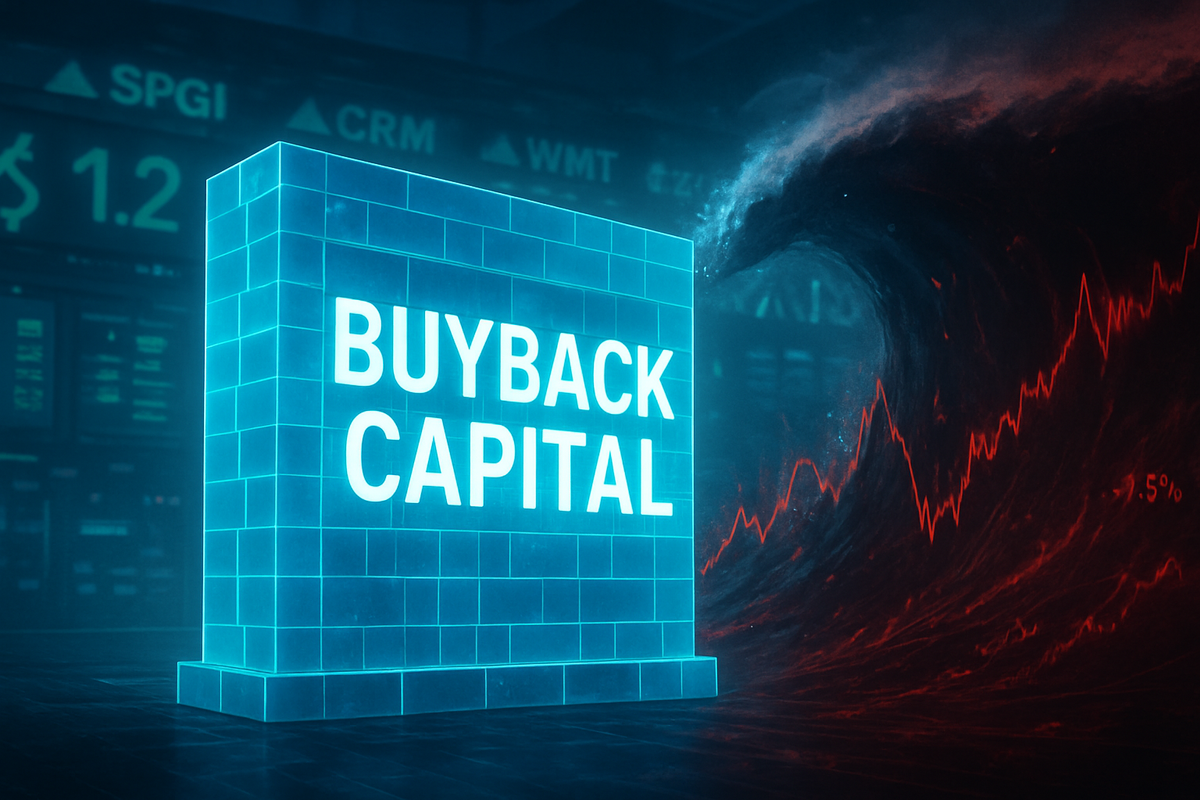
As of March 12, 2026, the U.S. equity markets are witnessing an unprecedented "Buyback Boom," with S&P 500 corporations on track to authorize a record-breaking $1.2 trillion in share repurchases this year. This surge comes at a critical juncture for Wall Street, as investors grapple with a volatile start to the year characterized by the "Tariff Shock" of January and a 35% spike in oil prices following intensified Middle East conflicts. In this turbulent environment, corporate treasuries have emerged as the "lender of last resort," deploying massive capital to provide a psychological and financial floor for stock prices during the current sell-off.
The sheer scale of these repurchase programs is reshaping the market's response to macroeconomic headwinds. While retail and institutional investors have pulled back amid disappointing January jobs data and geopolitical uncertainty, the "buyback desk" at major investment firms like Goldman Sachs (NYSE: GS) has reported sustained, informed demand from corporate issuers. By reducing share counts at an accelerated pace, these companies are effectively "manufacturing" earnings-per-share (EPS) growth, allowing mature large-cap firms to meet analyst estimates even as organic revenue growth cools in an increasingly protectionist global trade environment.
A Record-Breaking Quarter for Capital Returns
The first quarter of 2026 has been defined by a series of multi-billion dollar announcements that have signaled corporate confidence despite the "Tariff Shock" of January 20th. When the administration threatened 10–25% tariffs on several European nations—a move that triggered the market's worst day since 2024—corporate boards responded not with caution, but with capital. S&P Global (NYSE: SPGI) led the charge by reaffirming its aggressive capital return framework, which includes a 30-million-share authorization and a $2.5 billion accelerated share repurchase (ASR) program. By targeting a return of approximately 85% of its adjusted free cash flow, the financial data giant has established a firm valuation floor near the $400 level, even after issued guidance that initially spooked the market.
This wave of repurchases is not limited to the financial services sector. In early February 2026, Salesforce (NYSE: CRM) unveiled a staggering $50 billion repurchase program, one of the largest in corporate history. The move was a direct response to "disruption anxiety" surrounding the long-term impact of artificial intelligence on enterprise software. By utilizing a $25 billion senior notes offering to fund an immediate ASR, Salesforce signaled to the market that its cash flows remain robust and that its stock is an undervalued asset. Similarly, Walmart (NYSE: WMT) and American Express (NYSE: AXP) authorized programs of $30 billion and $16 billion, respectively, providing a critical buffer for the broader S&P 500 index (INDEXSP: .INX).
Winners, Losers, and the AI Strategic Pivot
The 2026 buyback surge has created a clear divide between "Cash Kings" and "AI Infrastructure Builders." Companies like S&P Global and Salesforce are winning over value-oriented investors by returning capital and protecting EPS growth. These firms are using their strong balance sheets to absorb selling pressure, turning market volatility into an opportunity to retire shares at a discount. American Express, in particular, has seen its stock price stabilize faster than its peers, as its $16 billion buyback program convinced investors of the high-end consumer's resilience despite the macro-economic turbulence of early March.
Conversely, the market has seen a dramatic pivot from perennial buyback heavyweights like Oracle (NYSE: ORCL). In a move that shocked the tech sector in February 2026, Oracle announced it has "effectively stopped" its share repurchases to fund a massive $50 billion expansion of its Oracle Cloud Infrastructure (OCI). Instead of buying shares, Oracle is now selling them through a $20 billion "at-the-market" equity program to fuel the AI infrastructure arms race. While this has caused short-term dilution and a significant sell-off in ORCL shares, analysts view it as a high-stakes bet on long-term growth over short-term price support. This highlights the double-edged sword of the current environment: companies with excessive debt or high CapEx requirements are being forced to choose between supporting their stock price and securing their future in the AI era.
The Significance of the "Financial Engineering" Narrative
The 2026 buyback phenomenon fits into a broader historical trend where corporate America acts as the primary driver of equity demand. Since 2000, buybacks have comprised nearly 100% of all net equity purchases in the U.S. market, but the 2026 surge to $1.2 trillion represents a new zenith. This event is significant because it highlights the growing gap between revenue growth (averaging ~8.8%) and EPS growth (averaging ~14.2%). Roughly 2–4% of the S&P 500’s total earnings growth is now being "manufactured" through share count reduction, a trend that masks the underlying cooling of the global economy.
Furthermore, these buybacks are serving a regulatory and political purpose. Despite the current administration's focus on taxing repurchases, corporations are choosing to pay the tax rather than let their valuations languish during geopolitical crises. The 2026 surge acts as a buffer against the ripple effects of the "Tariff Shock," preventing a free-fall in large-cap stock prices that could otherwise trigger a broader financial crisis. Historically, periods of high buyback activity, such as 2018 and 2021, preceded periods of market stabilization, and the 2026 "floor" is being watched by regulators as a sign of private sector resilience.
Navigating the Road Ahead: 2026 and Beyond
Looking toward the second half of 2026, the short-term outlook suggests that the $1.2 trillion buyback floor will remain intact as long as corporate cash flows stay positive. However, a potential strategic pivot looms for the tech sector. If companies like Oracle successfully monetize their massive AI investments, we may see a shift away from buybacks and toward "growth-at-any-cost" CapEx. Investors must watch for signs of "buyback exhaustion" in sectors where debt levels are rising, particularly if the 35% oil price spike leads to sustained inflation and higher interest rates that increase the cost of funding ASRs through debt issuance.
The long-term challenge will be the sustainability of this financial engineering. While buybacks provide a floor today, they reduce the capital available for future research and development. Market opportunities may emerge for "disruptor" companies that choose to invest in innovation rather than share count reduction, though they will have to contend with the immediate price volatility that the current buyback kings are avoiding. The scenario to watch is a "bifurcated market" where mature large-caps remain stable but stagnant, while AI-focused firms experience high-alpha volatility.
Summary of a Defensive Market Landscape
The surge in US corporate buybacks in early 2026 is a definitive statement of balance sheet strength in the face of man-made and geopolitical crises. By deploying over $1 trillion to retire shares, the S&P 500's largest constituents have successfully prevented a full-scale market capitulation during the most volatile quarter in years. Key takeaways include the emergence of Salesforce and S&P Global as defensive anchors and the surprising pivot of Oracle toward infrastructure investment, which serves as a reminder that capital allocation strategies are shifting in response to the AI revolution.
Moving forward, the market will likely remain in a state of "supported volatility." Investors should keep a close eye on the "buyback desk" activity in the coming months, as any slowdown in repurchase authorizations could leave the market vulnerable to the next round of tariff or energy-related shocks. For now, the corporate balance sheet remains the strongest pillar of Wall Street, providing a $1.2 trillion safety net for a world increasingly defined by uncertainty.
This content is intended for informational purposes only and is not financial advice.