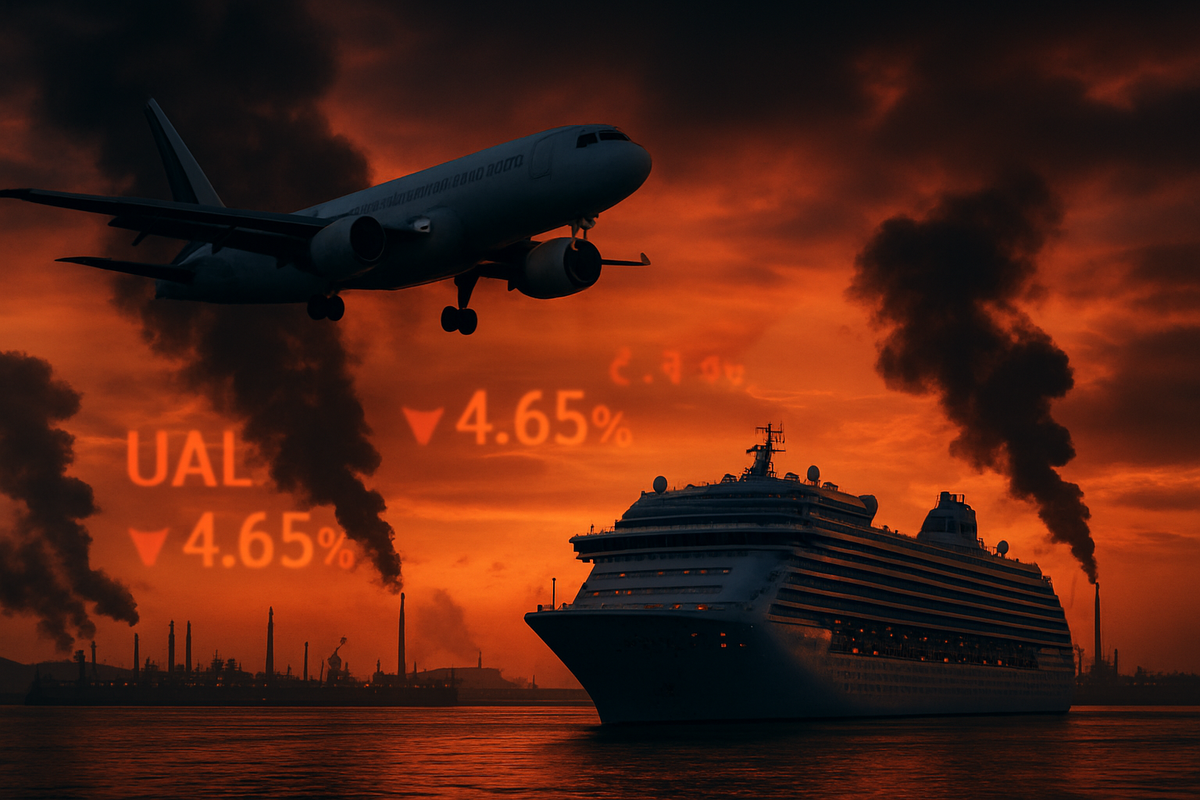
The global travel and transport sectors are facing their most significant crisis since the 2020 pandemic as the escalation of a full-scale war between Iran and Israel has sent energy markets into a tailspin. On March 13, 2026, shares of major travel providers plummeted, led by sharp declines in United Airlines Holdings, Inc. (NASDAQ: UAL), which fell 4.6%, and Carnival Corporation & plc (NYSE: CCL), which saw a staggering 7.9% drop. The sell-off reflects growing investor anxiety over surging operational costs and the potential for a prolonged disruption of critical global energy and transit routes.
The immediate implications of this geopolitical flare-up are being felt at the pump and in the cockpit. With Brent Crude prices skyrocketing from $70 to over $120 per barrel in less than a fortnight, the thin profit margins of the travel industry are under immense pressure. Analysts warn that if the conflict continues to simmer, the $22.6 billion in market value wiped from the travel sector in early March may only be the beginning of a broader structural decline for high-fuel-consumption industries.
A Flashpoint in the Middle East: From Escalation to Energy Crisis
The current market turmoil traces back to February 28, 2026, when a series of joint U.S. and Israeli air strikes, internally dubbed "Operation Epic Fury," targeted Iranian military infrastructure and air defense systems. The strikes, which reportedly led to the assassination of Iran’s Supreme Leader Ali Khamenei and the immediate succession of his son, Mojtaba Khamenei, triggered an unprecedented retaliatory response. Iran effectively closed the Strait of Hormuz, a move that halted roughly 20% of the world’s seaborne oil supply and reduced tanker traffic from 60 ships per day to fewer than five.
As of March 13, 2026, the conflict has intensified, with U.S. Central Command reporting strikes on over 6,000 targets within Iran. In retaliation, drone and missile attacks have targeted oil infrastructure in neighboring Gulf states and Israeli population centers. This has forced major aviation hubs, such as Dubai International Airport (DXB), into multi-day closures, stranding tens of thousands of passengers and necessitating costly, long-distance rerouting for international carriers.
The speed of the fuel price surge has been historic. Jet fuel prices witnessed a 58% jump in a single week, reaching $3.95 per gallon by March 6. For carriers like United Airlines (NASDAQ: UAL), which traditionally does not hedge its fuel expenses, the impact was immediate. CEO Scott Kirby has already cautioned that the carrier’s first-quarter financial results will take a "meaningful" hit, as the airline is now fully exposed to the extreme volatility of the spot market.
Winners and Losers in a War-Torn Market
The travel sector is undoubtedly the primary victim of this energy shock. Carnival Corp (NYSE: CCL) has been hit twice over: once by the surging cost of marine diesel and again by the closure of vital maritime routes in the Middle East, forcing the cancellation of dozens of high-margin luxury cruises. Competitors like Norwegian Cruise Line Holdings Ltd. (NYSE: NCLH) and Royal Caribbean Group (NYSE: RCL) have seen similar losses, with shares sliding between 6% and 7% as the "revenge travel" boom of the mid-2020s hits a geopolitical brick wall.
Conversely, the defense and domestic energy sectors have seen a dramatic re-rating. Lockheed Martin Corporation (NYSE: LMT) shares reached an all-time high of $692.00 on the back of massive demand for the THAAD anti-ballistic system and F-35 aircraft. Similarly, RTX Corporation (NYSE: RTX), formerly Raytheon, saw its backlog swell to a record $268 billion as the conflict depleted global stockpiles of Tomahawk cruise missiles and Patriot defense systems.
In the energy space, Exxon Mobil Corporation (NYSE: XOM) and Chevron Corporation (NYSE: CVX) have emerged as safe havens. XOM surged to $154.00, benefiting from its "geopolitically safe" production in the Permian Basin and Guyana. Chevron’s exposure to the Liquefied Natural Gas (LNG) supercycle has also made it a favorite for investors, particularly as Iranian drone strikes disrupted Qatari gas production, making North American exports more critical than ever to the global energy balance.
Broader Significance and Historical Echoes
The 2026 energy crisis bears a striking resemblance to the 1973 oil embargo and the 1990 Gulf War, but with the added complexity of a modern, interconnected global economy. This event marks a potential end to the era of cheap, reliable Middle Eastern energy, forcing a "regionalization" of supply chains. The closure of the Strait of Hormuz has not only spiked prices but has also fundamentally challenged the hub-and-spoke model of international aviation that relies heavily on Gulf-based transit.
Furthermore, this crisis is accelerating regulatory shifts that were previously moving at a much slower pace. Governments are now viewing Sustainable Aviation Fuel (SAF) as a national security imperative rather than just an environmental goal. The U.S. government has fast-tracked the 45Z Clean Fuel Production Credit, providing subsidies of up to $2.00 per gallon for alternative fuels to reduce reliance on foreign petroleum. This geopolitical shock may ironically provide the "green transition" with the financial and political momentum it has lacked for years.
The ripple effects are also extending to the maritime industry, where the closure of the Suez Canal and the Strait of Hormuz is forcing a return to longer, more expensive routes around the Cape of Good Hope. This shift is expected to exacerbate global inflation, as shipping costs for everything from electronics to grain are projected to rise by 15-20% in the coming months.
The Path Forward: Rerouting and Resilience
In the short term, the travel industry must pivot toward survival strategies. Airlines are likely to implement aggressive fuel surcharges and capacity cuts to maintain liquidity. We may also see a wave of consolidation as smaller, less-capitalized carriers struggle to cope with triple-digit oil prices. For cruise lines, the strategic pivot involves shifting fleets away from the Mediterranean and Indian Ocean toward the Caribbean and Pacific, though this will take months to coordinate and may result in a glut of capacity in "safe" markets.
Long-term, the industry’s focus will likely shift toward self-sufficiency. Investment in Alcohol-to-Jet (ATJ) technology, spearheaded by companies like LanzaJet, Inc., is expected to skyrocket. Analysts now predict that SAF could account for 5-8% of global jet fuel consumption by 2028, a massive leap from previous estimates. This "strategic vulnerability" will also likely lead to more robust fuel-hedging programs among airlines that had previously abandoned the practice.
Market opportunities may emerge in the rail and telecommunications sectors as "high-cost travel" becomes the new reality. If oil remains above $100 per barrel throughout 2026, the industry will have to reinvent the value proposition of global tourism, perhaps moving toward longer-duration, less-frequent trips to offset the prohibitive cost of transport.
Final Assessment: A New Geopolitical Reality
The events of March 2026 serve as a stark reminder that the global travel industry remains at the mercy of geopolitical stability. The sharp decline in stocks like United Airlines (NASDAQ: UAL) and Carnival Corp (NYSE: CCL) is not merely a temporary dip but a reaction to a fundamental shift in the global risk landscape. The era of "frictionless" global travel is being tested by the realities of kinetic warfare and energy blockades.
Moving forward, investors should closely monitor the status of the Strait of Hormuz and any potential de-escalation signals from the new Iranian leadership. However, the structural changes—higher defense spending, the acceleration of SAF, and the premium on non-Middle Eastern energy—are likely here to stay. The coming months will determine whether the travel sector can adapt to this "new normal" or if it will face a prolonged period of suppressed growth and heightened volatility.
This content is intended for informational purposes only and is not financial advice