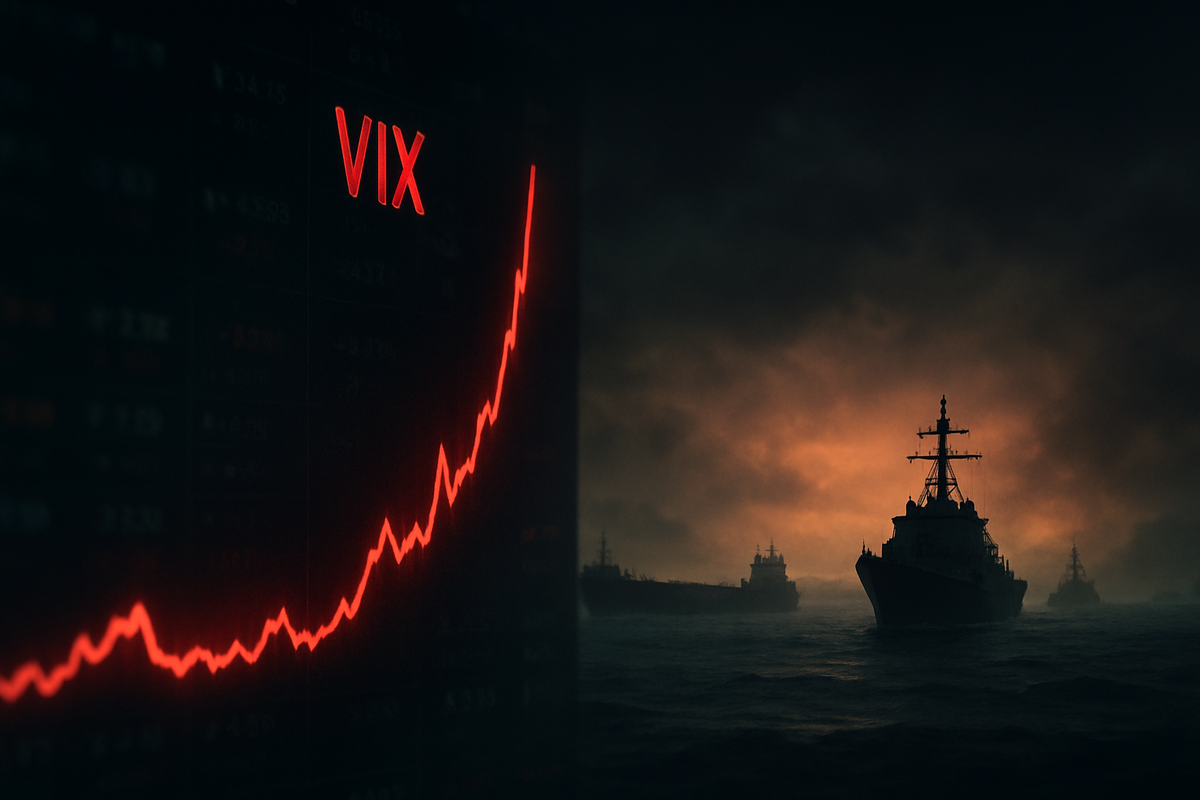
The CBOE Volatility Index (CBOE: VIX), widely recognized as Wall Street’s "fear gauge," experienced a dramatic 12.6% surge today, March 13, 2026, closing at a multi-year high of 27.29. This spike signals a decisive shift in investor sentiment from cautious optimism to outright alarm as a kinetic military conflict in the Middle East threatens to destabilize global energy supplies and ignite a broader regional war.
The jump to 27.29 indicates that institutional investors are aggressively hedging against the possibility of significant market swings. At this level, the VIX suggests that the S&P 500 could experience daily fluctuations of nearly 1.7% in the coming weeks. The move marks the highest reading for the index since the geopolitical shocks of 2022, reflecting a market that is no longer merely "pricing in" risk but is actively bracing for a sustained period of high-intensity volatility.
Anatomy of an Escalation: Operation Epic Fury and the Strait of Hormuz
The primary catalyst for today's market panic is the rapid escalation of a military campaign reportedly dubbed "Operation Epic Fury." Following weeks of rising tensions, a joint U.S.-Israeli military strike targeted key nuclear enrichment facilities and drone manufacturing hubs deep within Iranian territory. The situation took an even more volatile turn this morning with unconfirmed reports regarding the health and potential death of Iran’s Supreme Leader, Ayatollah Ali Khamenei, which has reportedly led to a complete breakdown in diplomatic channels between Tehran and the West.
In immediate retaliation, the Islamic Revolutionary Guard Corps (IRGC) initiated maneuvers to blockade the Strait of Hormuz, a narrow maritime artery through which approximately 20% of the world's daily oil consumption passes. By midday on March 13, reports of naval mines and drone swarms targeting commercial tankers in the Persian Gulf effectively paralyzed shipping lanes. This tactical maneuver has sent Brent crude oil prices spiraling toward $115 per barrel, as the specter of a prolonged energy supply shock looms over the global economy.
Initial market reactions were swift and severe. While broader indices saw deep red during the morning session, the move into the VIX reflected a "flight to quality," with capital pouring into U.S. Treasuries and gold. Stakeholders in the global logistics and energy sectors have expressed grave concerns that a total closure of the Strait could lead to an unprecedented spike in global inflation, complicating the efforts of central banks that had only recently begun to find stability.
Winners and Losers: Defense Surges While Travel Recedes
The surge in volatility has created a stark divide in the equity markets. Defense contractors have emerged as the primary beneficiaries of the heightened conflict. Lockheed Martin (NYSE: LMT), RTX Corporation (NYSE: RTX), and Northrop Grumman (NYSE: NOC) all saw their share prices reach new 52-week highs today. Investors are anticipating a massive surge in government spending as Western nations look to replenish depleted stockpiles of precision-guided munitions and advanced drone defense systems utilized in the strikes.
Conversely, the travel and leisure sectors have been decimated by the day's events. Surging jet fuel costs, coupled with the immediate closure of Middle Eastern airspace, have sent airline stocks into a tailspin. Delta Air Lines (NYSE: DAL), United Airlines (NYSE: UAL), and American Airlines (NYSE: AAL) all closed down more than 8% on the day. Regional flight hubs in Dubai and Qatar have reportedly cancelled 90% of their international departures, effectively severing key transit routes between Europe and Asia. The cruise industry, represented by companies like Carnival Corporation (NYSE: CCL), also faced heavy selling pressure as rising operational costs and regional instability dampened traveler confidence.
The energy sector presents a more nuanced picture. While traditional oil majors like ExxonMobil (NYSE: XOM), Chevron (NYSE: CVX), and ConocoPhillips (NYSE: COP) benefited from the skyrocketing price of crude, the physical risks to their infrastructure in the Persian Gulf remain a significant concern. However, domestic U.S. producers are being viewed as "safe havens" relative to their international counterparts, as their North American production is insulated from the immediate physical threats of the Strait of Hormuz blockade.
Historical Context and Wider Significance
A VIX reading of 27.29 places the current market environment in a "high-stress" regime. Historically, this level is comparable to the volatility spikes seen in September 2022, when markets reacted to unexpectedly high inflation data, and February 2022, during the initial stages of the Russian invasion of Ukraine. While today’s reading is far below the systemic panic levels of the 2008 financial crisis or the 2020 COVID-19 lockdowns—both of which saw the VIX exceed 80—it represents the 88th percentile of market anxiety over the last twelve months.
The wider significance of this event lies in its potential to disrupt the "soft landing" narrative that had dominated the first quarter of 2026. A sustained oil price of over $110 per barrel acts as a "regressive tax" on consumers, potentially stifling discretionary spending and reigniting inflationary pressures that many thought were under control. Furthermore, the shift in focus from monetary policy to raw geopolitical risk marks a significant change in the market's "operating system," where military developments now outweigh corporate earnings reports in terms of price impact.
Regulatory and policy implications are also mounting. If the blockade of the Strait of Hormuz persists, the U.S. administration may be forced to tap the Strategic Petroleum Reserve (SPR) once again, a move that carries its own political and economic risks. Internationally, the conflict is forcing a rapid re-evaluation of energy security policies, likely accelerating the shift toward domestic renewable energy and nuclear power as nations seek to decouple their economies from Middle Eastern instability.
Looking Ahead: Containment vs. Contagion
The next 48 to 72 hours will be critical in determining whether the VIX continues its climb toward the 35–40 range or begins to subside. Market participants are watching for signs of either a "decapitation-style" military resolution or a broader regional contagion involving other OPEC+ members. A key factor will be whether the blockade of the Strait of Hormuz can be broken by international naval forces or if it becomes a long-term strategic bottleneck.
In the short term, strategic pivots are already underway. Many institutional funds are shifting toward "defensive growth" and high-dividend-yielding stocks that can withstand higher inflationary environments. If the conflict remains contained, this VIX spike could eventually be seen as a "buying opportunity" for those with high risk tolerance. However, if the IRGC succeeds in maintaining the blockade, the market may have to prepare for a "stagflationary" scenario where growth slows even as prices rise.
Market opportunities may emerge in the cybersecurity and domestic energy infrastructure spaces as companies and governments shore up defenses against potential retaliatory cyberattacks or energy disruptions. The primary challenge for investors will be navigating the "noise" of real-time geopolitical updates and resisting the urge to make emotional trades in an environment where the "fear gauge" is screaming red.
Market Wrap-Up and Investor Outlook
The jump in the VIX to 27.29 on March 13, 2026, serves as a stark reminder that geopolitical risk remains the ultimate "black swan" for global markets. Today’s surge reflects a fundamental repricing of risk in the face of a direct military confrontation in the world's most sensitive energy corridor. The move by the VIX has effectively wiped out the gains of the past month, forcing a recalibration of expectations for the remainder of the year.
Moving forward, the market's trajectory will be dictated by the duration and intensity of the Middle East conflict. Investors should closely monitor crude oil futures and the rhetoric coming from both Washington and Tehran. While the current level of fear is high, it has not yet reached the "capitulation" levels seen in previous global crises, suggesting there may still be more room for volatility if the situation worsens.
For the coming months, the watchword is "resilience." Diversification into defense, domestic energy, and safe-haven assets like gold appears prudent as the geopolitical map is redrawn in real-time. Until the Strait of Hormuz is cleared and the leadership crisis in the region is resolved, the VIX is likely to remain at elevated levels, keeping investors on edge and market participants on high alert.
This content is intended for informational purposes only and is not financial advice.