In a rare and candid display of institutional commitment, Apple Inc. (NASDAQ: AAPL) CEO Tim Cook has formally pushed back against swirling retirement rumors as he reaches his 65th birthday milestone. Speaking on the cusp of the company’s historic 50th anniversary, Cook addressed growing speculation that he might step down following the April 1st celebrations. During a high-profile interview on Good Morning America this morning, March 17, 2026, Cook characterized his tenure as a labor of love, stating that a life without the Cupertino-based tech giant is currently "unimagined" and that he remains fully engaged in steering the company’s future.
The announcement comes at a pivotal moment for the world’s most valuable company. Under Cook's steady hand, Apple has evolved from a $377 billion niche hardware maker into a $3.7 trillion global services and technology juggernaut. While the market has been preoccupied with the logistics of his eventual succession, Cook’s firm stance has provided a stabilizing force for investors who have grown accustomed to his operational excellence. With the 50th-anniversary festivities less than two weeks away, the focus has shifted from an exit strategy to a celebration of a half-century of "Thinking Different."
The Architect of the Multi-Trillion Dollar Era Stays Put
The rumors regarding Cook's departure intensified in late 2025 as he approached his 65th birthday on November 1st. Many analysts had circled the April 2026 anniversary as a poetic and logical moment for a transition of power. However, Cook’s comments today emphasize a refusal to adhere to a traditional retirement timeline. "I love every day of being here," Cook remarked, noting that the intellectual stimulation of solving "tomorrow's problems" keeps him tethered to the Apple Park campus. This sentiment aligns with his 2021 interview with Kara Swisher, where he hinted at a ten-year horizon, though today’s remarks suggest he may be leaning toward the later end of that window or a transition into a Chairman role rather than a full exit.
The timeline leading up to this moment has been marked by a deliberate expansion of Cook's influence. Since taking the helm from Steve Jobs in August 2011, Cook has overseen the launch of the Apple Watch, the transition to Apple Silicon, and the massive growth of the Services division, which now rivals the size of Fortune 100 companies on its own. The current valuation of $3.7 trillion—which briefly touched $4 trillion late last year—is a testament to his pivot from a "cult of innovation" to a "machine of execution." Key stakeholders, including major institutional investors like Vanguard and BlackRock, have largely supported Cook’s cautious but lucrative management style, which has delivered a nearly 900% return during his tenure.
The reaction from the industry following this morning's interview has been one of cautious relief. While succession planning is a constant background noise in Silicon Valley, the immediate threat of a leadership vacuum at Apple would have likely triggered significant volatility. By reaffirming his commitment, Cook has effectively bought the company more time to groom its next generation of leaders. The immediate market response saw Apple shares tick up 1.2% in pre-market trading, reflecting a "stability premium" that the market often accords to Cook’s predictable and disciplined leadership.
Winners, Losers, and the Successor in Waiting
The primary beneficiary of Cook’s decision to remain is undoubtedly Apple itself. The company currently faces a delicate transition into generative AI and the further integration of its spatial computing headsets. Maintaining leadership continuity ensures that the multi-year product cycles currently in development will not be disrupted by a sudden change at the top. For shareholders, the "Cook Era" has been defined by massive stock buybacks and consistent dividend growth, a trend that is expected to continue as long as he remains in the CEO chair.
Conversely, the "losers" in this scenario might be competitors like Samsung Electronics Co., Ltd. (KRX: 005930) and Microsoft Corp. (NASDAQ: MSFT), who might have hoped for a period of internal distraction at Apple during a messy leadership handover. A stable Apple remains a formidable opponent in the race for AI dominance and hardware market share. Additionally, some younger executives within Apple may find their path to the C-suite temporarily elongated, though the company’s internal culture is famously patient.
The market’s focus is now firmly trained on John Ternus, Apple’s Senior Vice President of Hardware Engineering. Ternus has emerged as the front-runner to succeed Cook, particularly after his role was expanded in late 2025 to include oversight of both hardware and software design teams. Often described as a "technologist-first" leader with an even-tempered demeanor, Ternus is seen as the "Goldilocks candidate" who can bridge the gap between Cook’s operational rigor and the product-centric vision of the company’s founders. While Cook’s refusal to retire delays Ternus’s promotion, it also provides him with a longer runway to establish his public profile before taking the reins of a $3.7 trillion entity.
A Broader Trend of the 'Indispensable' CEO
Cook’s decision to stay past the age of 65 reflects a broader trend among major technology firms where veteran CEOs are increasingly seen as indispensable. Similar to Satya Nadella at Microsoft or Jensen Huang at NVIDIA Corp. (NASDAQ: NVDA), Cook represents a "steady hand" era where institutional knowledge and the ability to navigate complex global supply chains are prioritized over the disruptive energy of younger, less-tested leaders. This shift highlights a maturing industry where the risks of a failed succession at a multi-trillion dollar company are seen as catastrophic, leading boards to favor extended tenures for proven leaders.
This event also carries significant weight in the context of Apple’s historical precedents. When Steve Jobs passed the torch to Cook in 2011, the company was in a state of mourning and uncertainty. By dismissing retirement rumors now, Cook is ensuring that the eventual transition to someone like Ternus will happen from a position of record-breaking strength rather than crisis. This "handover from strength" is a model that many other Fortune 500 companies have struggled to replicate, often waiting until performance dips before making a change.
Furthermore, regulatory and policy implications cannot be ignored. Apple is currently navigating intense antitrust scrutiny in both the European Union and the United States. Cook has developed a specific diplomatic skill set, often personally engaging with global regulators and heads of state. Replacing him in the middle of these high-stakes legal battles could weaken Apple’s defensive posture. His decision to stay ensures that the company retains its most effective diplomat as it fights to protect the lucrative App Store ecosystem and its closed-loop hardware model.
What Lies Ahead: The Road to the 50th Anniversary and Beyond
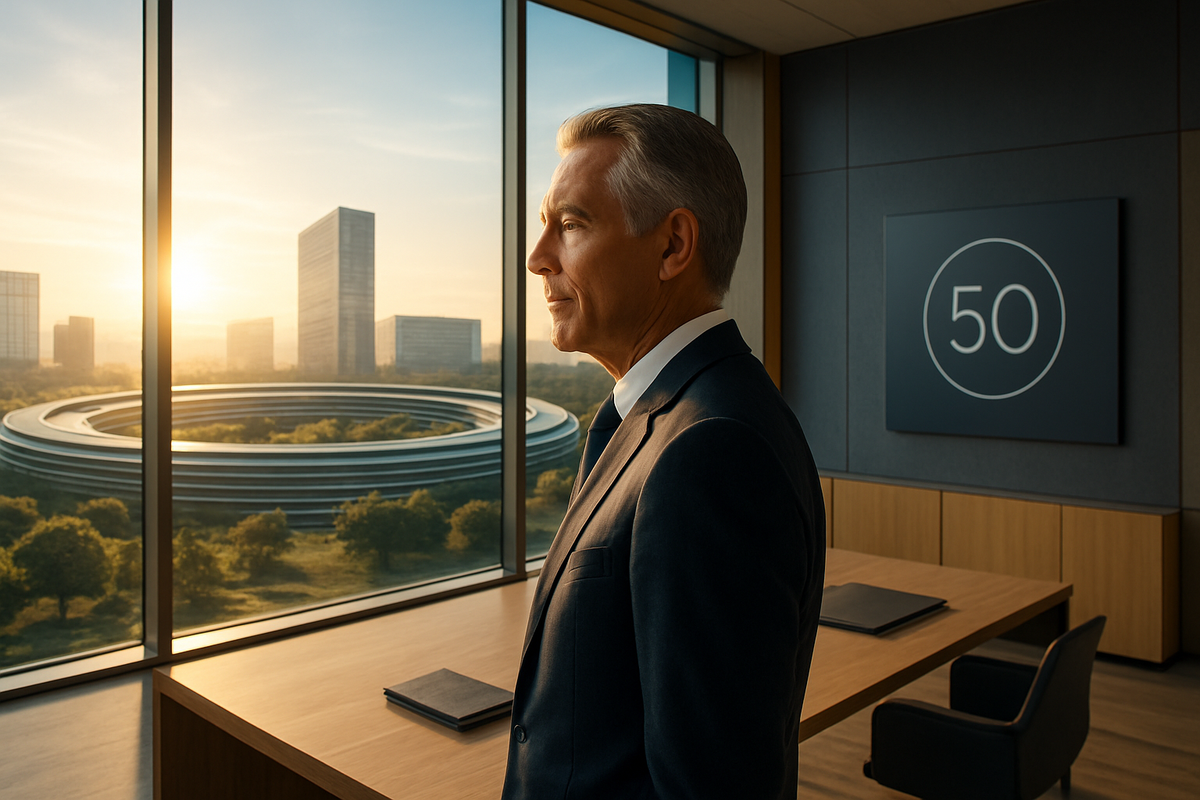
In the short term, the market's attention is fixed on April 1, 2026. Apple's 50th anniversary is expected to be more than just a retrospective; it is rumored to be a launchpad for "Ultra" tier devices, including a potentially revolutionary foldable iPhone or a high-end "MacBook Ultra" designed for professional AI workflows. The company has already begun its "50 Years of Thinking Different" campaign, including the launch of a new Instagram presence and a series of global events celebrating "human creativity." Cook’s presence at the helm during these celebrations ensures the narrative remains focused on the company’s legacy and future, rather than his personal exit.
Longer-term, the strategic pivot toward AI and services remains the cornerstone of the "Cook 2.0" era. Investors will be watching closely to see if Cook utilizes the next few years to finalize Apple’s "walled garden" transition, making the ecosystem even more indispensable to the average consumer. The challenge will be maintaining the high growth rates that the market has come to expect from a company of this scale. Cook must prove that even at 65, he has the vision to lead Apple into the next frontier of computing, whether that be through the Vision Pro line or as-yet-unannounced autonomous systems.
Final Assessment: Stability in a Changing World
Tim Cook’s dismissal of retirement rumors provides a clear signal: the era of stability at Apple is far from over. By stating that life without the company is "unimagined," Cook has tied his personal legacy even more tightly to the firm’s future performance. For the market, this is a "business as usual" signal that should keep volatility in check as the company navigates the complexities of the 2026 fiscal year. The growth from $377 billion to $3.7 trillion is a historic achievement, but the next trillion will likely require a different set of skills—ones that Cook believes he still possesses in abundance.
Investors should watch for the upcoming 50th-anniversary product announcements on April 1st as a barometer for the company’s creative health. While the "Ternus-in-waiting" narrative will continue to simmer in the background, the immediate focus is on whether Apple can turn its half-century milestone into a catalyst for the next decade of growth. As long as Tim Cook remains "unimagined" without Apple, the company’s trajectory appears firmly set on a path of disciplined, massive-scale expansion.
This content is intended for informational purposes only and is not financial advice