As of March 18, 2026, the United States economy finds itself at a crossroads, grappling with a cooling national GDP and the lingering effects of a high-interest-rate environment. However, a starkly different narrative is unfolding in the Southeast. Florida and Georgia have emerged as the dual engines of a regional economic miracle, fueled by a massive influx of capital into data centers, advanced manufacturing, and high-tech logistics. While the broader U.S. economy stares down a projected growth rate of just 1.9%, Florida is currently tracking at 2.3% for 2026, and Georgia is rebounding toward a solid 2.0%, defying the gravity of national macro headwinds.
This resilience is not merely a byproduct of the post-pandemic migration boom, but rather a structural shift in the region's economic identity. The "Sunshine State" and the "Peach State" are no longer just destinations for tourism and agriculture; they have become the preferred theater for the artificial intelligence (AI) infrastructure race and the domestic electric vehicle (EV) supply chain. With the recent ribbon-cutting of multi-gigawatt data center campuses and the full operational ramp-up of the Hyundai "Metaplant," the Southeast is proving that local industrial policy and energy reliability can override national volatility.
A Convergence of Gigawatts and Gateways
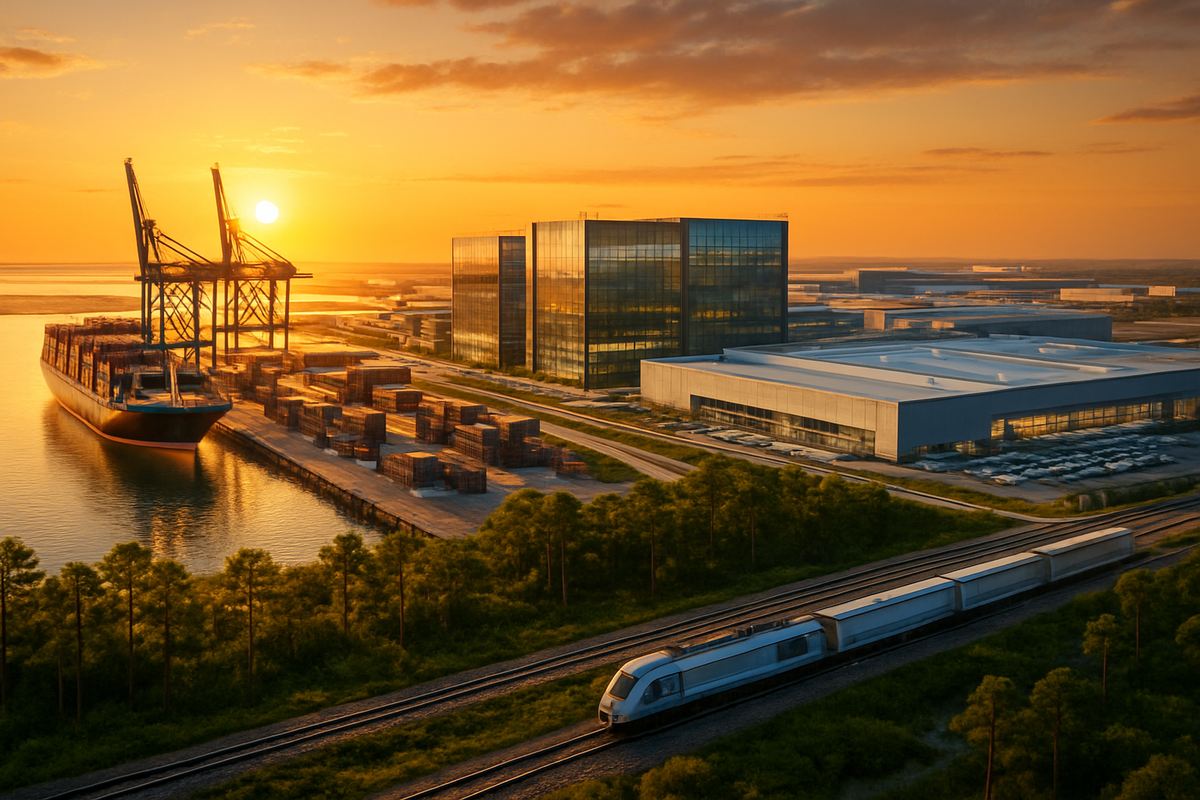
The first quarter of 2026 has been defined by a series of landmark infrastructure milestones. In Georgia, the much-anticipated "Project Steamboat"—a 324-megawatt development by Microsoft (NASDAQ: MSFT)—reached full operational status in Fulton County this month. This project is a cornerstone of a larger trend that has seen Georgia vault into the top three data center hubs in the nation. Meanwhile, in Florida, the narrative has shifted from edge computing to "gigawatt-scale" hosting. The late 2025 announcement of "Project Jarvis" in St. Lucie—a 1,000-megawatt data center campus—has sent ripples through the industry, signaling Florida’s emergence as a primary node for AI training clusters.
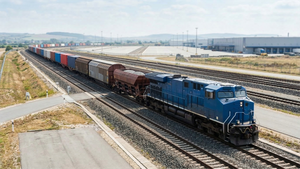
The logistics sector has been equally transformative. The Port of Savannah, managed by the Georgia Ports Authority, is preparing for the Spring 2026 opening of the Blue Ridge Connector. This $127 million inland rail terminal will link the port directly to the manufacturing heartland of Northeast Georgia, effectively bypassing highway congestion and lowering carbon footprints for the region's exporters. In Florida, JAXPORT (Jacksonville Port Authority) recently finalized a $250 million modernization of its Blount Island terminal, which has already begun processing record volumes for Southeast Toyota Distributors. These upgrades are critical as the region becomes the primary gateway for a reshored American supply chain.
On the manufacturing front, the Hyundai Motor Group (OTC:HYMTF) "Metaplant" in Bryan County, Georgia, has moved into its second phase of expansion. Having celebrated its grand opening in early 2025, the facility is now on track to increase its annual capacity to 500,000 vehicles by the end of 2026. This industrial gravity has pulled dozens of tier-one suppliers into the region, creating a "closed-loop" manufacturing ecosystem that is largely insulated from the global shipping disruptions that have plagued competitors in the Midwest and West Coast.
The Corporate Beneficiaries: Powering the Surge
The primary beneficiaries of this regional boom are the utility giants and infrastructure REITs that provide the foundation for industrial growth. NextEra Energy (NYSE: NEE), the parent company of Florida Power & Light, has seen its stock outperform the utility sector as it executes a $90 billion infrastructure plan through 2032. Its late 2025 partnership with Google Cloud (NASDAQ: GOOGL) to build multiple solar-powered data center campuses has positioned it as the "green utility" of choice for big tech. Similarly, Southern Company (NYSE: SO) through its subsidiary Georgia Power, is currently managing a $15 billion grid expansion. With 80% of its new demand coming from data centers, the company is effectively trading on the AI boom as much as on traditional rate-based growth.
In the digital infrastructure space, Equinix (NASDAQ: EQIX) has been a significant winner, expanding its "xScale" campuses in both Hampton, Georgia, and Miami, Florida. These facilities are designed to support the massive power requirements of AI "clusters," and Equinix’s early moves in the region have allowed it to capture high-margin tenants who are fleeing the power-constrained markets of Northern Virginia. On the logistics side, Norfolk Southern (NYSE: NSC) is currently at the center of the market's attention as it navigates a pending merger with Union Pacific, a move that would create the first truly transcontinental railroad. The company’s focus on the "Southeast corridor" has made it indispensable to the new EV plants dotting the Georgia landscape.
However, the rapid growth has not been without its losers. Smaller logistics firms and legacy trucking companies that failed to automate are being squeezed out by giants like UPS (NYSE: UPS), which recently shuttered its older Atlanta hubs in favor of its AI-driven "SMART" facility. Furthermore, real estate developers focused solely on residential projects in Florida are facing headwinds as insurance costs and higher interest rates cool the housing market, even as industrial land prices in the state continue to skyrocket.
A Structural Shift in the Industrial Map
The resilience of the Southeast in 2026 is part of a broader "Great Realignment" of the American industrial map. Historically, the U.S. manufacturing base was centered in the Rust Belt, but the 2026 data shows a definitive tilt toward the "Battery Belt" of the South. This shift is driven by three primary factors: energy availability, pro-business regulatory environments, and integrated logistics. Unlike the Northeast, where power grids are struggling to keep up with data center demand, Southern Company and NextEra have aggressively expanded their nuclear and solar footprints, providing the "energy certainty" that hyperscalers and manufacturers crave.
Regulatory policy has also played a pivotal role. Georgia’s "Ready for Business" site designations and Florida’s aggressive tax incentives for high-tech manufacturing have created a "fast-track" environment that contrasts sharply with the permit-heavy coastal states. This has led to a historical precedent where the Southeast is effectively "decoupling" from national economic cycles. While the U.S. as a whole might be entering a period of stagflation, the Southeast is experiencing a "super-cycle" of investment that mirrors the industrialization of the mid-20th century.
However, this rapid expansion brings new regulatory challenges. Local governments are increasingly concerned about the water usage and noise pollution associated with massive data center campuses. In Georgia, new legislation is being debated in early 2026 that would require data center operators to invest in local water infrastructure as a condition for power access. Additionally, the labor market remains tight; the regional unemployment rate of 3.4% in Georgia and under 4% in Florida has led to significant wage inflation, forcing companies to accelerate their investments in robotics and AI-driven automation.
Navigating the 2027 Horizon
Looking ahead to the remainder of 2026 and into 2027, the Southeast must manage the "growing pains" of its own success. The short-term challenge will be the "air draft" clearance projects at regional ports, such as the power line raising in Jacksonville, which will allow larger neo-Panamax vessels to dock. Until these are completed, logistics bottlenecks could temporarily cap the growth of the manufacturing sector. In the long term, the region will need to ensure that its educational pipeline can produce the specialized technicians required for the semiconductor and aerospace facilities currently under construction, such as L3Harris's (NYSE: LHX) new spacecraft manufacturing site in Palm Bay.
Strategic pivots are already underway. Rivian (NASDAQ: RIVN), after a period of uncertainty, has begun heavy construction on its $5 billion plant in Stanton Springs, Georgia, as of early 2026. The success of this facility will be a bellwether for the "Next Gen" EV market. If Rivian can successfully scale its R2 and R3 platforms from this facility, it will cement Georgia’s status as the global hub for EV production. Conversely, any delays could signal a cooling of the initial EV hype, forcing the state to further diversify into green hydrogen or aerospace.
A New Economic Benchmark
The resilience of Florida and Georgia in 2026 marks the end of an era where these states were seen as secondary to the national economic narrative. By outperforming the U.S. average in GDP and job creation during a period of national cooling, the Southeast has established itself as the new benchmark for industrial and technological growth. For investors, the takeaway is clear: the most stable returns are no longer found in traditional "growth" tech alone, but in the intersection of tech and the physical world—data centers, power grids, and automated logistics.
Moving forward, the market should watch for the "2026 Capacity Crunch." As more data centers come online, the cost of electricity and industrial land will be the primary metrics of success. Investors should monitor the earnings of Southern Company and NextEra for signs of how they are managing the unprecedented load demand. The Southeast has built the "factory of the future," and for now, the world is beating a path to its door.
This content is intended for informational purposes only and is not financial advice.