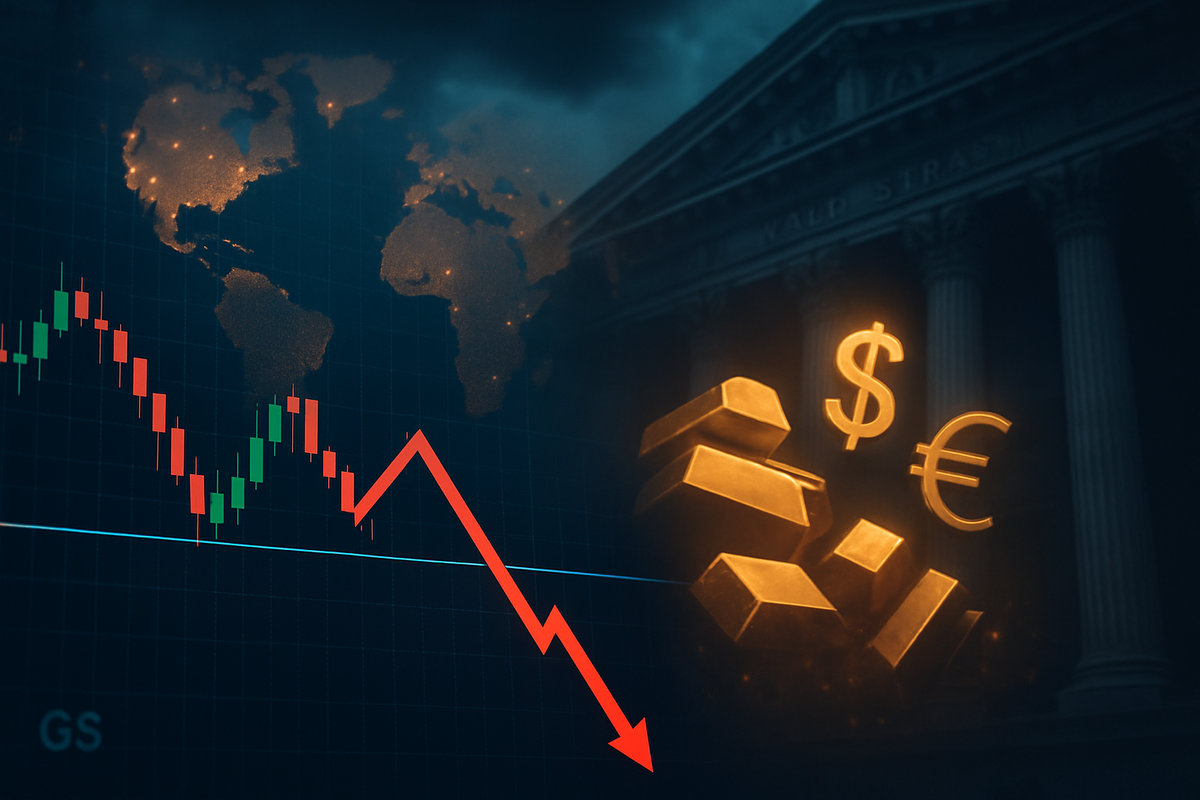
In a dramatic shift for financial markets on March 2, 2026, shares of Goldman Sachs (NYSE: GS) collapsed below a critical technical support level of $868.44, officially completing a bearish "Head and Shoulders" topping pattern that has been months in the making. This technical breakdown occurred against a backdrop of severe global instability, as the Dow Jones Industrial Average (DJIA) plummeted over 500 points to hover near the 48,500 mark. The move represents a stark reversal for the banking giant, which had reached record highs just weeks earlier before being caught in a perfect storm of technical exhaustion and a sudden "flight to safety" among global investors.
The breach of the $868.44 neckline is more than just a chart signal; it reflects a fundamental reappraisal of the investment banking sector's resilience in an era of renewed geopolitical conflict. As Middle Eastern tensions escalated over the weekend, investors aggressively rotated out of high-beta financial institutions and into traditional safe havens. This exodus has punished the major investment banks, which now face a double-edged sword: soaring market volatility that could boost trading revenue, countered by a total freeze in the lucrative mergers and acquisitions (M&A) and initial public offering (IPO) markets that Goldman Sachs typically dominates.
The Anatomy of a Technical Collapse
The technical deterioration of Goldman Sachs began in mid-January 2026, following a historic rally that saw the stock touch an all-time high of $975.86. Analysts at the time noted the formation of a "Head and Shoulders" pattern—a classic indicator of a trend reversal. The "Left Shoulder" formed during a year-end rally in December 2025, followed by the "Head" at the January peak, and a weaker "Right Shoulder" that topped out in early February 2026. The $868.44 level acted as the "neckline," providing a sturdy floor throughout January and February until the heavy selling pressure of late February took hold.
The final blow came during the February 27 trading session, when the stock closed at $859.57, signaling the definitive break of the pattern. By the morning of March 2, the momentum-driven sell-off accelerated, with pre-market prices dipping toward $836.05. This move was catalyzed by a "Black Swan" event over the weekend: a significant escalation in military conflict between U.S./Israeli forces and Iran. The resulting spike in Brent crude oil to over $82 per barrel and a historic surge in gold prices to $5,400 per ounce left investors with little appetite for the risk-sensitive valuations of the banking sector.
Initial market reactions have been swift and unforgiving. Institutional desks that utilize algorithmic trading triggered "sell" orders as soon as the $868.44 level was violated, creating a feedback loop of downward pressure. While Goldman's Fixed Income, Currencies, and Commodities (FICC) trading division is expected to see a windfall from the current market chaos, the broader consensus is that the "Head and Shoulders" completion points toward a technical "measured move" that could see the stock test the $760 level in the coming months if the geopolitical situation does not stabilize.
A Divergent Landscape: Winners and Losers
The market rout of March 2026 has created a stark divide between industries positioned to benefit from chaos and those tied to global economic growth. In the banking sector, the pain is being felt acutely by JPMorgan Chase & Co. (NYSE: JPM), which saw its shares slide as management warned of "sticky" inflation and "pre-2008" market conditions. JPMorgan's recent earnings miss in its investment banking fees has made it a primary target for investors looking to reduce exposure to the financial sector. Morgan Stanley (NYSE: MS) also faced selling pressure, despite recent strong performance in its wealth management arm, as the broader "risk-off" sentiment ignored individual company fundamentals in favor of sector-wide liquidation.
Conversely, the "flight to safety" has been a massive boon for defense contractors and energy firms. Raytheon (NYSE: RTX) and Lockheed Martin (NYSE: LMT) saw their shares jump 6.2% and 2.9% respectively, as the prospect of prolonged regional warfare in the Middle East drove expectations for increased defense spending. Data analytics firm Palantir Technologies (NASDAQ: PLTR) also surged by 5.7% on reports of its software being utilized for frontline military intelligence. In the energy space, Exxon Mobil (NYSE: XOM) and Chevron (NYSE: CVX) moved against the grain of the falling Dow, approaching record levels as oil supplies through the Strait of Hormuz faced credible threats of disruption.
Wider Significance and Historical Precedents
The breakdown of Goldman Sachs is emblematic of a broader industry trend where high-valuation "megabanks" are losing their luster as the primary drivers of market growth. This event draws historical comparisons to the geopolitical shocks of the early 1970s and the 2011 Eurozone crisis, where technical breakdowns in bellwether financial stocks preceded periods of prolonged economic "stagflation." The current spike in oil prices is particularly concerning for the Federal Reserve, as it reignites fears that inflation will remain "higher-for-longer," effectively removing any hope of interest rate cuts in 2026.
Regulatory and policy implications are also looming. As the "flight to safety" pushes capital into gold and Treasuries, liquidity in the private credit and corporate bond markets is beginning to thin. This could lead to increased scrutiny from the Federal Reserve and the SEC regarding the capital buffers of major investment banks. If the volatility persists, there may be renewed calls for tighter risk management protocols, reminiscent of the post-2008 regulatory environment, as policymakers attempt to prevent the "contagion" of Middle Eastern instability from fracturing the domestic financial system.
The Path Forward: Strategic Pivots and Scenarios
In the short term, Goldman Sachs and its peers will likely focus on maximizing their trading desk revenue to offset the cratering of their advisory and underwriting business. A strategic pivot toward "defensive" banking—focusing on cash management and risk-hedging services for corporate clients—is expected to be the priority for the remainder of the first half of 2026. However, if the technical breakdown continues to play out toward the $760 target, Goldman may be forced to consider more aggressive cost-cutting measures or a re-prioritization of its capital allocation to maintain its dividend and share buyback programs.
Market opportunities may emerge in the cybersecurity and alternative energy sectors, which often thrive when traditional global supply chains and energy infrastructures are under threat. For Goldman, the challenge will be navigating a "high-volatility, low-growth" environment where its traditional prestige in M&A carries less weight than its ability to manage extreme tail-risk. Potential scenarios range from a rapid stabilization if diplomatic efforts in the Middle East succeed, to a "bear market" phase for financials if the technical neckline at $868.44 transitions from former support into a permanent ceiling of resistance.
Assessing the Market Moving Forward
The events of March 2, 2026, serve as a potent reminder that even the most prestigious institutions are not immune to the combined force of technical patterns and geopolitical reality. The completion of the Head and Shoulders pattern on Goldman Sachs’ chart is a signal that the post-pandemic "bull era" for investment banking may have reached a definitive end. As the Dow Jones struggles to find its footing, the focus for investors has shifted from growth at any cost to capital preservation and the search for tangible "safe" assets.
Moving forward, investors should watch the $800 psychological level for Goldman Sachs and the 48,000 level for the Dow Jones as the next major lines of defense. The upcoming quarterly earnings season will be critical in determining whether the surge in trading revenue can truly bridge the gap left by the missing M&A fees. For now, the "flight to safety" remains the dominant narrative, and until the geopolitical smoke clears, the technical damage to the banking sector appears both deep and durable.
This content is intended for informational purposes only and is not financial advice.