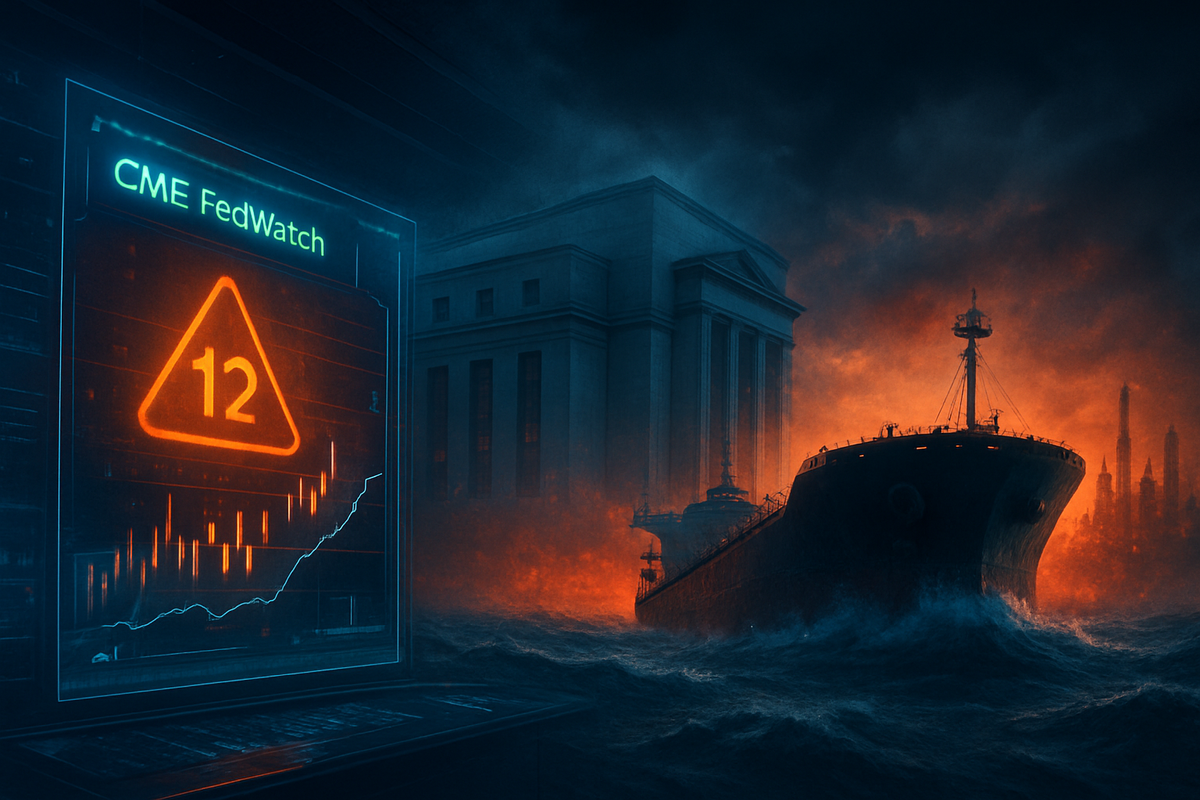
NEW YORK — In a dramatic reversal of the monetary narrative that has dominated global markets for over a year, investors are bracing for the possibility of a renewed tightening cycle. As of March 20, 2026, the CME FedWatch tool, a primary barometer for interest rate expectations, is now signaling a 12% probability of a 25-basis-point rate hike at the Federal Reserve’s upcoming April meeting. While 12% may seem modest in isolation, it represents a seismic shift from just six weeks ago, when the market was pricing in a near-certainty of rate cuts through the summer.
This sudden hawkish pivot has been fueled almost exclusively by a "black swan" energy shock that has sent Brent crude oil prices screaming past $110 per barrel. With the Consumer Price Index (CPI) threatening to breach 3.5% by early summer, the Federal Reserve’s "higher-for-longer" mantra has been replaced by a more aggressive "higher-for-now" urgency. The immediate implication for the market is a "pincer movement" of rising costs and tightening credit, which has already begun to compress valuation multiples across the technology and retail sectors while sparking a massive rotation into energy and defensive havens.
The seeds of this volatility were sown in late February 2026, when an escalation of the U.S.-Israel-Iran conflict led to a partial blockade of the Strait of Hormuz, the world’s most critical maritime oil transit point. Almost overnight, global supply contracted by an estimated 8 million barrels per day, according to the International Energy Agency (IEA). The resulting price spike was instantaneous; West Texas Intermediate (WTI) surged from $68 to over $98 per barrel in less than 20 days, forcing the Federal Open Market Committee (FOMC) to rethink its entire 2026 roadmap.
At the most recent FOMC meeting on March 18, 2026, the Fed opted for a "Hawkish Hold," maintaining the federal funds rate at 3.50% to 3.75%. However, it was the post-meeting press conference by Fed Chair Jerome Powell that truly rattled the markets. Powell characterized the current inflationary pressure as "murky" and refused to rule out further hikes if energy-driven costs begin to bleed into "sticky" core services. This rhetoric was a stark departure from the "dovish pivot" expectations of early January, effectively resetting the 10-year U.S. Treasury yield to 4.38% as investors scrambled to price in the new reality.
The timeline of this shift has been breathtakingly short. In early February, the CME FedWatch tool showed a 0% chance of a hike, with traders instead debating whether the Fed would cut rates by 75 or 100 basis points by year-end. By mid-March, those "pivot bets" were largely abandoned. Market reaction on March 19 and 20 saw the S&P 500 lose nearly 3% of its value in 48 hours, as the realization set in that the "goldilocks" soft landing scenario—low inflation and steady growth—was being replaced by the specter of "stagflation" (rising prices and cooling growth).
In this environment of expensive oil and looming rate hikes, the corporate landscape has split into distinct camps of winners and losers. Energy titans like Exxon Mobil (NYSE: XOM) and Chevron (NYSE: CVX) have emerged as the primary beneficiaries of the supply crunch. Exxon Mobil (NYSE: XOM) shares hit an all-time high of $161.87 this week, as the company’s massive upstream portfolio allows it to capture nearly every dollar of the oil price surge. Similarly, Chevron (NYSE: CVX) has outperformed the broader S&P 500 by nearly 30% year-to-date, fueled by record cash flows that analysts expect will lead to a new round of aggressive share buybacks and dividend hikes.
Conversely, the airline and logistics sectors are under severe duress. United Airlines (NASDAQ: UAL) and Delta Air Lines (NYSE: DAL) have seen their stocks tumble as jet fuel costs—the largest variable expense for carriers—skyrocket. United Airlines (NASDAQ: UAL) is down nearly 17% since the start of the year, as the company warns of mandatory fuel surcharges that could dampen travel demand for the busy summer season. While Delta Air Lines (NYSE: DAL) has been slightly more resilient due to its ownership of a refinery in Pennsylvania, the broader industry is facing a margin squeeze that could lead to consolidated flight schedules and higher consumer fares.
The technology and retail giants are also feeling the heat. Apple (NASDAQ: AAPL) and Amazon (NASDAQ: AMZN) have both seen their share prices sag as the twin threats of higher rates and lower discretionary spending converge. For Apple (NASDAQ: AAPL), the concern is that consumers, pinched by $4-per-gallon gasoline, will delay upgrading to the latest hardware. For Amazon (NASDAQ: AMZN), the challenge is twofold: surging fuel costs for its vast delivery network and rising energy expenses for its AWS data centers, which are the backbone of the current AI infrastructure boom. Amazon (NASDAQ: AMZN) recently announced 16,000 layoffs in a preemptive strike against what it calls a "K-shaped" economic slowdown.
The wider significance of this shift lies in its resemblance to the "stagflationary" shocks of the 1970s and 2022. Historically, energy shocks that occur while the Federal Reserve is already in a restrictive stance have been the most reliable precursors to recessions. Unlike the 2022 oil spike, which occurred as the Fed was just beginning to raise rates from zero, the 2026 shock hits an economy where rates are already at a decade-high 3.5%. This leaves the Fed with very few "easy" choices: they can hike rates to kill inflation at the risk of a deep recession, or they can pause and allow a second wave of inflation to take root.
This event also signals a major disruption to the "AI trade" that has carried the market for the past two years. Many high-growth tech firms have valuations predicated on a "lower-for-longer" interest rate environment. If the 12% probability of an April hike grows into a majority expectation, the "equity risk premium"—the extra return investors demand for holding stocks over safe bonds—will likely expand, leading to a further correction in P/E multiples across the Nasdaq. Furthermore, the geopolitical nature of the oil shock suggests that "energy security" will once again supersede "energy transition" in national policy debates, potentially slowing the momentum of green energy initiatives.
The ripple effects extend beyond the U.S. to major trading partners. A "hawkish Fed" typically strengthens the U.S. dollar, making it more expensive for developing nations to service their dollar-denominated debt. This could trigger a broader emerging market crisis if oil prices remain elevated for more than a single quarter. Comparisons to the 1973 Arab Oil Embargo and the 1979 Iranian Revolution are becoming frequent in research notes, as analysts warn that a protracted closure of the Strait of Hormuz could cut global GDP growth to a meager 0.7% for the 2026-2027 period.
Looking ahead, the next 30 days will be critical for both the Fed and the markets. The short-term possibility is a "volatility spike" as traders await the next round of CPI and PCE inflation data. If headline inflation shows even a minor acceleration, that 12% hike probability could easily jump to 50% or higher. Public companies will likely need to engage in strategic pivots; expect more "cost-cutting" announcements from S&P 500 firms as they attempt to protect margins from rising input costs. JPMorgan Chase (NYSE: JPM) has already begun lowering its valuation of certain loan portfolios, signaling that the banking sector is preparing for a period of increased credit stress.
A market opportunity may emerge for investors who can identify "energy-efficient" winners—companies that can maintain operations with low fuel sensitivity—or those in the "defensive" retail space like Walmart (NYSE: WMT). While Walmart (NYSE: WMT) is not immune to logistics costs, its dominance in the grocery sector provides a "moat" as consumers shift their spending from discretionary items to essentials. In the long term, this crisis may accelerate the "reshoring" of manufacturing as companies seek to shorten supply chains and reduce their exposure to global energy-transit chokepoints.
Potential scenarios range from a "short-lived shock" (if a diplomatic solution is found in the Middle East) to a "full-blown energy recession" (if the blockade persists). In the latter scenario, the Fed may be forced into an emergency "pivot-back-to-cuts" by late 2026, but only after the economy has already entered a contraction. For now, the "unthinkable" has become a distinct possibility, and the market’s "soft landing" hopes have been put on indefinite hold.
In summary, the sudden shift in interest rate expectations is a stark reminder that energy remains the "master resource" of the global economy. The rise of a 12% hike probability in the CME FedWatch tool serves as a warning shot to investors who had become complacent in the "pivot" narrative. Key takeaways include the resurgence of energy as a safe-haven sector, the growing vulnerability of the airline and consumer tech industries, and the very real risk of a "second wave" of inflation that could force the Fed's hand.
Moving forward, the market will likely trade on "headline risk" related to the Middle East and domestic inflation prints. Investors should watch for the "dot plot" revisions in upcoming Fed communications and pay close attention to the price of Brent crude as a leading indicator for the April rate decision. The "unthinkable" April hike is no longer a fringe theory; it is a developing reality that could define the financial landscape for the remainder of 2026.
This content is intended for informational purposes only and is not financial advice.