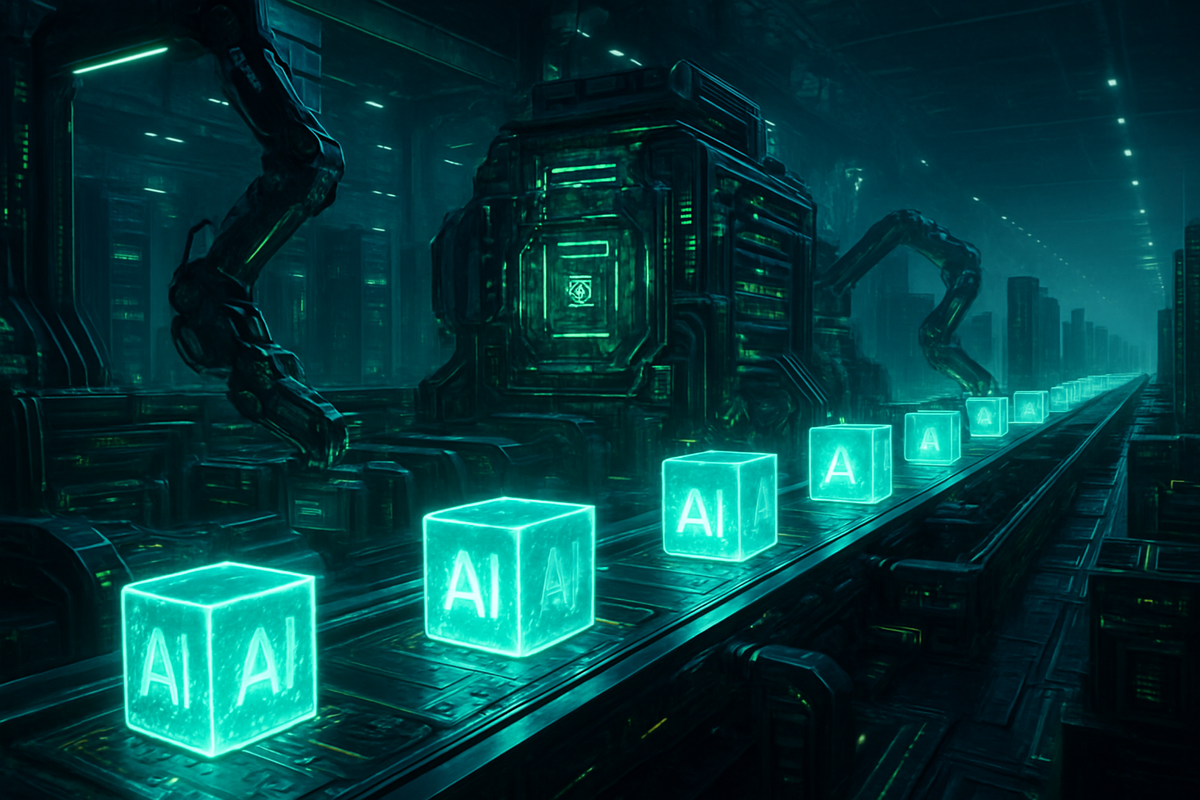
At the GTC 2026 conference in San Jose, Nvidia CEO Jensen Huang delivered a keynote that may redefine the industrial landscape for the next century. Moving beyond the hardware-centric narrative that propelled the company to a multi-trillion-dollar valuation, Huang officially pitched "AI Tokens" as a new, fundamental market category. In this vision, the data centers of the past have been replaced by "AI Factories," production facilities where raw electricity and data are the fuel, and the primary unit of economic output is the "token"—a discrete packet of machine-generated intelligence.
The immediate implications of this shift are profound. By framing AI as a manufactured commodity rather than a software tool, Nvidia (NASDAQ: NVDA) is positioning itself as the indispensable architect of a "Token Economy." This pivot suggests that the era of "training mania"—the 2023-2024 rush to build massive models—has matured into the "Inference Inflection," where the global market’s focus shifts to the continuous, industrial-scale production of reasoning. As Huang noted during his address, "The first industrial revolution produced electricity; the second, with the help of the AI Factory, produces intelligence."
The Birth of the Token Economy: GTC 2026 and the Vera Rubin Era
The center of Huang’s presentation was the official unveiling of the Vera Rubin architecture, the highly anticipated successor to the Blackwell line. Named after the pioneering astronomer who provided evidence for dark matter, the Rubin platform is a "seven-chip" integrated system designed specifically for the high-throughput production of tokens. The timeline leading to this moment has been a relentless march toward vertical integration. Following the successful rollout of Blackwell in 2024 and 2025, Nvidia moved to consolidate the entire data center stack, culminating in the Rubin architecture's ability to deliver a 35x improvement in inference performance.
Key to this new market category is Huang’s "Tokens per Watt" metric. At GTC 2026, he introduced a mathematical formula for the modern CEO: Revenue = (Tokens per Watt) × (Available Gigawatts). This framing forces enterprises to view energy efficiency as a direct revenue multiplier rather than just a cost center. By defining the AI token as a measurable unit of output—much like a kilowatt-hour of electricity or a barrel of oil—Nvidia has created a standardized way for the financial markets to value the "productivity of the mind."
The reaction from industry stakeholders has been nothing short of transformative. Major cloud providers and sovereign nations are already lining up to build what Huang calls "1-Gigawatt AI Factories." These facilities, projected to cost upwards of $100 billion each, are expected to generate $150 billion in annual revenue by selling tiered "token packages." The industry has responded with "Inference Inflection" fever, as analysts from major firms like Goldman Sachs and Morgan Stanley project a $1 trillion order book for Nvidia’s infrastructure through 2027.
Winners and Losers in the Industrialization of Intelligence
The shift to a token-based economy has created a clear hierarchy of winners. Chief among them is Taiwan Semiconductor Manufacturing Company (NYSE: TSM), which remains the "ultimate gatekeeper" of the 2nm (N2) node required for the Rubin chips. With its capacity booked through 2026, TSMC has successfully leveraged its monopoly to implement significant price hikes. Close behind is Vertiv Holdings (NYSE: VRT), often called the "Utility Company of the AI Era." As AI Factories push rack densities to 150kW, Vertiv’s liquid cooling systems have become a non-negotiable component of the infrastructure, resulting in a record-breaking $15 billion backlog.
In the networking space, Arista Networks (NYSE: ANET) has emerged as a primary beneficiary of the transition toward Ethernet-based AI back-ends. While Nvidia’s proprietary InfiniBand was the early standard, the hyperscale demand for open 1.6T switches has allowed Arista to capture significant market share. Similarly, Micron Technology (NASDAQ: MU) is seeing explosive demand for its HBM4 (High-Bandwidth Memory), which acts as the critical storage layer for the billions of tokens being generated in real-time.
Conversely, the "Token Economy" poses an existential threat to legacy players. Intel (NASDAQ: INTC) has found itself increasingly marginalized, as it was notably absent from Nvidia's Vera CPU roadmap. While Intel continues to compete in the low-cost inference niche, its traditional dominance in the server market is being eroded by Nvidia’s integrated ARM-based Grace and Vera CPUs. Furthermore, legacy Software-as-a-Service (SaaS) companies that have been slow to pivot from "retrieval-based" tools to "agentic-reasoning" models are facing what some analysts call a "platform extinction event." In a world where intelligence is manufactured at scale, basic software licenses are being devalued in favor of token-based "Agents-as-a-Service."
From Training to Inference: The Wider Significance of AI Manufacturing
This event marks a historic shift in how the technology sector fits into the broader global industry. Historically, computing was viewed as an overhead expense—a cost of doing business. Huang’s "Token Economy" flips this narrative, turning compute into a manufacturing process. This shift mirrors the transition from the artisanal era to the assembly line; we are moving from "bespoke AI models" to "mass-produced AI tokens." This fits into the broader trend of "Sovereign AI," where nations like Saudi Arabia, Japan, and France are investing in state-owned AI Factories to ensure their "intelligence independence."
The ripple effects are reaching beyond the tech sector into global energy policy and regulation. The demand for "gigawatt-scale" factories has forced a renewed conversation about nuclear energy and grid modernization. Regulatory bodies are now beginning to consider how to monitor the "token supply," much like central banks monitor the money supply. If tokens are the new currency of productivity, then the companies and nations that control the "token presses" hold immense geopolitical and economic power.
Historically, this moment draws comparisons to the electrification of the United States in the early 20th century. Just as General Electric and Westinghouse didn't just sell lightbulbs but the entire infrastructure for a new way of living, Nvidia is selling the entire infrastructure for a new way of thinking. This is the industrialization of cognition, and the AI token is the fundamental unit of that new reality.
The Road Ahead: Agentic Scaling and the 1GW Frontier
Looking forward, the next phase of the "Token Economy" involves the rise of "Agentic AI." Unlike the simple chatbots of 2023, these autonomous agents are designed to perform complex multi-step reasoning, often consuming millions of internal "thinking tokens" before providing a single answer to a user. This "fourth scaling law" suggests that AI performance will no longer be limited by the size of the training data, but by the amount of "inference compute" or "thinking time" allocated to an agent.
Strategic pivots will be required from the "Magnificent Seven." Microsoft (NASDAQ: MSFT), Alphabet (NASDAQ: GOOGL), and Amazon (NASDAQ: AMZN) are already aggressively scaling their custom silicon projects—Maia, TPU, and Trainium/Inferentia—to provide a lower-cost alternative to Nvidia's premium tokens. The challenge for these cloud giants will be balancing their massive capital expenditures on Nvidia hardware with their desire to control their own token production costs. In the long term, we may see a tiered market emerge: "Commodity Tokens" produced on custom cloud silicon for basic tasks, and "High-Reasoning Tokens" produced on Nvidia’s Rubin architecture for complex scientific and financial research.
Conclusion: Navigating the Tokenized Future
Jensen Huang’s pitch at GTC 2026 has successfully reframed Nvidia’s hardware as the "machinery of the mind." The key takeaway for the market is that the AI revolution is no longer just a software trend; it is a physical, industrial buildout of unprecedented scale. The "AI Token" has emerged as the defining metric of this era, serving as the bridge between raw electrical power and economic value. As the world transitions toward the "Inference Inflection," the focus will remain on "Tokens per Watt" as the ultimate measure of competitive advantage.
Moving forward, the market will be defined by the race to build 1-Gigawatt factories and the ability of corporations to integrate "Agentic AI" into their workflows. Investors should keep a close watch on capital expenditure cycles from hyperscalers and the progress of the Vera Rubin rollout throughout 2026. The shift from "SaaS" to "Intelligence-as-a-Service" is well underway, and in this new economy, those who control the production of tokens will likely control the future of industry itself.
This content is intended for informational purposes only and is not financial advice.