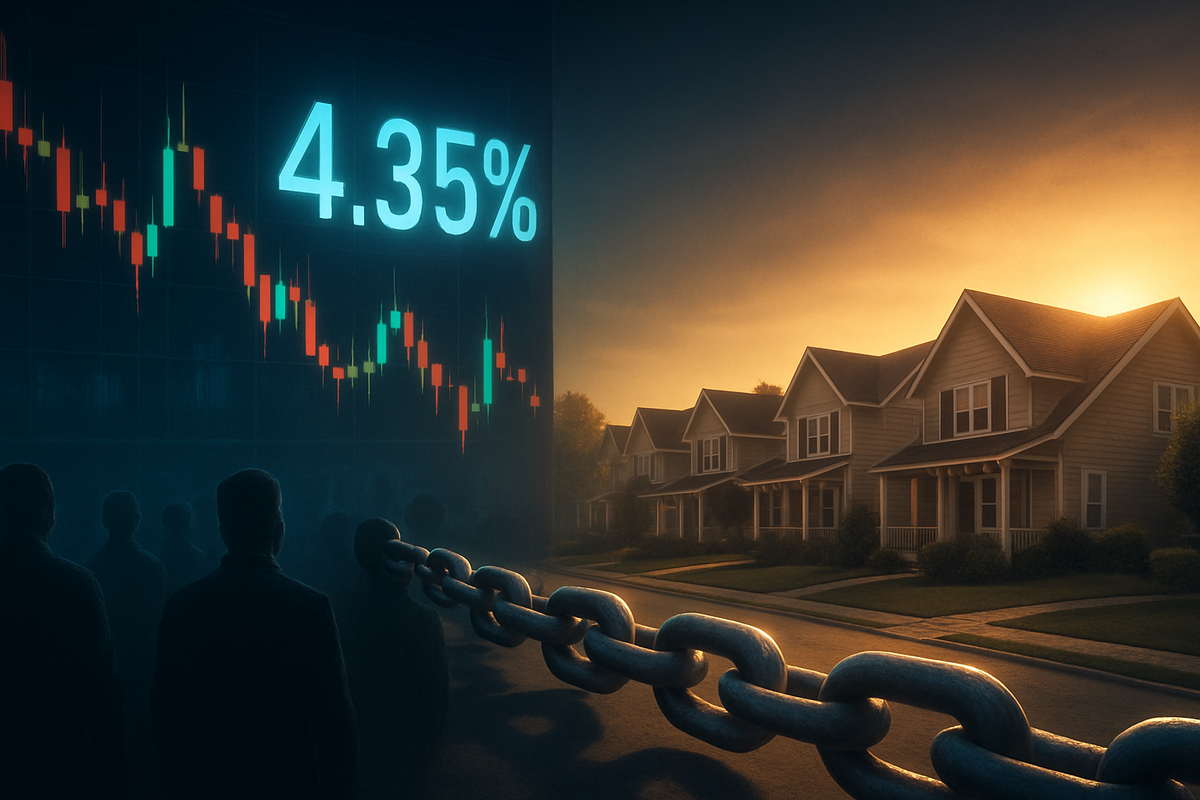
The financial landscape shifted violently today, March 20, 2026, as the benchmark 10-year U.S. Treasury yield surged to 4.35%, its highest level in over a year. This aggressive breakout marks a definitive end to the brief period of "yield relief" seen throughout 2025 and signals a "higher-for-longer" interest rate environment that is already reverberating through every corner of the economy. From the kitchen tables of middle-class families to the glass-walled boardrooms of Silicon Valley, the implications of this 4.35% threshold are profound and immediate.
For U.S. households, the spike translates directly into more expensive debt, effectively cooling a housing market that had only just begun to recover. Simultaneously, on Wall Street, the jump is acting as a "valuation anchor," dragging down high-growth sectors—most notably technology—as the "risk-free" rate of return offered by government bonds becomes increasingly attractive compared to the uncertain future profits of even the most dominant tech giants.
The Path to 4.35%: A Convergence of Global Shocks
The climb to 4.35% was not a slow ascent but rather a sharp breakout triggered by a "perfect storm" of macroeconomic pressures. Following a period of relative stability and Federal Reserve easing in early 2025, yields began to creep upward in the first quarter of 2026. The primary catalyst for today’s jump was a sudden geopolitical energy shock, as renewed conflicts in key oil-producing regions sent crude prices soaring, reigniting fears of "sticky" inflation that the Fed might be unable to suppress without further tightening.
Throughout the trading session, market participants watched in real-time as the 10-year yield—often considered the world’s most important interest rate—breached key technical resistance levels. The move was fueled by a massive sell-off in the bond market, as institutional investors repositioned their portfolios in anticipation of a more hawkish stance from the Federal Open Market Committee (FOMC). By midday, the yield had solidified its position at 4.35%, sparking a wave of volatility across global equity markets.
Key stakeholders, including primary dealers and treasury secretaries, have been forced to recalibrate their forecasts. The initial market reaction was swift: the Nasdaq Composite plunged over 2% within hours, while the U.S. dollar strengthened against major peers. Traders have largely abandoned bets on any further rate cuts for the remainder of 2026, moving instead to price in a "neutral rate" that is structurally higher than anything the market has seen in nearly two decades.
Winners and Losers in a High-Yield Era
The most immediate "losers" in this environment are the technology behemoths that lead the market indices. Apple (NASDAQ: AAPL) and Microsoft (NASDAQ: MSFT) have both seen their share prices pressured as investors apply higher discount rates to their future earnings. Under a standard Discounted Cash Flow (DCF) model, as the "risk-free rate" (the 10-year yield) rises, the present value of future cash flows diminishes. For Apple, the challenge is twofold: its valuation is being compressed while its consumer base faces higher borrowing costs for its premium hardware. Even the vanguard of the artificial intelligence revolution, Nvidia (NASDAQ: NVDA), has not been immune; despite its massive revenue growth in 2026, the stock faced a sharp sell-off today as traders de-risked and locked in gains.
Conversely, some sectors are finding a silver lining in the rising yields. Large-cap financial institutions, such as JPMorgan Chase & Co. (NYSE: JPM), typically benefit from expanding Net Interest Margins (NIM) as the spread between what they pay depositors and what they charge for loans widens. Similarly, companies in the energy and materials sectors, like Exxon Mobil Corp. (NYSE: XOM), often act as hedges against the inflation that is currently driving yields higher. These "real asset" plays are increasingly seen as safe havens for capital fleeing the high-duration volatility of the tech sector.
For the American consumer, the news is almost entirely negative. The 10-year Treasury yield serves as the primary benchmark for 30-year fixed mortgage rates. With the yield at 4.35%, mortgage rates are expected to surge toward the 7.35% range, effectively pricing out thousands of prospective homebuyers. Furthermore, interest rates on auto loans and private student debt—which track the 10-year closely—are projected to exceed 8.5%, further straining household discretionary spending and threatening to slow down the broader consumer economy.
Broader Significance and Historical Precedents
The jump to 4.35% is a significant "wake-up call" because it echoes the volatility of late 2023 when yields briefly touched 5%. At that time, 4.35% was considered the "breakout zone" that triggered a major market rotation. In the context of March 2026, this move suggests that the low-inflation, low-rate environment of the 2010s was an anomaly rather than the norm. The market is now coming to terms with a structural shift where "cheap money" is no longer a guaranteed lubricant for economic growth.
This event also highlights a growing divergence in the global economy. While the U.S. deals with sticky inflation and rising yields, other major economies are struggling with stagnation, leading to a "strong dollar" problem that could hurt the international earnings of American multinationals. The regulatory implications are also mounting; the Federal Reserve now faces the difficult task of balancing financial stability—as higher yields put pressure on bank balance sheets—with its mandate to maintain price stability in the face of an energy-driven inflation spike.
Historically, periods of rapidly rising yields have often been the precursor to economic cooling or even recession. The current yield curve remains under intense scrutiny; if the jump in the 10-year yield is followed by even higher short-term rates, the "inverted yield curve" could signal deeper trouble ahead. For now, the 4.35% level serves as a psychological barrier that has been decisively broken, forcing a re-evaluation of what constitutes a "fair" price for risk in the mid-2020s.
The Road Ahead: Strategic Pivots and Market Resilience
In the short term, investors should prepare for continued volatility as the market searches for a new equilibrium. High-growth companies that lack current profitability will likely see the most significant "valuation haircuts," forcing many to pivot toward aggressive cost-cutting and a focus on immediate cash flow rather than distant "moonshot" projects. We may see a slowdown in capital expenditures (CapEx) across the tech sector, as the cost of financing new data centers and AI infrastructure becomes increasingly burdensome.
Long-term, this environment may create a "Great Shakeout," where only the most well-capitalized firms survive and thrive. Market opportunities may emerge in the form of high-quality corporate bonds, which now offer yields competitive with the stock market for the first time in years. For households, the strategic adaptation will likely involve a "wait and see" approach to big-ticket purchases, potentially leading to a cooling of the red-hot luxury and real estate markets.
Potential scenarios moving forward include a "plateau effect," where yields stabilize around 4.5% if inflation begins to taper off, or a further climb toward 5% if energy prices remain unchecked. Investors will be closely watching the upcoming FOMC minutes and the next round of Consumer Price Index (CPI) data to see if the Fed plans to intervene or if they will allow the market to self-correct through higher borrowing costs.
Final Assessment: A New Reality for 2026
The jump in the 10-year Treasury yield to 4.35% is more than just a technical milestone; it is a fundamental recalibration of the cost of capital in the modern economy. The "soft landing" narrative that dominated 2025 has been dealt a significant blow, and the market must now navigate a landscape where the "risk-free" return is a formidable competitor to equity growth. The era of easy gains driven by multiple expansion is, for now, over.
Key takeaways for investors moving forward include the importance of "yield-sensitive" positioning and a focus on balance sheet strength. Companies with high debt loads and low current earnings will remain under pressure, while those with significant cash reserves and the ability to pass on costs to consumers will be the winners of this cycle. The market is moving toward a "show me the money" phase, where actual earnings and dividends carry more weight than future potential.
As we move through the second quarter of 2026, the primary metric to watch will be the resilience of the American consumer. If household spending remains robust despite 7%+ mortgage rates and high-interest credit cards, the economy may yet avoid a downturn. However, the 4.35% yield represents a tightening of the economic noose that few can ignore, and its lasting impact will likely be felt for years to come.
This content is intended for informational purposes only and is not financial advice.