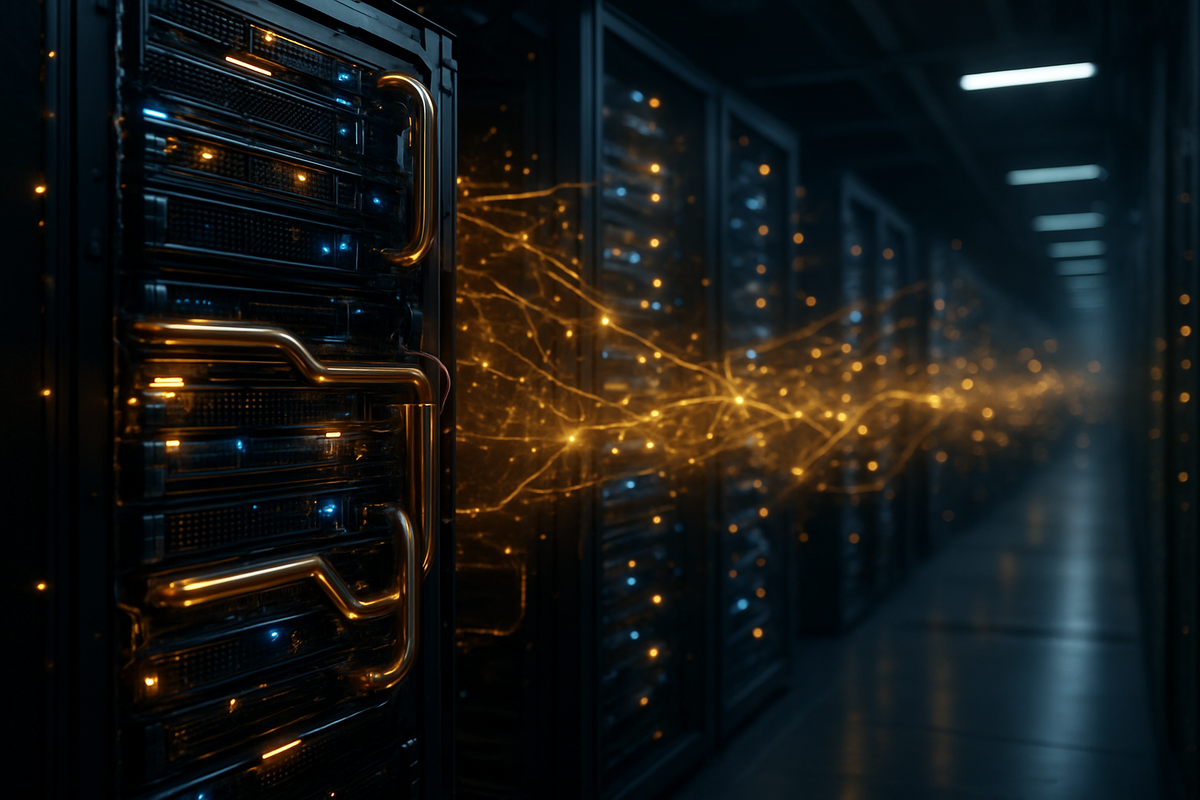
As of late March 2026, the global financial landscape has shifted its focus from the software "AI hype" of previous years toward the physical infrastructure required to sustain it. At the center of this industrial pivot stands Dell Technologies (NYSE: DELL), which has transformed itself from a legacy PC and storage provider into the primary architect of the "AI Factory." Following a record-breaking fiscal year 2026 that concluded in January, the company has seen its market capitalization soar, driven by a nearly insatiable demand for high-end AI servers and a strategic pivot into the electrical and thermal management of modern data centers.
The implications for the broader market are profound. Dell’s massive $43 billion AI server backlog serves as a leading indicator for the health of the entire hardware sector. As the company successfully navigates a "flight to quality" from more volatile competitors, its performance has become a bellwether for the industrial-scale deployment of generative AI. Investors are no longer just looking at chips; they are looking at the integrated systems, cooling solutions, and power management that Dell has mastered to keep the world’s most powerful GPUs running.
The $113 Billion Milestone: A New Era of Hardware Supremacy
The timeline of Dell’s ascendancy reached a fever pitch in February 2026, when the company reported its full-year fiscal 2026 earnings. The results were nothing short of a paradigm shift: total revenue hit a record $113.5 billion, a 19% increase year-over-year, largely fueled by a 342% explosion in AI-optimized server shipments during the fourth quarter alone. This performance was anchored by the successful rollout of the 17th Generation PowerEdge line, specifically the XE9780 models built on the NVIDIA (NASDAQ: NVDA) Blackwell architecture.
Key players in this success include CEO Michael Dell and COO Jeff Clarke, who orchestrated a deep-tier partnership with NVIDIA dubbed the "Dell AI Factory." This initiative provides a full-stack solution—integrating hardware, proprietary software, and consulting services—that has become the default choice for Fortune 500 enterprises and "Sovereign AI" projects in the Middle East and Southeast Asia. The market reaction has been overwhelmingly bullish; as of March 25, 2026, Dell’s stock is trading in the $155–$165 range, representing a 64% gain over the past twelve months.
Beyond the servers themselves, Dell has moved aggressively into the "plumbing" of the data center. Recognizing that the newest chips generate unprecedented heat, Dell integrated liquid cooling technologies directly into its supply chain. By partnering with thermal management leaders, Dell now offers racks capable of handling up to 480kW of power—a nearly twenty-fold increase from industry standards just two years ago. This move has allowed Dell to capture a larger share of the total data center "spend," moving beyond the server and into the power and cooling infrastructure.
Winners and Losers in the Infrastructure Arms Race
The primary beneficiary of Dell’s rise, other than its own shareholders, is Vertiv Holdings Co (NYSE: VRT). As Dell’s primary partner for modular data center components and Direct Liquid Cooling (DLC) technologies, Vertiv has seen its order book swell alongside Dell’s server backlog. The two companies have essentially created a "turnkey" AI data center solution that allows enterprises to bypass the multi-year wait times associated with traditional data center construction. Similarly, NVIDIA (NASDAQ: NVDA) continues to win as Dell remains its largest and most reliable channel for getting high-end Blackwell and Vera Rubin chips into the hands of enterprise customers.
Conversely, Super Micro Computer (NASDAQ: SMCI), once the darling of the AI hardware boom, has found itself on the losing end of a "flight to quality." Throughout late 2025 and early 2026, persistent governance concerns and supply chain investigations led many Tier-2 cloud providers to migrate their orders to Dell. While Super Micro remains a speed leader in the market, its margins have been compressed to a razor-thin 6.4% as it fights to retain market share through aggressive pricing. Dell’s superior scale and balance sheet have allowed it to absorb supply chain shocks that have left smaller players struggling.
Hewlett Packard Enterprise (NYSE: HPE) presents a more complex picture. While HPE has successfully pivoted toward high-margin networking through its acquisition of Juniper Networks, its AI server backlog of approximately $5 billion is dwarfed by Dell’s $43 billion. HPE is finding success in niche "Sovereign AI" markets and networking-heavy deployments, but in the pure-play battle for the AI enterprise data center, Dell has established a clear lead. For investors, the "hardware trade" has narrowed from a broad rising tide to a selective group of dominant, integrated players.
The Global Supply Chain Realignment and the AI PC Cycle
Dell’s performance is a cornerstone of two broader industry trends: the "China Exit" strategy and the AI PC super-cycle. By March 2026, Dell has nearly completed its mandate to remove all Chinese-made chips from its enterprise products, a move that has forced a massive realignment of the global electrical component supply chain toward manufacturing hubs in Malaysia, Vietnam, and Ireland. This shift has not only mitigated geopolitical risk but has also given Dell a more resilient, if initially more expensive, supply chain than many of its competitors.
The "AI PC" is the second major tailwind. Over 55% of Dell’s commercial shipments now consist of "Copilot+ PCs" featuring integrated Neural Processing Units (NPUs). This transition, supported by Microsoft (NASDAQ: MSFT), has triggered a long-awaited corporate refresh cycle. This is no longer just about laptops; it is about the components inside. The demand for low-power, high-performance silicon, and specialized DRAM and NAND has surged, with Dell utilizing its massive purchasing power to secure priority allocations during a period where memory prices have nearly doubled.
Historically, the hardware market has been viewed as cyclical and low-margin. However, the current event mirrors the build-out of the internet backbone in the late 1990s, but with a crucial difference: Dell is demonstrating sustained high-margin growth through proprietary services and software integration. The company has moved from being a "box mover" to a "solution provider," a transition that has fundamentally changed how the market values hardware manufacturers in the AI era.
What Comes Next: The Vera Rubin Era and Sovereign AI
In the short term, the market will be watching the transition from the NVIDIA Blackwell architecture to the next-generation Vera Rubin (NVL72) platform. Dell has already announced its PowerEdge XE9812, designed specifically for these exascale workloads. The challenge for Dell will be managing the sheer physical scale of these systems, which require even more sophisticated power and cooling infrastructure. Strategic pivots into modular, prefabricated data centers will likely become the company’s next major growth engine, as customers look for "instant" AI capacity.
Longer-term, the rise of "Sovereign AI"—where nations build their own domestic computing power to ensure data sovereignty—represents a multi-billion dollar opportunity. Dell’s ability to navigate complex international regulations and provide a secure, non-Chinese-dependent supply chain puts it in a unique position to win these massive government contracts. However, potential challenges include the volatility of memory prices and the potential for a "digestion period" where customers focus on implementing the hardware they have already purchased before ordering more.
A Legacy Transformed: Key Takeaways for the Future
As we look toward the remainder of 2026, the transformation of Dell Technologies is complete. The company has successfully shed its image as a desktop computer manufacturer and emerged as the indispensable backbone of the AI economy. With a record $113.5 billion in revenue and a backlog that stretches well into 2027, Dell has proven that in the AI era, hardware is not a commodity—it is the foundational constraint and the primary enabler of progress.
For investors, the key takeaway is the importance of integration. Dell’s success is not just about selling servers; it is about the synergy between its partnership with NVIDIA, its thermal management expertise through Vertiv, and its global logistics scale. Moving forward, the market will closely monitor Dell’s ability to maintain its ~18% margins in the face of rising component costs. While the "easy money" of the initial AI surge may have been made, Dell’s position as a "contracted infrastructure compounder" makes it a central fixture of the modern technology portfolio.
This content is intended for informational purposes only and is not financial advice.