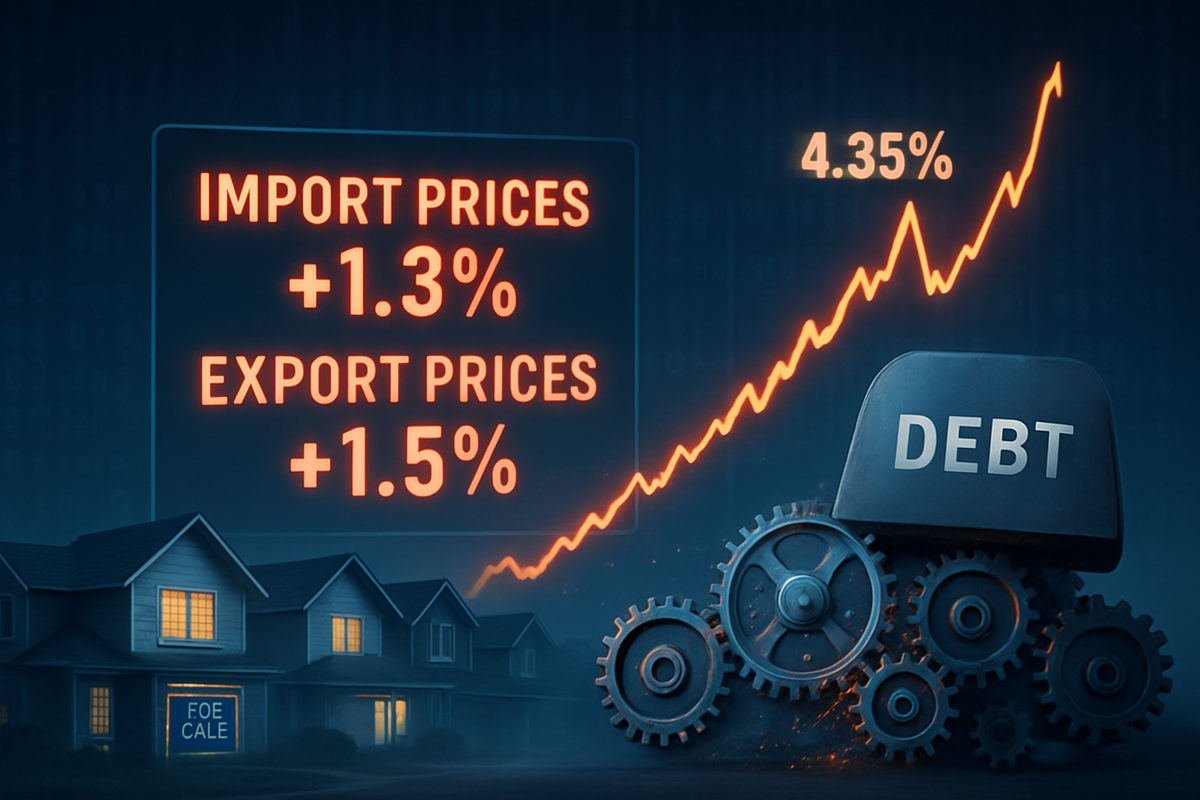
WASHINGTON, D.C. — The U.S. economic landscape shifted dramatically on March 26, 2026, as the Bureau of Labor Statistics released trade inflation data that caught Wall Street off guard. Import prices surged by 1.3% in February, while export prices climbed 1.5%, marking the sharpest monthly increase in nearly four years. This unexpected inflationary pulse, fueled by geopolitical tensions and preemptive trade maneuvers, has sent shockwaves through the financial markets, casting a shadow over the "soft landing" hopes that dominated the early part of the year.
The immediate implications are stark: the data suggests that the "last mile" of the inflation fight is becoming a marathon rather than a sprint. With the 10-year Treasury yield breaching the critical 4.35% threshold, the cost of borrowing is tightening its grip on the economy. This dual pressure of rising input costs and escalating interest rates is hitting interest-sensitive sectors—specifically housing and small-cap stocks—with a force not seen since the post-pandemic volatility of 2022.
A "Perfect Storm" of Trade Shocks and Sticky Inflation
The February trade price spike was driven by a combination of "core" goods inflation and volatile energy costs. While fuel imports rose 3.8% due to ongoing military friction in the Middle East, the 1.1% jump in core import prices (excluding food and fuel) signaled a deeper structural issue. Economists point to "tariff front-running" as a primary culprit; businesses have been aggressively importing goods to beat anticipated tax hikes, inadvertently driving up the very prices they were trying to hedge against. This surge occurred alongside a weakening U.S. dollar, which fell roughly 7% over the previous year, making imported components significantly more expensive for American manufacturers.
Initial market reactions were swift and unforgiving. As the data hit the wires at 8:30 AM ET, the 10-year Treasury yield surged from 4.21% to 4.35% within the hour. Equity futures immediately turned red, with investors bracing for a more hawkish Federal Reserve. The timeline leading to this moment began in late 2025, when a fragile recovery in the manufacturing sector started to collide with rising national debt—now surpassing $39 trillion—and persistent fiscal deficits that have kept upward pressure on long-term rates.
Key stakeholders, including Federal Reserve officials and trade policy advisors, are now facing a difficult recalibration. The consensus view that the Fed would begin a steady rate-cutting cycle in mid-2026 is now being questioned. Instead, market participants are pricing in a "higher for longer" scenario, or even the outside possibility of a defensive rate hike if headline CPI continues its march toward the projected 4.3% in the second quarter.
Sector Casualties: Housing Giants and Small-Cap Vulnerability
The most immediate casualties of the yield spike are the nation's homebuilders. Shares of major players like D.R. Horton (NYSE: DHI) and Lennar (NYSE: LEN) faced selling pressure as the 30-year fixed mortgage rate climbed toward 6.5%. The housing market, which had shown signs of life in late 2025, is now stalling as affordability reaches a breaking point. For companies like Lennar, the rising cost of imported raw materials—timber, steel, and electronics—compounds the problem, squeezing profit margins from both the supply and demand sides.
Small-cap stocks, as represented by the iShares Russell 2000 ETF (NYSEARCA:IWM), entered a technical correction on the news, falling more than 10% from their recent highs. Unlike large-cap technology firms that sit on mountains of cash, approximately 32% of the debt held by companies in the Russell 2000 is floating-rate. As yields rise, these companies see their interest expenses balloon almost instantly. Furthermore, many small-cap firms are facing a "maturity wall" in 2026, requiring them to refinance pandemic-era debt at rates that are now double or triple what they were previously paying.
Conversely, the energy sector is emerging as a defensive winner. ExxonMobil (NYSE: XOM) and other major producers are benefiting from the same supply constraints and geopolitical risks that are driving trade inflation higher. As export prices for U.S.-produced energy climb, these firms are seeing record cash flows, providing a rare bright spot for value-oriented investors in an otherwise turbulent market.
Wider Significance: A Return to 1970s-Style Volatility?
This current event fits into a broader trend of "de-globalization" and the weaponization of trade policy. The 2026 inflation spike echoes the late 1970s, where energy shocks and structural economic shifts led to a decade of stagflation. However, the modern twist includes a massive $39 trillion debt burden that limits the government's ability to provide fiscal stimulus without further fueling inflation or driving yields even higher.
The ripple effects are extending to America’s trading partners. As the U.S. imports less due to higher costs, export-heavy economies in Europe and Asia are feeling the chill. Regulatory and policy implications are also looming large; the Federal Reserve may be forced to maintain a restrictive stance even as economic growth slows, a "hawkish pause" that could test the resilience of the labor market. Historical precedents, such as the 2018 trade war period, suggest that when trade inflation and rising yields coincide, the result is typically a period of prolonged market volatility and a rotation away from growth-oriented assets.
The Road Ahead: Navigating the "Maturity Wall"
In the short term, the market will likely undergo a "de-risking" phase. Investors are expected to move away from small-cap growth stocks and toward defensive sectors like utilities and consumer staples. The immediate challenge for the corporate world is the 2026 refinancing cycle. Companies that failed to lock in long-term low rates during the 2021-2024 window now face a grueling environment where capital is both expensive and scarce.
Strategic pivots will be required for businesses to survive this new era of "sticky" inflation. We may see an acceleration of "near-shoring"—moving production closer to the U.S. to avoid trade-related price shocks—though this transition takes years, not months. For the housing sector, the focus will likely shift toward smaller, more affordable "starter homes" and multi-family units as the dream of the suburban single-family home becomes increasingly out of reach for the average buyer.
Wrap-Up: A New Macro Reality for Investors
The trade inflation data of March 26, 2026, serves as a stark reminder that the global economy remains in a state of flux. The primary takeaway is that inflation is not yet defeated, and the "cost of everything"—from imported goods to the money used to buy them—is rising. The 10-year Treasury yield at 4.35% acts as a valuation anchor, dragging down high-multiple stocks and freezing the housing market.
Moving forward, the market is likely to remain in a "wait-and-see" mode regarding the Federal Reserve's next move. Investors should closely watch the upcoming CPI releases and corporate earnings reports for signs of margin compression. The era of cheap money is firmly in the rearview mirror, and the coming months will distinguish the resilient companies with strong balance sheets from those caught on the wrong side of the 2026 maturity wall.
This content is intended for informational purposes only and is not financial advice.