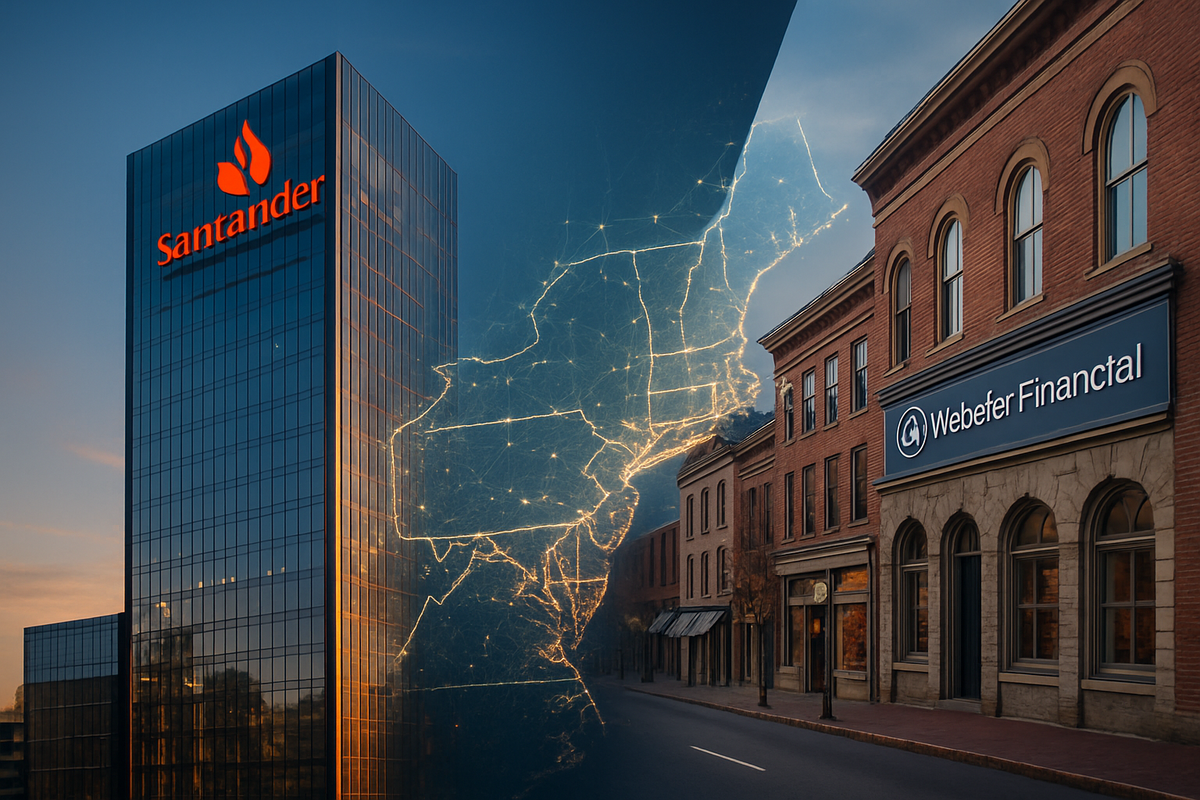
In a move that signals a tectonic shift in the U.S. mid-tier banking landscape, Spanish banking giant Banco Santander (NYSE: SAN) has moved forward with its ambitious $12.2 billion acquisition of Webster Financial Corporation (NYSE: WBS). The deal, which received formal approval for a critical capital increase during Santander’s Annual General Meeting on March 27, 2026, marks the firm's most significant push into the North American market in over a decade. By absorbing the Stamford-based lender, Santander is positioning itself to challenge the dominance of domestic regional heavyweights while diversifying its revenue streams away from the volatile European and South American markets.
The immediate implications of this merger are profound. Upon the expected closing in the second half of 2026, the combined entity will command approximately $327 billion in total assets, vaulting it into the ranks of the top 10 largest retail and commercial banks in the United States. For Santander, the acquisition is less about simple expansion and more about a fundamental restructuring of its U.S. identity. By integrating Webster’s high-quality commercial loan book and stable deposit base, the Madrid-based lender aims to transition from a niche player known primarily for consumer finance and auto lending into a diversified commercial powerhouse with a dominant footprint in the high-net-worth corridors of the Northeast.
The Path to a Transatlantic Powerhouse
The road to this $12.2 billion milestone began in earnest on February 3, 2026, when the two boards announced a definitive agreement. Under the terms of the deal, Webster shareholders are set to receive $75.59 per share—a 16% premium over the volume-weighted average price prior to the announcement. The consideration is structured as a mix of 65% cash and 35% stock, with Webster investors receiving $48.75 in cash and 2.0548 Santander American Depositary Shares (ADSs) for each share held. This hybrid structure was designed to provide immediate liquidity while allowing Webster’s long-term investors to participate in the projected upside of Santander’s global ecosystem.
Key architects of the deal include Santander Executive Chair Ana Botín and Webster CEO John Ciulla. In the new organizational chart, Ciulla is slated to take the reins as CEO of Santander Bank, N.A., the group’s primary U.S. retail arm, while Christiana Riley remains at the helm of Santander US. This leadership structure is intended to ensure "cultural continuity," particularly within Webster’s commercial banking divisions, which are the primary prize of the acquisition. Market reactions initially saw a surge in Webster’s stock, though prices have recently stabilized around $68.07 as of March 30, 2026, reflecting the typical arbitrage gap and broader market volatility stemming from recent geopolitical tensions in the Middle East.
Winners and Losers in the Northeast Corridor
The clear winners in this transaction are Webster Financial Corporation shareholders and the broader Santander Group executive team, who have finally secured the "missing piece" of their U.S. strategy. Santander’s Return on Tangible Equity (RoTE) in the U.S. is projected to hit a staggering 18% by 2028, largely driven by $800 million in expected annual cost synergies. These savings are anticipated to come from the consolidation of back-office operations and the migration of Webster’s legacy systems to Santander’s proprietary "Gravity" cloud banking platform.
Conversely, the "losers" may include regional competitors like Citizens Financial Group (NYSE: CFG) and M&T Bank Corporation (NYSE: MTB). These institutions now face a revitalized rival with a lower cost of capital and a massive balance sheet capable of underwriting larger commercial credits. Furthermore, while the bank has promised to maintain a strong presence in Stamford, Connecticut, and Boston, Massachusetts, employees in redundant administrative roles across the Northeast may face uncertainty as Santander looks to extract the aforementioned $800 million in synergies. Mid-market commercial clients, however, could see a "win" through increased competition, as the new Santander-Webster entity battles for market share with aggressive lending rates.
A Strategic Pivot in Global Banking
This acquisition is a masterclass in the "bolt-on" strategy that has become the hallmark of the 2026 banking era. For years, European banks have been retreating from the U.S. market, unable to compete with the scale of titans like JPMorgan Chase & Co. (NYSE: JPM). Santander is bucking this trend, betting that Webster’s deposit-rich franchise will provide the stable funding needed to fuel its high-margin consumer and auto-finance businesses. This move aligns with a broader industry trend where international banks seek "safe harbor" assets in the U.S. to offset slower growth in mature European economies.
Historically, the deal draws comparisons to the 2022 merger between M&T Bank and People's United, which similarly sought to consolidate the Northeast market. However, Santander’s global reach adds a layer of complexity and opportunity that domestic mergers lack. Regulators in both the U.S. and the EU are currently scrutinizing the deal's impact on systemic risk. While the transaction is expected to pass, it represents a test case for how post-2023 banking regulations handle the expansion of a Global Systemically Important Bank (G-SIB) into the U.S. middle market.
The Road to Integration and H2 2026
As the calendar turns toward the second half of 2026, the focus shifts from financial engineering to operational execution. Short-term challenges include the daunting task of merging two distinct corporate cultures and technical infrastructures. Santander has historically struggled with a fragmented U.S. image, and the success of this deal hinges on whether John Ciulla can successfully transplant Webster's "relationship-first" commercial banking DNA into the larger, more bureaucratic Santander framework. Failure to retain key Webster relationship managers could lead to "deposit flight" as competitors circle the combined entity's best clients.
In the long term, Santander may use this expanded platform to launch a more aggressive digital banking assault. With Webster’s deposits as a foundation, the bank is rumored to be preparing a nationwide roll-out of its "Openbank" digital brand by early 2027. This potential pivot would allow Santander to compete not just in its physical Northeast footprint, but in every state, leveraging its new scale to challenge fintechs and traditional banks alike. Investors should watch for any delays in regulatory approval, as well as the bank’s first-quarter 2027 earnings, which will provide the first real data on synergy realization.
A Final Assessment of the Transatlantic Giant
The $12.2 billion acquisition of Webster Financial is more than just a merger; it is a statement of intent. By the end of 2026, Banco Santander will likely have transformed from a specialized lender into a top-tier U.S. regional powerhouse. The deal successfully addresses Santander's historical weakness—a lack of stable, low-cost core deposits—while providing Webster the global resources it needs to serve increasingly international middle-market clients. It is a bold, high-stakes play that, if successful, could provide a blueprint for other international banks looking to survive and thrive in the American market.
For the market moving forward, this deal signals that the "Goldilocks" era of mid-sized regional banks may be ending, replaced by a world of "super-regionals" and global behemoths. Investors should remain vigilant regarding integration costs and the macroeconomic environment, particularly inflation and interest rate shifts, which could impact the valuation of the combined loan book. For now, the Santander-Webster union stands as the defining financial event of early 2026, marking the beginning of a new chapter in the history of transatlantic banking.
This content is intended for informational purposes only and is not financial advice