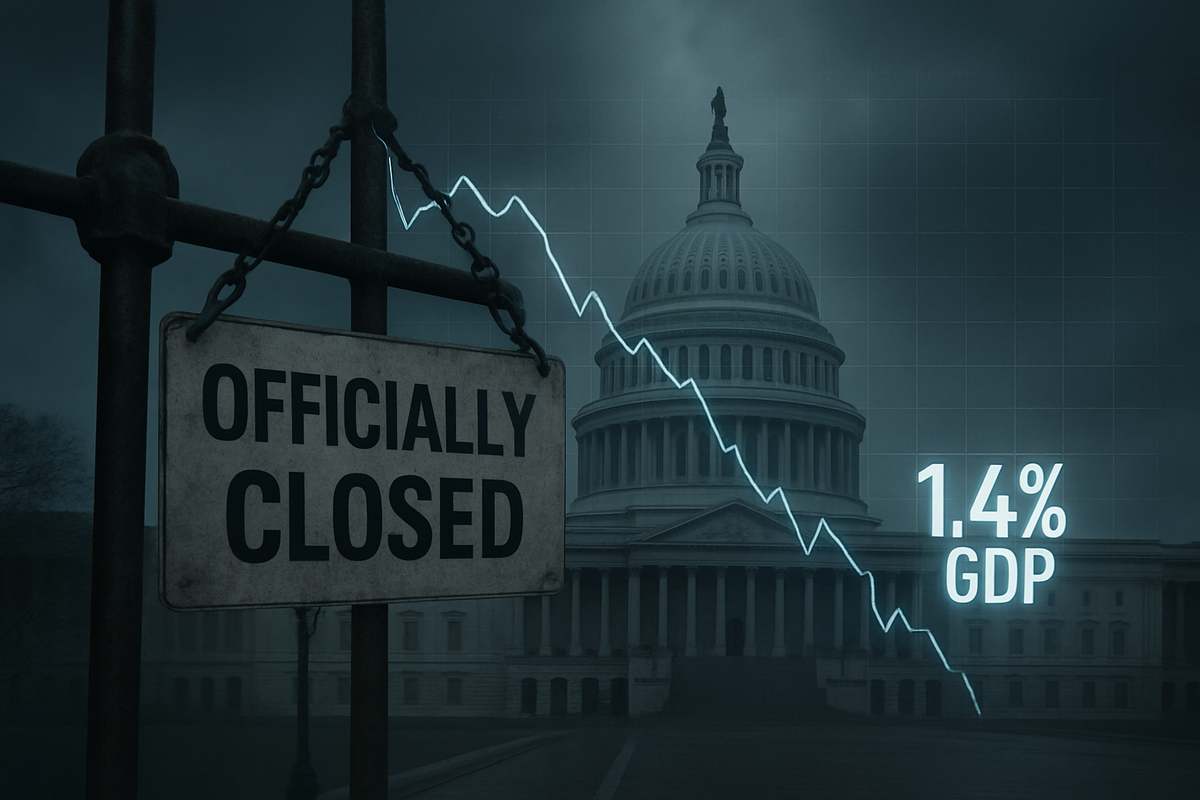
The U.S. economy hit a definitive wall in the final months of 2025, with the Bureau of Economic Analysis (BEA) reporting that fourth-quarter Gross Domestic Product (GDP) grew at a lackluster annualized rate of just 1.4%. This figure represents a staggering deceleration from the 4.4% growth recorded in the third quarter and fell far short of the Wall Street consensus, which had hovered around 2.9% to 3.0%. The primary culprit for this economic stall was the unprecedented 43-day federal government shutdown, a fiscal paralysis that severely constricted government outlays and sent shockwaves through the private sector.
The immediate implications of this "growth gap" are already being felt across the financial landscape. With consumer sentiment hitting levels not seen since the late 1970s and federal spending contracting by over 16% in a single quarter, the specter of a recession looms larger than it has in years. For the markets, the report has solidified a "K-shaped" reality, where large-cap technology and defense firms remain insulated by backlogs, while consumer-facing businesses and the broader transportation sector struggle to find their footing in an environment of policy-induced uncertainty.
Anatomy of a Miss: Policy Gridlock and Economic Friction
The root of the Q4 slowdown can be traced back to October 1, 2025, when a bitter congressional impasse over immigration reforms and Affordable Care Act (ACA) subsidies triggered a total lapse in federal appropriations. The resulting 43-day shutdown, which lasted until November 12, eclipsed the previous record of 35 days set in 2018–2019. During this period, approximately 900,000 federal employees were furloughed, and nearly 2 million others—including TSA agents and active-duty military personnel—were forced to work without pay. This massive interruption in personal income for federal workers immediately manifested as a sharp drop in regional consumer spending, particularly in the mid-Atlantic corridor.
Economically, the data is grim. Federal government spending and investment plummeted by an annualized 16.6% in the fourth quarter, effectively subtracting 1.15 percentage points from the overall GDP growth rate. Analysts at firms like Goldman Sachs had warned that the shutdown would be a drag, but the severity of the "spending vacuum" caught even the most bearish observers by surprise. The shutdown also caused a secondary crisis: a data blackout. The BEA was forced to delay its initial reports, leaving investors and the Federal Reserve flying blind during the critical transition into the 2026 fiscal year.
Market reaction to the 1.4% print was swift and defensive. In the weeks following the release, the S&P 500 (NYSEARCA:SPY) retreated roughly 7% year-to-date, while the tech-heavy Nasdaq 100 (NASDAQ: QQQ) saw a double-digit decline as investors re-evaluated growth multiples in a slowing economy. Treasury yields initially dipped as the market began to price in an emergency "pivot" from the Federal Reserve, with traders now betting on multiple rate cuts in early 2026 to offset the fiscal damage.
Turbulence and Tarnish: Winners and Losers of the Fiscal Freeze
The "fiscal freeze" of late 2025 created a stark divide between industries. The hardest hit was undoubtedly the aviation and travel sector. Delta Air Lines (NYSE: DAL) reported a pre-tax profit hit of approximately $200 million, citing over 2,000 flight cancellations and a significant drop in bookings during the peak of the TSA staffing crisis. Similarly, American Airlines (NASDAQ: AAL) disclosed a revenue loss of $325 million, while Southwest Airlines (NYSE: LUV) was forced to slash its full-year EBIT forecast as the shutdown compounded the pain of rising fuel costs.
Consumer discretionary stocks also bore the brunt of the shutdown's psychological impact. McDonald’s (NYSE: MCD) noted a "challenging environment" as low-to-middle income traffic slowed significantly during the pay-gap period for federal workers. The home improvement sector saw even sharper declines; Trex (NYSE: TREX), a leader in high-end decking, saw its stock price tumble after revising full-year revenue guidance downward by 31%, citing a precipitous drop in discretionary home spending. Even global giants like Nike (NYSE: NKE) issued cautious guidance, warning of a "K-shaped" consumer pullback and slowing e-commerce traffic.
However, the chaos created a unique set of "winners." Precious metals became the ultimate haven as confidence in federal stability wavered. Silver prices doubled in late 2025, hitting record highs above $84 per ounce. The iShares Silver Trust (NYSEARCA:SLV) saw record inflows as investors used the metal as a hedge against geopolitical instability and the domestic fiscal crisis. Within the defense sector, the picture was mixed. While smaller contractors struggled with cash flow, large-cap firms like Leidos (NYSE: LDOS) remained remarkably resilient, reporting a 7% revenue increase driven by existing backlogs and long-term service contracts that were pre-funded prior to the shutdown.
A Fragile Equilibrium: Broader Significance and the Return of "K-Shaped" Anxiety
This event fits into a broader, more concerning trend of "fiscal volatility" becoming a permanent fixture of the U.S. investment landscape. Unlike the 2018–2019 shutdown, which occurred during a period of robust global growth, the 2025 shutdown hit an economy already grappling with high interest rates and "invisible inflation"—a phenomenon where consumers spend more for fewer goods. The drop in the University of Michigan’s Consumer Sentiment Index to 50.3 in November—its lowest level since 1978—suggests that the damage to public trust may outlast the actual funding gap.
The ripple effects are extending to the regulatory and monetary policy sphere. For years, the Federal Reserve has focused on combating inflation through tightening; however, the Q4 GDP miss has forced a radical shift in priorities. The central bank must now decide whether to provide liquidity to a slowing economy or maintain rates to prevent a resurgence of inflation driven by supply chain hiccups caused by the shutdown. This "policy trap" is a direct result of the 43-day gridlock, and it has left competitors in the global market—particularly in Europe and Asia—with a rare opportunity to gain ground as U.S. domestic demand falters.
Historically, this period will likely be compared to the stagflationary shocks of the 1970s. The combination of stalled government spending and resilient "core" private demand (which grew at 1.9%) suggests an economy that is fundamentally sound but being held hostage by its own governance. The "K-shaped" recovery has now evolved into a "K-shaped" slowdown, where affluent consumers continue to spend on luxury goods and AI-driven technology, while the average federal contractor or service worker is forced into austerity.
The Q1 Horizon: Recovery or Relapse?
Looking ahead, the market is bracing for a volatile first half of 2026. While many analysts expect a "rebound" in Q1 as back-pay for federal workers is distributed and delayed projects are greenlit, the scar tissue remains. Airlines have already begun cutting capacity for the 2026 spring season, anticipating that the "travel fatigue" from the shutdown will linger. Strategically, companies are moving toward more "shutdown-proof" business models, increasing their cash reserves and diversifying their revenue streams away from direct federal dependency.
Two primary scenarios are emerging for the remainder of 2026. In the optimistic scenario, the Q4 dip is a "one-off" fiscal anomaly, and a Fed rate cut in April triggers a robust recovery. In the more pessimistic scenario, the 43-day shutdown has already tipped the U.S. into a "rolling recession," where the collapse in consumer sentiment and the delay in federal contract awards lead to a secondary wave of layoffs in the private sector. Investors should pay close attention to Q1 corporate earnings calls for signs of "delayed realization" of these losses.
Final Verdict: An Economy Running on Fumes
The Q4 GDP report is a sobering reminder that political dysfunction is no longer just a headline risk—it is a measurable economic anchor. The 1.4% growth rate is not just a "miss"; it is a symptom of a system where the world's largest economy can be paralyzed by 43 days of legislative deadlock. For investors, the key takeaways are clear: the K-shaped divide is deepening, and fiscal stability can no longer be taken for granted as a baseline assumption.
Moving forward, the market will be hyper-sensitive to any signs of further congressional friction. The "silver surge" and the resilience of firms like Leidos (NYSE: LDOS) suggest that defensive positioning is currently the winning strategy. As we move into the second quarter of 2026, the primary watchwords will be "liquidity" and "resilience." Investors should closely monitor retail sales and employment data to see if the "43-day ghost" continues to haunt the American consumer or if the economy can finally exorcise the spirits of the longest shutdown in history.
This content is intended for informational purposes only and is not financial advice.