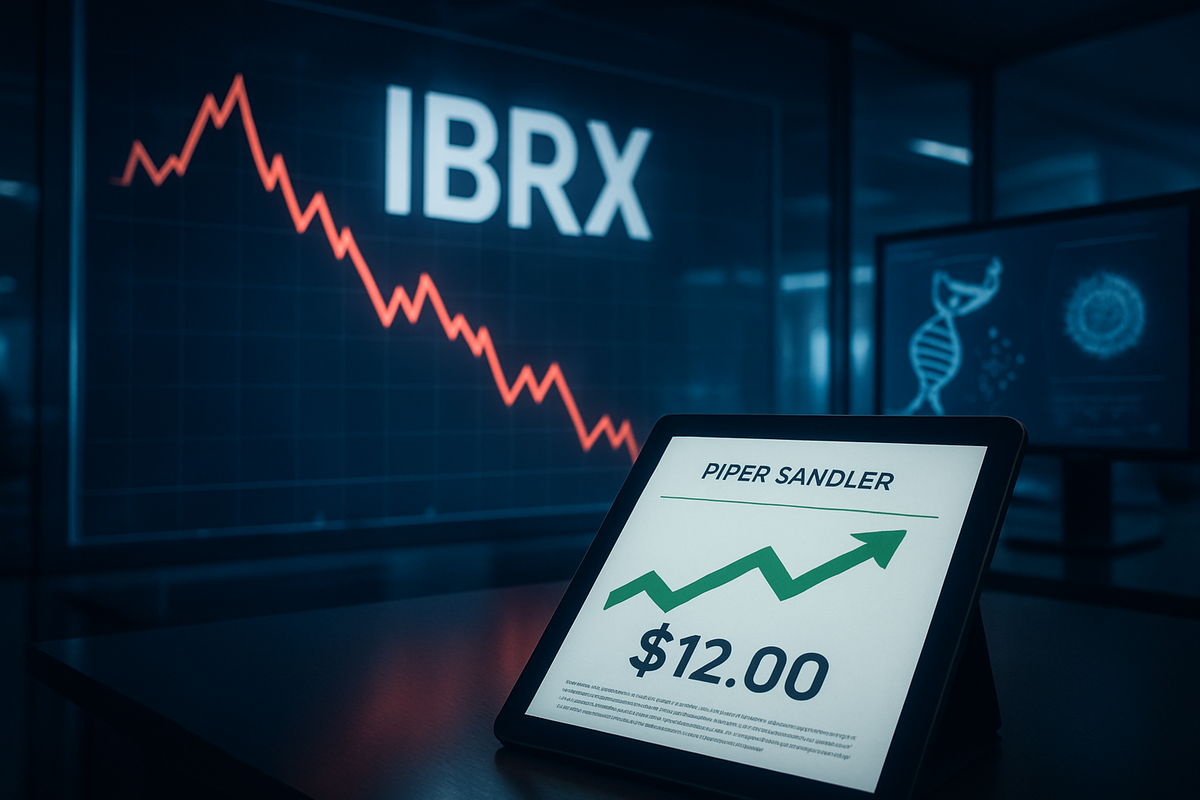
In a classic case of "selling the news," shares of ImmunityBio, Inc. (NASDAQ: IBRX) took a sharp dive on Wednesday, March 4, 2026, plummeting over 13% to close at $9.02. The sell-off came as a surprise to many retail investors, especially considering that the drop coincided with a significant price target hike from Piper Sandler (NYSE: PIPR), which raised its valuation of the immunotherapy firm from $7.00 to $12.00. The divergence between analyst optimism and market action highlighted a volatile tug-of-war between long-term growth prospects and short-term profit-taking.
The downward pressure followed a massive 9% run-up earlier in the week, driven by anticipation for the company’s full-year 2025 earnings report and a series of business updates. Despite reporting a staggering 700% year-over-year increase in net product revenue and narrowing its quarterly losses, the market’s reaction suggests that much of the "good news" had already been priced into the stock during its meteoric rise throughout early 2026.
Earnings Beat Meets Profit-Taking: The March 4 Meltdown
The catalyst for the week’s volatility was the March 2 release of ImmunityBio’s Q4 and full-year 2025 financial results. The company reported that its flagship product, ANKTIVA, generated $113 million in net revenue for 2025, a massive leap from the previous year. For the fourth quarter, the company posted an earnings per share (EPS) loss of ($0.06), which actually beat the consensus analyst estimate of ($0.08). These figures confirmed that ImmunityBio had successfully transitioned from a clinical-stage biotech into a high-growth commercial entity.
Leading up to the March 4 session, IBRX shares had touched a weekly high of $10.44 on Monday, buoyed by the strong headline numbers. However, by Wednesday morning, the sentiment shifted. Even as Piper Sandler analyst Edward Tenthoff issued a glowing report maintaining an "Overweight" rating and projecting 2026 net revenues to climb toward $195 million, the stock began a steady slide. Traders noted that since the start of 2026, IBRX had already quintupled in value, rising from under $2.00 to double digits in just two months.
The timeline of the sell-off suggests a coordinated exit by institutional holders and early-year buyers looking to lock in gains. While the business update included a successful scale-up of ANKTIVA in the U.S. and new regulatory approvals in Europe and the Middle East, the lack of a "new" blockbuster announcement—such as a major pharmaceutical partnership or an accelerated FDA timeline for its next indication—left the stock vulnerable to a retracement. By the closing bell on March 4, the stock had surrendered all of its weekly gains and then some, leaving recent buyers underwater despite the improved analyst outlook.
Winners and Losers in the Immunotherapy Arms Race
While ImmunityBio (NASDAQ: IBRX) shareholders felt the immediate sting of the 13% drop, the broader oncology market viewed the volatility with caution. The primary "winners" of the day were short-sellers and institutional bears who had bet that the stock's 500% year-to-date gain was unsustainable. These traders capitalized on the "gap and trap" scenario where the Piper Sandler upgrade provided the liquidity needed for large-scale exits.
Direct competitors in the non-muscle invasive bladder cancer (NMIBC) space, such as Merck & Co., Inc. (NYSE: MRK) and Johnson & Johnson (NYSE: JNJ), remained relatively stable. Merck, which produces the market-leading systemic immunotherapy Keytruda and controls much of the global TICE BCG supply, may see the IBRX volatility as a sign that the newcomer still faces significant hurdles in unseating established giants. Meanwhile, Johnson & Johnson (NYSE: JNJ) is currently scaling its recently approved Inlexzo (TAR-200) device, which competes directly with ANKTIVA in the BCG-unresponsive market.
On the losing side, retail investors who chased the stock at its $10.44 peak were the hardest hit. However, CG Oncology, Inc. (NASDAQ: CGON) also saw a minor sympathy dip of 2%, as the sell-off in IBRX raised temporary questions about the valuation of the entire NMIBC sub-sector. If the market leader in revenue growth like ImmunityBio can see such a sharp correction on "good" news, smaller peers awaiting their own BLA (Biologics License Application) approvals may face increased scrutiny regarding their commercial launch trajectories.
A Broader Shift: From Clinical Potential to Commercial Reality
The March 4 event fits into a wider industry trend where the "clinical catalyst" era of biotech is being replaced by the "commercial execution" era. For years, ImmunityBio’s valuation was tied to FDA approval milestones and trial data. Now that ANKTIVA is in the hands of oncologists across 33 countries, investors are shifting their focus to granular metrics: gross margins, insurance reimbursement rates, and geographic penetration. The sell-off reflects a market that is no longer satisfied with "potential" but is instead meticulously weighing the costs of a global commercial rollout.
Furthermore, the backdrop of the global BCG shortage continues to be a defining factor for the industry. ImmunityBio’s strategy to develop its own recombinant BCG with the Serum Institute of India is a significant regulatory and policy move that could redefine the standard of care. This "dual-track" approach—providing both the immunotherapy (ANKTIVA) and the necessary companion agent (BCG)—is a historical precedent in oncology where a company seeks to own the entire treatment vertical to bypass supply chain bottlenecks that have plagued the industry for decades.
This event also draws comparisons to the 2024-2025 cycles seen in other high-growth sectors, where "beat and raise" quarters frequently resulted in sell-offs because they failed to exceed the "whisper numbers" of an overheated market. The regulatory milestone in Saudi Arabia for lung cancer (NSCLC) granted in early 2026 served as a major validator, but as the March 4 price action shows, even global expansion cannot always protect a stock from the gravity of a 500% run-up.
The Road Ahead: Strategic Pivots and Potential Recoveries
Looking forward, the short-term outlook for ImmunityBio involves a period of consolidation. The company is expected to use the remainder of the first half of 2026 to stabilize its new share price floor while continuing the aggressive rollout of its Expanded Access Program, which currently supports nearly 600 patients in the U.S. alone. Analysts will be watching the next two quarters closely to see if the revenue growth can maintain its triple-digit trajectory or if the initial "surge" of demand from the BCG-unresponsive patient backlog begins to level off.
The most critical catalyst on the horizon is the planned BLA submission for ANKTIVA in the BCG-naïve (frontline) NMIBC setting, slated for Q4 2026. If ImmunityBio can secure approval for this much larger patient population, it would move ANKTIVA from a secondary treatment to a primary one. Strategic adaptations may also include further diversification into lung cancer and other solid tumors, where the company’s "Tri-Ad" vaccine and natural killer (NK) cell platforms are currently undergoing Phase 2 trials.
Market opportunities remain vast, particularly as the company eyes the high-end private healthcare markets in the Middle East and the broader European Union. However, the challenge will be managing the "cash burn" associated with such a rapid global expansion. While the Q4 2025 report showed a decelerating burn rate, any sign of a capital raise (dilution) in the coming months could provide another excuse for the bears to take control of the narrative.
Investor Wrap-Up: Navigating the Volatility
The March 4 sell-off of ImmunityBio serves as a poignant reminder that stock price and company performance do not always move in tandem in the short term. Despite a 13% drop, the underlying business fundamentals—highlighted by a 700% revenue increase and a price target hike to $12.00 by Piper Sandler—suggest that the company's long-term trajectory remains intact. The "plummet" appears to be a technical correction rather than a fundamental breakdown of the ANKTIVA commercial story.
Moving forward, the market will transition from watching "headline news" to watching "execution data." Investors should keep a close eye on the Q1 2026 revenue numbers, which will be the first real test of whether the momentum from late 2025 has carried over into the new year. Key metrics to watch include the conversion rate of the Expanded Access Program into commercial sales and any updates regarding the FDA's stance on the recombinant BCG supply chain.
In summary, while the March 4 dip was painful for recent entrants, the de-risking of the commercial platform and the vocal support from major analysts like Edward Tenthoff provide a "bull case" that is hard to ignore. As the volatility subsides, the focus will return to whether ImmunityBio can truly dominate the NMIBC landscape or if the established giants will find a way to re-assert their dominance in a rapidly evolving immunotherapy market.
This content is intended for informational purposes only and is not financial advice.