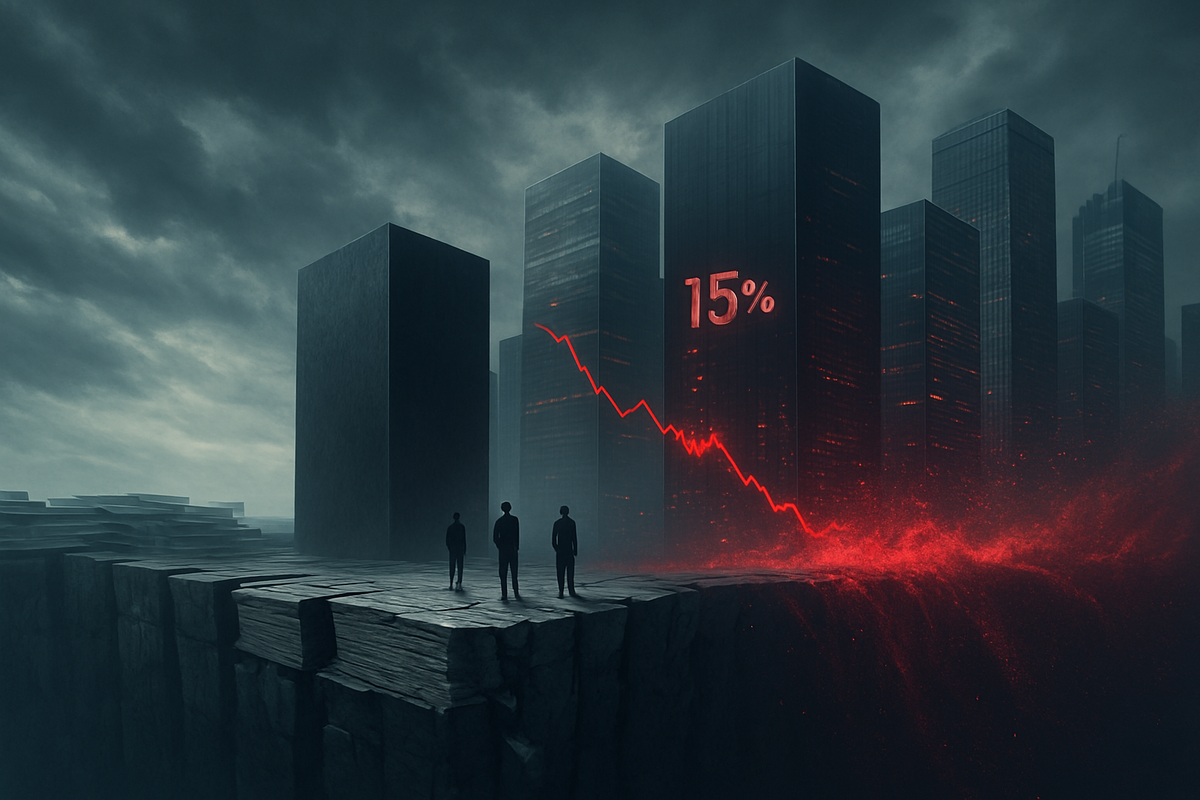
NEW YORK — The "Golden Age" of private credit has met its most grueling stress test yet. As of March 4, 2026, the $1.7 trillion private lending market and its symbiotic partner, private equity, are facing a brutal reckoning. After years of rapid expansion fueled by low interest rates and a retreat by traditional banks, these opaque corners of the financial world are now grappling with a "maturity wall" and a surge in borrower distress that has analysts warning of a potential 15% default rate.
The immediate fallout is visible on Wall Street, where the once-indomitable alternative asset managers are, in the words of industry insiders, "taking it on the chin." A combination of sustained high interest rates, a collapse in software sector valuations due to AI disruption, and a liquidity crunch in retail-facing funds has sent shockwaves through a sector that many hoped was insulated from broader market volatility.
The 2026 Moment of Truth: A $162 Billion Reckoning
The current crisis traces its roots back to the "cheap money" era of 2021, when private equity sponsors loaded mid-market companies with floating-rate debt to fund leveraged buyouts. While firms successfully "kicked the can" down the road in 2024 and 2025 through liability management exercises (LMEs) and "Payment-in-Kind" (PIK) toggles—paying interest with more debt rather than cash—the road has finally run out. In February 2026, a bombshell report from UBS strategists raised the "worst-case scenario" for private credit defaults to a staggering 15%.
This warning coincides with the arrival of a $162 billion "maturity wall"—debt that must be refinanced this year at significantly higher costs. Unlike previous years, where lenders were willing to extend terms, the credit appetite has soured. The software industry, which represents roughly 40% of all sponsor-backed private credit loans, has been hit hardest. A narrative shift, catalyzed by Citrini Research, suggests that Generative AI has eroded the competitive moats of many SaaS (Software-as-a-Service) companies, leading to a valuation collapse and a "distribution drought" for private equity firms unable to exit their aging investments.
Winners and Losers: The Bifurcation of Alt-Assets
The pain has not been distributed equally, creating a stark divide between those who diversified early and those who stayed heavily leveraged in corporate cash-flow lending. Blue Owl Capital (NYSE: OWL) has become the primary cautionary tale of the 2026 crisis. After being forced to restrict redemptions in its retail-facing funds to preserve liquidity, its stock has plummeted over 60% from its late-2024 highs. The firm’s reliance on the very software-lending model now under fire has made it a lightning rod for investor skepticism.
In contrast, Apollo Global Management (NYSE: APO) has emerged as a relative "winner" by pivoting toward its insurance-heavy model, Athene, and focusing on Asset-Backed Finance (ABF) rather than pure corporate leverage. While Blackstone (NYSE: BX) and KKR & Co. Inc. (NYSE: KKR) have seen their share prices experience drawdowns of approximately 40% during this cycle, their massive "perpetual capital" vehicles have provided a buffer against the retail redemptions that crippled smaller peers. Meanwhile, Ares Management (NYSE: ARES) is aggressively seeking to capture market share in the restructuring space, though it remains exposed to the broader decline in middle-market credit quality.
The Wider Significance: Shadow Banking and Systemic Risk
This event marks the first time the modern private credit ecosystem has faced a sustained period of high interest rates without the safety net of central bank intervention. The "higher-for-longer" environment has created a liquidity trap: roughly 40% of private-credit borrowers are now reporting negative free cash flow. This creates a systemic risk that Moody’s and S&P Global (NYSE: SPGI) have warned could bleed into the broader economy. Because these loans are held in private funds and insurance portfolios rather than on bank balance sheets, the lack of transparency makes it difficult for regulators like the SEC to gauge the true extent of the rot.
The crisis also reflects a fundamental shift in how technology impacts finance. The AI-driven automation that was supposed to drive efficiency has instead disrupted the business models of the "zombie companies" that private equity firms had kept afloat for years. This "deflationary cascade" is forcing a total repricing of risk, similar to the 2008 financial crisis, though this time the epicenter is the "shadow banking" sector rather than the mortgage market.
What Comes Next: Restructuring and the Return of the 'Workout'
In the short term, expect a massive wave of corporate restructurings. The era of easy extensions is over, and "distressed exchanges"—where lenders take equity in exchange for debt forgiveness—will likely account for over half of all defaults in the coming months. Private equity sponsors will be forced to either inject fresh equity into their portfolio companies or hand the keys to the lenders.
Long-term, the industry must adapt to a "lower-multiple" world. The strategic pivot will likely move away from speculative software ventures and toward tangible infrastructure and asset-backed lending. We may also see increased regulatory pressure on the private wealth channels that fueled the sector's growth, as retail investors who were promised "bond-like" stability find themselves locked in funds that cannot meet redemption requests.
Summary and Investor Outlook
The early 2026 private credit crisis is a stark reminder that leverage is a double-edged sword. The "15% default" warning from UBS serves as a ceiling for the current anxiety, but even a move toward the 5% baseline projected by S&P would represent a tectonic shift for a market accustomed to near-zero defaults.
Key Takeaways for Investors:
- Watch the Redemptions: Liquidity in "non-traded" BDCs and REITs is the first line of defense; if more firms follow Blue Owl in restricting exits, the panic could intensify.
- The AI Factor: Corporate credit is no longer just about cash flow; it’s about technological durability. Companies whose moats can be bridged by AI are toxic in the current lending environment.
- Mark-to-Market Pain: Private markets are finally being forced to recognize the valuations that public markets hit months ago. Expect significant "down-rounds" and asset write-downs in Q2 2026 earnings.
As the market continues to "take it on the chin," the resilience of the financial system will depend on whether these private losses stay private—or if they trigger a broader contagion in the global banking sector.
This content is intended for informational purposes only and is not financial advice.