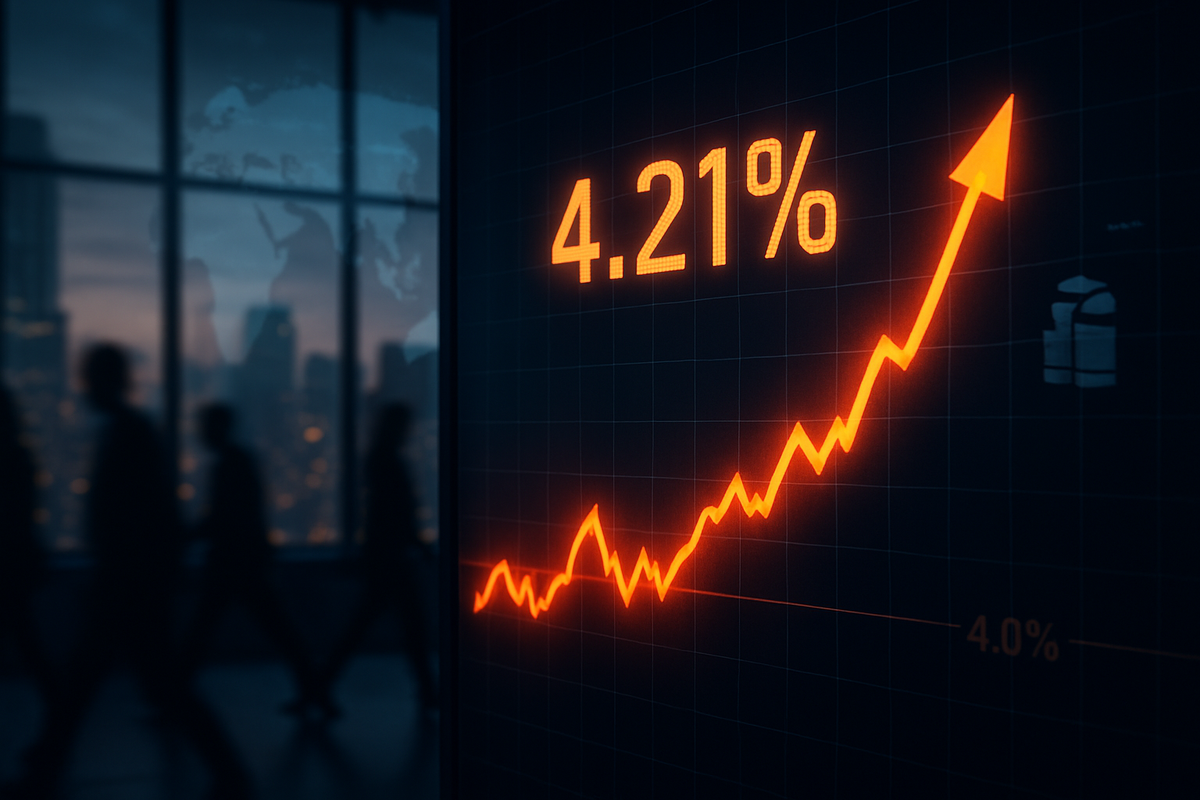
The US Treasury market has entered a period of intense turbulence as the benchmark 10-year yield surged past the critical 4.0% threshold this week, reaching 4.21%—its highest level in over a year. This aggressive climb is the result of a "perfect storm" of persistent domestic inflation, a massive wave of corporate debt issuance, and a sudden escalation of geopolitical tensions in the Middle East that has sent global energy prices skyrocketing. The move has sent shockwaves through the broader economy, immediately manifesting in higher borrowing costs for prospective homebuyers and a reassessment of valuations for high-growth sectors.
For the American consumer and the corporate world, the implications of this yield spike are profound. Mortgage rates, which were beginning to stabilize in late 2025, have pivoted sharply upward, threatening to freeze an already tight housing market. Meanwhile, the "higher-for-longer" interest rate environment is forcing public companies to face a daunting reality: the era of cheap capital has not returned, and the cost of maintaining the massive debt loads required for the ongoing artificial intelligence (AI) infrastructure race is becoming increasingly expensive.
The Catalyst: A Confluence of Geopolitical Friction and Fiscal Reality
The current volatility can be traced back to early February 2026, when a series of military escalations in the Persian Gulf led to the partial closure of the Strait of Hormuz. This critical maritime chokepoint, through which a significant portion of the world’s oil supply flows, saw a sudden spike in insurance premiums and shipping delays, driving Brent crude oil prices above $100 per barrel for the first time in years. The bond market, which had been pricing in a series of gradual interest rate cuts from the Federal Reserve, was forced to rapidly adjust for a new "energy-driven" inflation spike.
Throughout late February and early March, the Federal Reserve—led by Chair Jerome Powell—signaled a more hawkish stance, suggesting that the planned 2026 rate-cutting cycle may be paused or even reversed if secondary inflationary effects take hold. This shift in sentiment was exacerbated by the release of February’s Consumer Price Index (CPI) data, which showed "sticky" services inflation that refused to trend toward the Fed’s 2% target. Market participants, including major institutional investors like BlackRock, Inc. (NYSE: BLK) and Vanguard, have been forced to dump long-dated Treasuries, pushing prices down and yields up.
Further complicating the landscape is the sheer volume of Treasury issuance. To fund a ballooning federal deficit, the U.S. Treasury Department has been holding record-breaking auctions. The mismatch between the high supply of new debt and the waning appetite from international buyers has forced the government to offer higher yields to attract capital. This "supply-side" pressure on yields has created a floor that even the Fed's previous policy adjustments have failed to lower, marking a significant departure from the market dynamics of the previous decade.
The Corporate Divide: Who Stands to Gain and Who Faces the Brunt
The surge in the 10-year yield creates a stark divide between capital-rich institutions and those dependent on frequent refinancing. Large financial institutions like JPMorgan Chase & Co. (NYSE: JPM) and Bank of America Corp. (NYSE: BAC) find themselves in a complex position. While a steeper yield curve—where long-term rates are significantly higher than short-term rates—can improve Net Interest Margins (NIM) by allowing them to lend at higher rates, the suddenness of the move has also led to "unrealized losses" on their existing bond portfolios. However, if the economy remains resilient, these banks are positioned to capture higher returns on their vast lending operations.
Conversely, the technology and real estate sectors are feeling the heat. Tech giants that have pivoted heavily into AI infrastructure, such as Microsoft Corp. (NASDAQ: MSFT) and Oracle Corp. (NYSE: ORCL), are currently navigating a "maturity wall" of debt. These companies have issued billions in corporate bonds to fund the construction of massive data centers and the acquisition of expensive GPU clusters. As the 10-year yield climbs, the cost of servicing this debt rises, potentially squeezing the ambitious R&D budgets that have fueled the AI boom. Software-focused firms with high P/E ratios are also seeing their valuations compressed as the "discount rate" used by analysts—directly tied to the 10-year Treasury—increases.
The housing sector is arguably the most immediate casualty of the 4.0% yield breach. Leading homebuilders like D.R. Horton, Inc. (NYSE: DHI) and Lennar Corp. (NYSE: LEN) have seen their stock prices stumble as the 30-year fixed mortgage rate tracked the Treasury surge, hitting 7.0% this week. These companies had spent much of 2025 using "mortgage buydowns" to help buyers afford homes, but with yields at these levels, the cost of providing those incentives is eating significantly into their profit margins. Real Estate Investment Trusts (REITs) like Digital Realty Trust, Inc. (NYSE: DLR), which manage data center properties, are also under pressure as their capital-intensive business models become more expensive to maintain.
Historical Context and the Shift in Market Infrastructure
This period of volatility mirrors the "Taper Tantrum" of 2013 or the inflationary shocks of the late 1970s, but with a modern twist: the influence of algorithmic trading and the sheer scale of the U.S. debt. Historically, the 10-year Treasury yield served as a stable anchor for the global financial system. However, the recent volatility suggests that the "risk-free" rate is no longer viewed as a static constant. The market is now factoring in a "term premium"—an extra return demanded by investors for the risk of holding debt over a long period—that had been largely absent for the last fifteen years.
The broader industry trend is a shift away from the "Goldilocks" environment of low inflation and low rates. This has significant regulatory implications, as the Federal Deposit Insurance Corporation (FDIC) and other regulators are closely monitoring bank balance sheets for interest-rate risk, hoping to avoid a repeat of the regional banking crisis seen in early 2023. Furthermore, the decoupling of the U.S. bond market from other global markets is becoming more apparent. While the European Central Bank may be moving toward cuts, the U.S. market's unique exposure to energy prices and massive fiscal spending has created a divergence in global yields, leading to a stronger dollar and further complicating international trade.
The Path Ahead: Strategic Pivots and Market Outlook
In the short term, investors should expect continued volatility as the market awaits the next Federal Open Market Committee (FOMC) meeting. If the Fed remains silent or issues further hawkish warnings, the 10-year yield could test the 4.5% level, a scenario that would likely trigger a broader sell-off in equities. Corporations are already beginning to pivot, with many accelerating their bond offerings to "get ahead" of even higher rates, while others are looking toward private credit markets as an alternative to traditional public debt issuance.
In the long term, the market may be entering a "new normal" where the 10-year yield fluctuates between 3.5% and 5.0%, rather than returning to the 0-2% range seen post-2008. This will require a fundamental shift in investment strategies, favoring companies with high free cash flow and minimal debt-refinancing needs. The AI sector, while currently a driver of debt, may eventually provide the productivity gains needed to offset inflationary pressures, but that transition could take years to materialize.
Conclusion: Navigating a High-Yield Reality
The recent climb of the 10-year Treasury yield toward and beyond 4.0% represents more than just a fluctuation in a chart; it is a fundamental repricing of risk in the global economy. Driven by a combination of geopolitical instability in the Middle East and the harsh realities of U.S. fiscal policy, this volatility is likely to remain a primary theme for the remainder of 2026. While the surge provides a tailwind for some financial institutions, it poses a direct threat to the housing market and the capital-intensive growth strategies of Silicon Valley.
As we move forward, the "watch list" for investors is clear: monitor oil price stability, the Fed’s rhetoric regarding "energy-driven inflation," and the success of upcoming Treasury auctions. The stability of the 10-year yield is the linchpin of the global financial system; until it finds a sustainable floor, the market will remain on edge, forced to adapt to a world where the cost of capital is no longer a footnote, but a headline.
This content is intended for informational purposes only and is not financial advice.