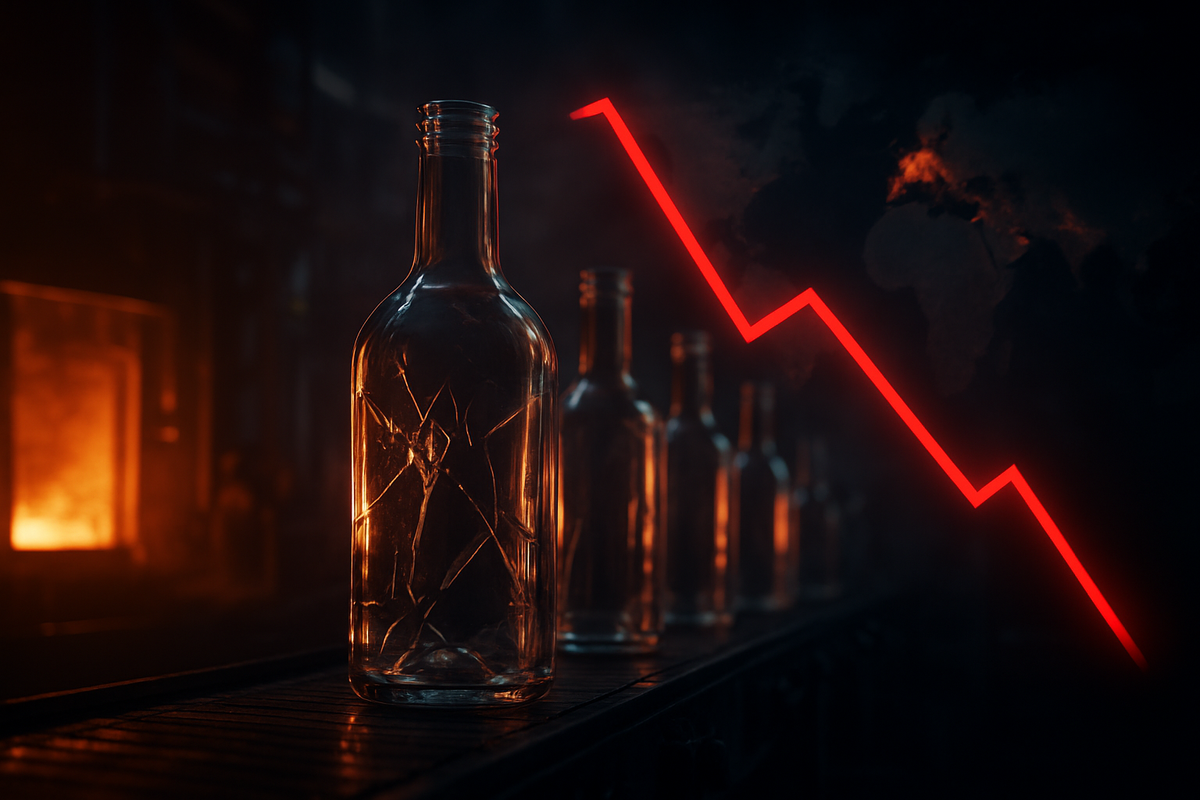
The glass packaging industry, once considered a resilient bastion of the "circular economy," is facing a moment of reckoning. Shares of O-I Glass (NYSE: OI) have plummeted by a staggering 33% since February 2026, dropping from a stable $15.00 range to roughly $10.00 as of early April. This sharp contraction reflects a market losing confidence in the company’s ability to navigate a brutal combination of expiring energy hedges in Europe and a fresh geopolitical explosion in the Middle East that has sent global energy markets into a tailspin.
The immediate implications are dire for the Perrysburg, Ohio-based manufacturer. While the company’s "Fit to Win" restructuring program has successfully trimmed hundreds of millions in operational costs, these internal efficiencies are being overwhelmed by external macro shocks. As of April 10, 2026, investors are fleeing industrial stocks with high European footprints, fearing that O-I Glass’s 2026 guidance—once touted as a turnaround milestone—is now fundamentally unachievable under current conditions.
A Perfect Storm: Timeline of a 33% Decline
The decline began in earnest following the February 10, 2026, earnings call. Although O-I Glass reported fourth-quarter 2025 earnings that technically beat analyst expectations, the underlying revenue figures told a more ominous story: ten consecutive quarters of year-over-year revenue declines. Management’s initial 2026 guidance relied on a fragile assumption of stable energy prices and a recovery in premium spirit volumes—assumptions that were dismantled within weeks by global events.
The situation turned critical on February 28, 2026, when an escalation of the long-simmering Middle East conflict led to military strikes near the Strait of Hormuz. The resulting naval blockades and insurance premium hikes caused Brent crude to surge past $110 per barrel, reigniting stagflationary pressures across the globe. For O-I Glass, which operates 68 plants in 19 countries, the timing was catastrophic. The company was already bracing for a disclosed $150 million "step-up" in European energy costs due to the expiration of favorable, long-term natural gas hedges signed during the post-pandemic era.
Market reaction was swift and merciless. By mid-March, technical indicators showed a "death cross" in the stock's performance, as the market priced in the risk of sustained high-energy inputs. Unlike lighter packaging materials, glass manufacturing is uniquely energy-intensive, requiring furnaces to operate at roughly 2,700 degrees Fahrenheit 24 hours a day. With the TTF natural gas index in Europe spiking over 60% since the start of the year, the "energy reset" that O-I management warned about has transformed from a manageable headwind into a structural threat to the company’s 2026 EBITDA targets of $1.25 billion to $1.30 billion.
Fragile Vessels: Winners and Losers in the Packaging Sector
The current crisis has created a sharp divergence in the packaging sector. O-I Glass stands as a primary casualty, given its heavy reliance on European production and the high thermal mass of its product. Similarly, European competitors like Vidrala (BME:VID) are struggling to pass through sudden surcharges to beverage giants who are themselves facing consumer pushback on pricing. These companies are losing ground to "cheap imports" from regions with lower energy costs, such as Turkey and Southeast Asia, which are increasingly flooding the Mediterranean market.
Conversely, aluminum packaging firms are emerging as relative winners. Ball Corporation (NYSE: BALL) and Ardagh Metal Packaging S.A. (NYSE: AMBP) have seen a modest uptick in interest as beverage brands reconsider their packaging mix. While aluminum smelting is also energy-intensive, the logistical costs and breakage risks associated with glass make aluminum an attractive hedge for beverage companies looking to maintain margins amidst rising freight costs. Furthermore, aluminum's lower shipping weight offers a reprieve from the surging fuel surcharges currently plaguing global logistics.
The energy sector itself, particularly US-based exporters of Liquefied Natural Gas (LNG), stands to benefit from the European supply gap. Companies like Cheniere Energy (NYSE: LNG) are seeing increased long-term demand as European industrial players scramble to secure non-Russian, non-Middle Eastern energy sources. However, for O-I Glass, these long-term supply shifts do little to alleviate the immediate pain of the 2026 energy "step-up" and the resulting margin compression that has seen their market cap erode to just over $1.5 billion.
The Glass Ceiling: Wider Significance and Industry Trends
This event highlights a significant shift in the "Green Packaging" narrative. For years, glass was championed for its infinitely recyclable nature and health profile compared to plastics. However, the current energy crisis is exposing the vulnerability of the glass industry to carbon-intensive manufacturing processes. The wider significance lies in the "deglobalization" of heavy industry; as energy costs diverge wildly between regions, the era of shipping heavy glass bottles across oceans is becoming economically untenable.
O-I Glass’s struggles also reflect a broader trend of "demand destruction" in the premium spirits and wine sectors. High energy prices act as a regressive tax on consumers, reducing discretionary spending on the very high-margin products that O-I’s business model relies upon. This mirrors the 1970s stagflation era, where industrial manufacturers were squeezed between rising input costs and a consumer base that could no longer afford the finished product. Regulatory pressures are also mounting, as European authorities push for even higher energy efficiency standards, requiring capital-intensive furnace upgrades at a time when O-I’s balance sheet is already under strain.
Historically, glass manufacturers have used "energy surcharges" to protect margins, but the current geopolitical overhang from the Middle East suggests that these surcharges may no longer be enough. If Brent crude remains above $100 and natural gas volatility persists, the industry may see a permanent shift toward regionalized, "mini-factory" models or a forced transition to fully electric furnaces—a technological pivot that requires billions in capital that O-I Glass, with $4.2 billion in net debt, may find difficult to fund.
Shatter or Solidify: What Comes Next
In the short term, investors should prepare for a potential downward revision of O-I’s 2026 guidance in the upcoming Q1 earnings report. The company will likely announce further "cold repairs" and temporary plant idlings across Europe to stem the bleeding. A strategic pivot toward more aggressive asset sales is also on the table; O-I may need to divest non-core geographic assets to pay down its 3.5x leveraged debt and satisfy bondholders who are increasingly wary of the company’s exposure to European energy volatility.
Long-term, the survival of O-I Glass as a market leader depends on the success of its MAGMA (Modular Advanced Glass Manufacturing Asset) technology. This initiative aims to create flexible, smaller-scale production lines that can be turned on and off more easily than traditional furnaces. If the company can accelerate the rollout of MAGMA, it may find a way to navigate a high-volatility energy environment. However, this is a multi-year play, and the market’s immediate concern is whether the company can survive the 2026 "squeeze" without a dilutive equity raise.
Conclusion: A Cautionary Tale for Industrial Investors
The 33% collapse of O-I Glass serves as a stark reminder of the "geopolitical tax" now levied on global industrial players. The key takeaways are clear: internal cost-cutting measures like "Fit to Win" are necessary but insufficient when faced with structural shifts in global energy markets and the closure of critical trade routes like the Strait of Hormuz. For O-I, the 2026 guidance was a promise made in a different geopolitical era—one that has been shattered by the realities of a more volatile world.
Moving forward, the market will be looking for two things: the duration of the Middle East conflict and the company’s ability to implement "emergency surcharges" without losing volume to aluminum and plastic competitors. Investors should watch the $10.00 support level closely; a break below this could signal a deeper crisis of liquidity. For now, O-I Glass remains a high-risk turnaround story whose fate is as much in the hands of global diplomats and energy traders as it is in the hands of its own management.
This content is intended for informational purposes only and is not financial advice