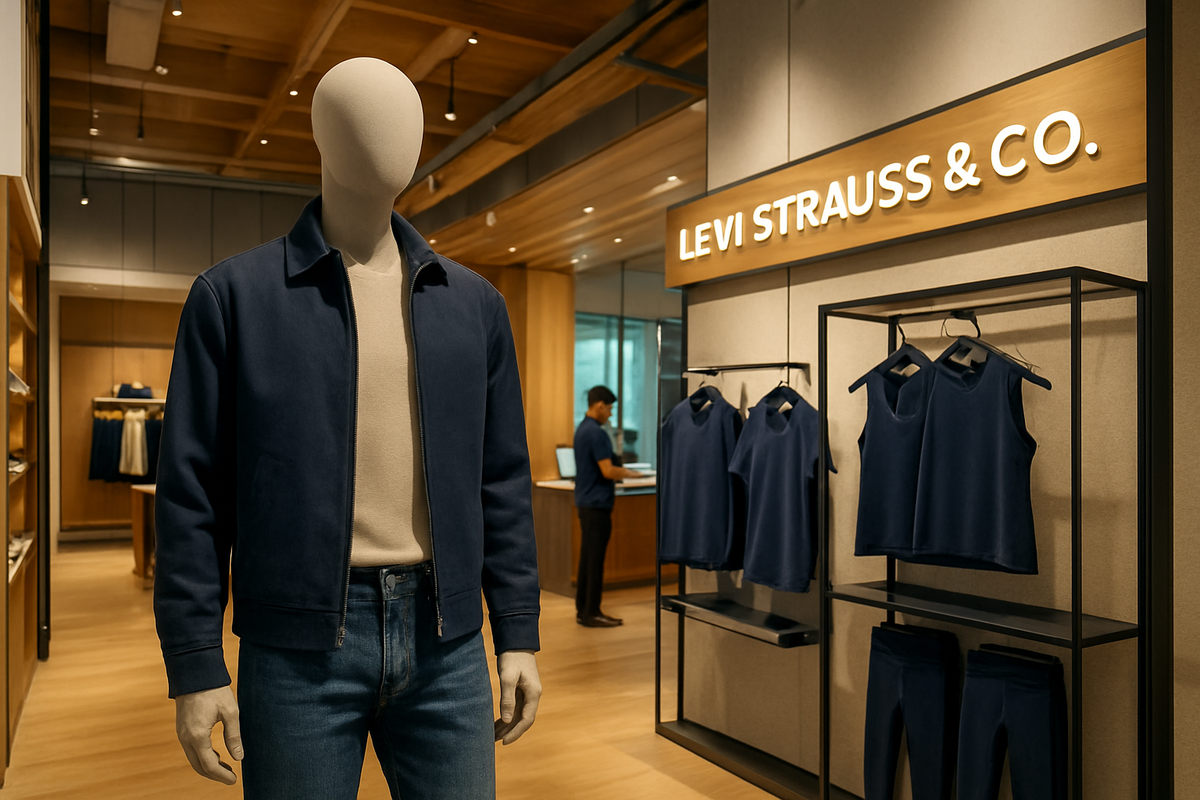
SAN FRANCISCO — April 10, 2026 — Levi Strauss & Co. (NYSE: LEVI) has signaled a definitive shift in the global apparel hierarchy following a blowout first-quarter earnings report that saw the heritage brand shatter analyst expectations. By successfully pivoting from a pure-play jeans manufacturer to a diversified "head-to-toe" lifestyle brand, Levi’s has not only beat the street on revenue and earnings but has also effectively insulated itself against the volatility currently plaguing the broader consumer discretionary sector.
The quarterly results, released earlier this week, reveal a company in the midst of a high-speed evolution. With double-digit growth in non-denim categories and a massive surge in its Direct-to-Consumer (DTC) channels, Levi’s is proving that its 173-year-old brand can be as agile as any modern digital native. As the company raises its full-year guidance, the market is beginning to view the "denim giant" through a new lens: a high-margin, lifestyle-first retail powerhouse.
Diversification and Efficiency Fuel the Q1 Beat
In the fiscal quarter ended late February 2026, Levi Strauss & Co. reported net revenue of $1.74 billion, a 14% increase compared to the same period last year. This performance comfortably cleared consensus estimates, driven largely by an 11% beat on adjusted diluted earnings per share, which landed at $0.42. The company's bottom line was bolstered by the continued execution of "Project Fuel," a multi-year productivity initiative launched by CEO Michelle Gass. This strategy has streamlined the corporate hierarchy—reducing global corporate headcount by 15%—and redirected those savings into brand-building and digital innovation.
A critical milestone in the quarter was the finalization of the divestiture of the Dockers® brand, which Levi Strauss & Co. officially offloaded to focus exclusively on its high-growth segments. This "leaner" approach allowed the core Levi’s brand and the rapidly expanding Beyond Yoga® division to take center stage. Beyond Yoga, the company’s premium activewear play, posted a staggering 23% growth rate, confirming that the company is successfully competing for the lucrative "wellness" dollar. Meanwhile, the "tops" category—including shirts, sweaters, and outerwear—grew by 13%, proving that customers are increasingly looking to Levi’s for more than just a pair of 501s.
The most significant structural shift remains the company’s aggressive move toward a DTC-first model. Direct-to-Consumer sales now account for 52% of total net revenues, up from 48% just a year ago. This pivot to owned retail and e-commerce (which saw a 21% jump in digital sales) has allowed Levi’s to capture higher margins and maintain tighter control over its brand narrative, shielding it from the "wholesale blues" that have dragged down competitors in the mid-tier retail space.
Winners and Losers in the Lifestyle Arms Race
The success of Levi’s Q1 results has sent ripples through the apparel industry, creating clear winners and losers as the "Casualization 2.0" trend takes hold. Levi Strauss & Co. is currently the clear winner, having successfully occupied the "premium casual" niche that bridges the gap between fast fashion and luxury. By expanding into tops and activewear, the company is directly challenging the dominance of athletic-lifestyle giants.
Among those feeling the heat is Lululemon Athletica Inc. (NASDAQ: LULU). While Lululemon remains a formidable player, it has faced a "valuation reset" in early 2026 due to domestic stagnation and leadership transitions. Levi’s Beyond Yoga brand is beginning to chip away at Lululemon’s market share by offering a similar "lifestyle" promise with a fresh brand identity. Conversely, The Gap, Inc. (NYSE: GAP) has emerged as a surprisingly resilient competitor. Under new leadership, Gap has returned to its "basics" roots, capturing the value-conscious consumer that Levi’s is slowly leaving behind as it pushes into higher price points.
In the pure denim space, Kontoor Brands, Inc. (NYSE: KTB)—the parent company of Wrangler and Lee—remains a steady but specialized winner. While Levi’s chases the high-margin lifestyle shopper, Kontoor has fortified its position in the "utility" and "Westernwear" segments. However, the disparity in margin growth between Levi’s DTC-heavy model and the wholesale-dependent legacy brands is becoming impossible for investors to ignore, positioning LEVI as the preferred stock for those seeking growth within the discretionary sector.
The Significance of the "Beyond Denim" Strategy
The broader significance of Levi's Q1 performance lies in its successful navigation of a changing retail landscape where brand loyalty is increasingly difficult to maintain. By evolving into a lifestyle brand, Levi Strauss & Co. is following a blueprint similar to that of high-end luxury houses, where the "brand" is an ecosystem rather than a product. This shift helps the company avoid the "commodity trap" of basic denim, where price wars and high inventory levels often erode profitability.
The divestiture of Dockers is a historical turning point for the company. It marks the end of an era where Levi’s attempted to be a "house of brands" for every demographic, pivoting instead toward a focused portfolio of high-momentum labels. This move mirrors a wider industry trend where conglomerates are spinning off underperforming or slow-growth legacy assets to unlock value for shareholders. Furthermore, the company’s heavy investment in its loyalty programs and mobile app reflects a data-driven approach to retail that is quickly becoming the minimum requirement for survival in 2026.
Regulatory and macroeconomic factors also play a role. As global trade tensions lead to fluctuating tariff environments, Levi’s "Project Fuel" has optimized the supply chain to be more resilient. By managing inventories with extreme precision—up only 4% despite a 14% revenue gain—the company has demonstrated a level of operational maturity that distinguishes it from the "boom and bust" cycles of its fast-fashion peers.
What Lies Ahead: Guidance and Strategic Pivots
Looking forward, the outlook for Levi Strauss & Co. remains robust. Encouraged by the Q1 beat, management has raised the full-year 2026 revenue growth guidance to a range of 5.5% to 6.5%. The company also bumped its adjusted EPS forecast to $1.42–$1.48, signaling confidence that the current momentum is sustainable through the back half of the year. Investors should expect a continued push into international markets, particularly in Asia and Europe, where the "lifestyle" pivot has even higher margin potential.
However, challenges remain. The company must prove that Beyond Yoga can scale into a multi-billion-dollar global brand without losing its niche appeal. Additionally, as the company pushes further into the "lifestyle" and "tops" categories, it will face fiercer competition from specialized apparel brands. The short-term focus will likely be on the integration of AI-driven personalization in their DTC channels to further drive the "head-to-toe" basket size, while the long-term goal remains reaching a 55% or higher DTC mix.
A New Era for a 19th-Century Icon
Levi Strauss & Co.'s Q1 2026 earnings report is more than just a financial beat; it is a validation of a massive strategic overhaul. By leaning into its heritage while aggressively diversifying its product line and sales channels, the company has successfully decoupled its performance from the general headwinds of the apparel industry. The "Beyond Denim" strategy is no longer a future goal—it is the current reality of the business.
As we move further into 2026, the market will be watching to see if the company can maintain its margin expansion in the face of potential macroeconomic cooling. For now, Levi’s stands as a leader in the consumer discretionary space, proving that even the oldest names in fashion can reinvent themselves for a digital, lifestyle-oriented future. Investors should keep a close eye on DTC growth figures and the performance of Beyond Yoga as the primary indicators of the company's long-term trajectory.
This content is intended for informational purposes only and is not financial advice.