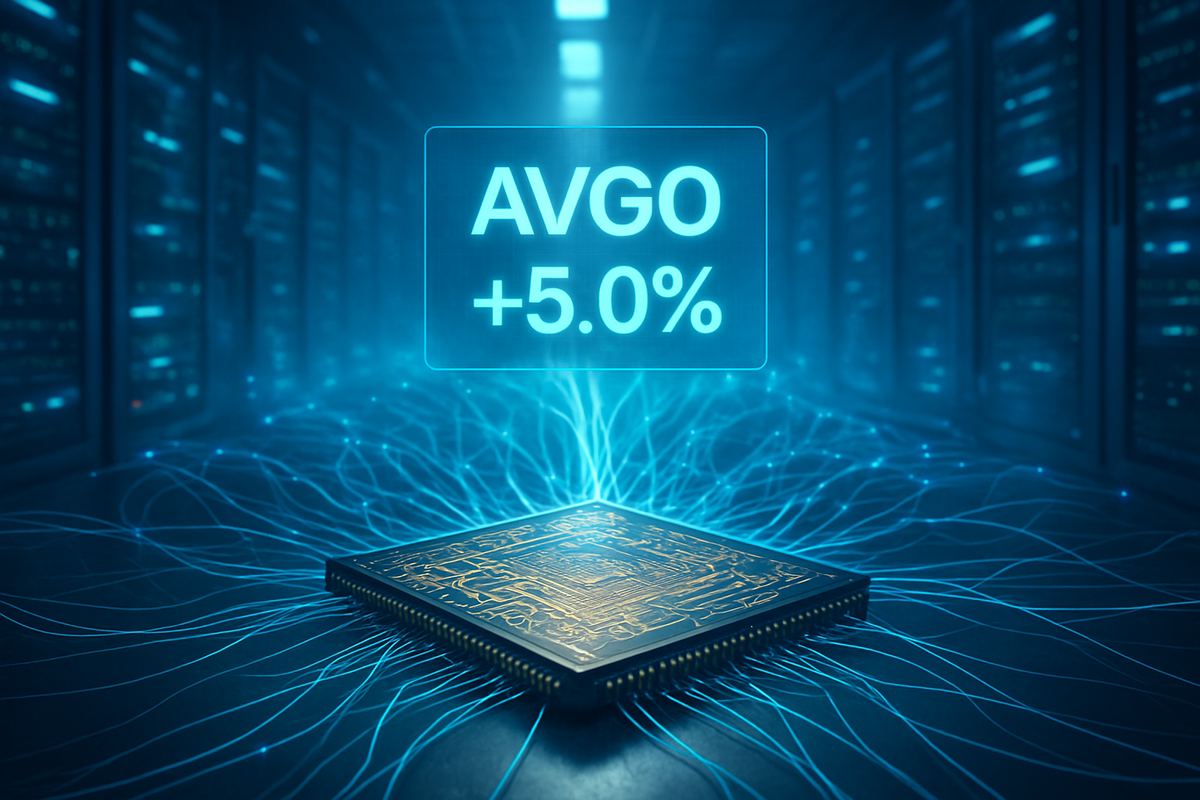
Shares of Broadcom Inc. (Nasdaq:AVGO) surged more than 5% during Friday’s trading session on April 10, 2026, closing at a new record high as investors reacted to a confluence of bullish catalysts within the artificial intelligence infrastructure sector. The rally, which added billions to the company’s market capitalization, underscores Broadcom’s evolution from a diversified hardware manufacturer into what many analysts now call the "indispensable architect" of the AI era. With today’s gains, Broadcom is rapidly closing the gap on the world’s most valuable companies, fueled by its dominant position in custom silicon and high-margin software.
The immediate implication of today's price action is a fundamental shift in market sentiment regarding the "AI trade." While the initial wave of AI investment focused heavily on general-purpose GPUs, the market is now aggressively rewarding companies that provide the specialized networking and custom-designed chips required for large-scale inference and energy-efficient data centers. Broadcom’s 5% jump today suggests that institutional investors are increasingly viewing the company as a safer, more diversified bet for the long-term AI cycle compared to its more volatile semiconductor peers.
The Catalyst: Custom Silicon and the $100 Billion Vision
The primary driver for today’s rally was a series of upgraded outlooks from major Wall Street firms, following rumors of a massive new custom ASIC (Application-Specific Integrated Circuit) agreement with a Tier-1 hyperscaler, widely believed to be OpenAI or Apple Inc. (Nasdaq:AAPL). This comes on the heels of Broadcom’s successful deployment of Google’s (Nasdaq:GOOGL) v7 "Ironwood" Tensor Processing Units (TPUs), which have set new benchmarks for performance-per-watt in AI training.
The timeline leading to this moment has been one of calculated execution. Since its 10-for-1 stock split in July 2024, Broadcom has methodically integrated its $61 billion acquisition of VMware, transforming it into a high-margin recurring revenue engine. By early 2026, the transition of VMware’s top 10,000 customers to a subscription-based cloud foundation model was largely complete, providing the stable cash flow necessary to fund massive R&D in the semiconductor space. This dual-engine strategy—high-growth AI chips paired with defensive, high-margin software—has made the company a favorite for both growth and value investors.
Key players in this narrative include Broadcom CEO Hock Tan, whose disciplined approach to acquisitions and focus on "moat-heavy" businesses has been vindicated by the market. Industry reaction to today's move has been overwhelmingly positive, with analysts noting that Broadcom’s 60% to 70% share of the custom AI ASIC market makes it the primary beneficiary as tech giants move away from "off-the-shelf" hardware toward bespoke solutions that reduce their reliance on any single vendor.
Winners and Losers in the AI Arms Race
The ripple effects of Broadcom's ascent are creating a clear divide in the technology sector. The primary winners, aside from Broadcom itself, are the hyperscale cloud providers like Alphabet and Meta Platforms Inc. (Nasdaq:META). By partnering with Broadcom to design custom silicon, these companies can bypass the high premiums associated with general-purpose chips and optimize their hardware for specific AI models, such as Llama 4 or Gemini. This partnership model solidifies Broadcom’s role as a "partner-competitor" to the traditional GPU giants.
However, the "losers" in this scenario may include secondary semiconductor players who lack the scale or the deep engineering relationships required to compete in the custom ASIC space. While Marvell Technology Inc. (Nasdaq:MRVL) remains a strong competitor, Broadcom’s massive lead in networking fabric—specifically its Jericho3-AI switches—creates a high barrier to entry. Furthermore, as Broadcom captures more of the "AI wallet" from major enterprises, legacy networking firms that failed to pivot quickly to AI-optimized fabrics are finding their market share under pressure.
A Structural Shift in the Tech Hierarchy
Today’s move is not just a daily fluctuation; it represents a broader trend where the physical infrastructure of the internet is being rebuilt for the age of agentic AI. Historically, Broadcom’s rise is being compared to the dominance of Cisco Systems during the 1990s internet boom. However, unlike the 90s, where hardware became commoditized, Broadcom’s IP in high-speed connectivity and custom chip design is becoming more specialized and difficult to replicate.
The wider significance also touches on regulatory and policy implications. As Broadcom nears a $2 trillion valuation, it will face increased scrutiny over its market dominance in networking and software. Yet, because its products are the bedrock of the transition to energy-efficient AI, regulators may find it difficult to impede a company so critical to national and corporate productivity goals. The precedent being set here is one of "systemic importance"—where a single semiconductor firm becomes as vital to the global economy as a major central bank or energy provider.
The Path to the Top 5 by 2030
Looking ahead, market predictions now place Broadcom as a strong contender to join the ranks of the five largest companies in the world by 2030, potentially joining or even displacing current leaders like Microsoft Corp. (Nasdaq:MSFT) or Amazon.com Inc. (Nasdaq:AMZN). To achieve this, Broadcom must maintain its breakneck pace of innovation in its XPU (Accelerator) roadmap. The short-term goal is hitting the $100 billion AI revenue run-rate that Hock Tan teased in late 2025—a goal that analysts now see as conservative rather than aspirational.
The next strategic pivot for Broadcom will likely involve "Silicon Photonics," a technology that uses light instead of electricity to move data between chips. As AI models grow to trillions of parameters, the bottleneck is no longer compute power, but the speed and energy cost of data movement. If Broadcom can dominate the transition to optical interconnects, its position in the data center will be virtually unassailable through the end of the decade.
Investment Outlook and Final Thoughts
Broadcom’s 5% rally on April 10, 2026, serves as a powerful signal that the AI era is entering its "industrialization phase." The market is moving beyond the hype of chatbots and toward the reality of massive-scale infrastructure. The key takeaways for investors are clear: Broadcom has successfully diversified its revenue streams, secured the loyalty of the world’s largest tech spenders, and built a software business that provides a floor for its valuation during any potential chip cycle downturns.
Moving forward, the market will be watching for the formal announcement of Broadcom's next-generation 3nm and 2nm custom chip contracts. Investors should also monitor the operating margins of the VMware segment; if Broadcom can sustain its current 75%+ margins while continuing to grow its AI revenue at 20% to 30% annually, the "Top 5 by 2030" prediction may be realized much sooner than expected. For now, Broadcom stands as a testament to the power of strategic focus and the sheer scale of the ongoing AI revolution.
This content is intended for informational purposes only and is not financial advice.