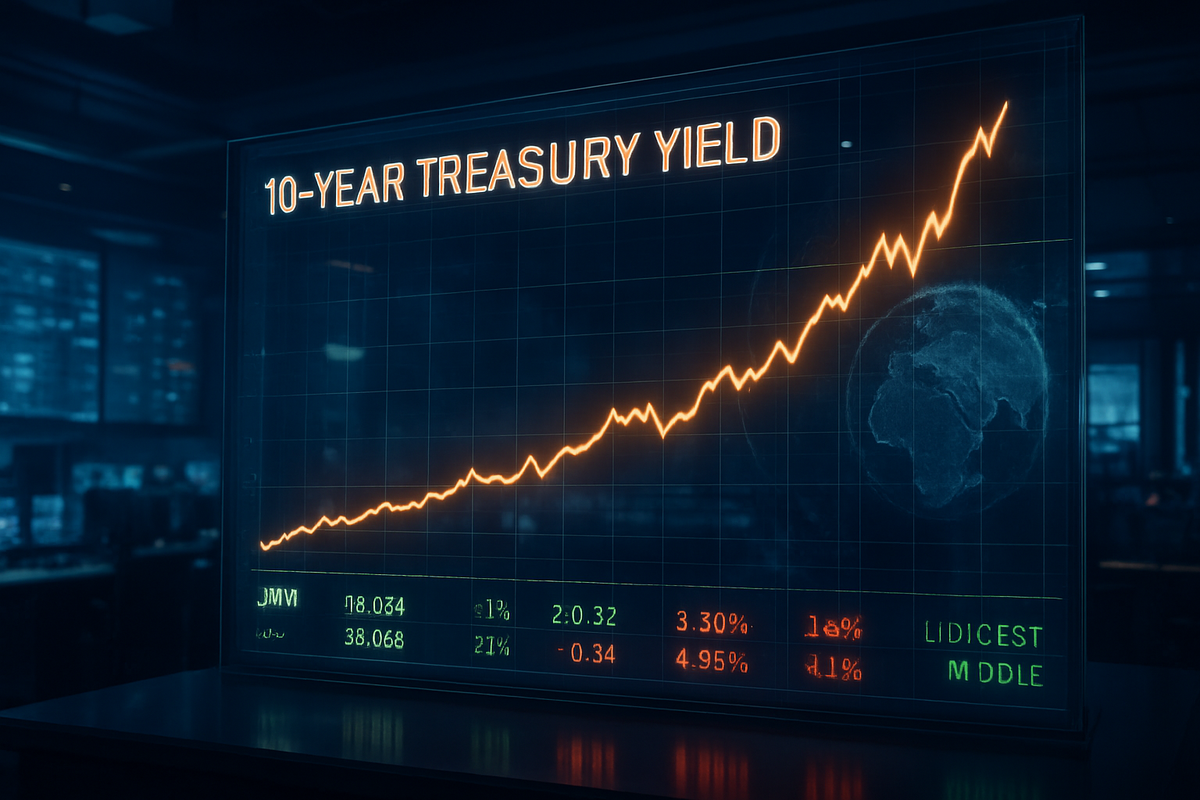
As of April 14, 2026, the global financial landscape has reached a pivotal structural milestone. After a grueling 27-month inversion—the longest in the history of the United States Treasury market—the yield curve has finally steepened back into positive territory. The benchmark 10-year Treasury yield is currently holding steady at 4.29%, marking a significant "valuation gravity" moment that is forcing investors to recalibrate their expectations for inflation, growth, and the cost of capital.
The shift, characterized by analysts as a "bear steepener," comes as the market grapples with a complex cocktail of sticky inflation and severe geopolitical tensions in the Middle East. While the positive slope of the yield curve usually signals a return to economic normalcy, the current environment is anything but traditional. The "un-inversion" is being driven less by optimism and more by a violent return of the term premium, as investors demand higher compensation for the long-term risks associated with energy shocks and fiscal expansion.
The Path to 4.29%: Geopolitics and the End of the Inversion Era
The journey to the current 4.29% yield level was accelerated by a series of dramatic events in early 2026. The primary catalyst was the escalation of the Iran-Israel conflict, which culminated in a partial blockade of the Strait of Hormuz in March. This geopolitical chokepoint, responsible for nearly a quarter of global maritime petroleum trade, saw a massive disruption that sent Brent crude oil prices soaring above $120 per barrel. The resulting "March Oil Shock" forced a jump in headline CPI to 3.6%, effectively ending any immediate hopes for aggressive rate cuts from the Federal Reserve.
Throughout late 2025 and the first quarter of 2026, the spread between the 10-year and 2-year Treasury notes slowly narrowed from its deeply negative territory. By mid-April 2026, the 10-2 spread reached approximately +54 basis points, with the 2-year yield hovering around 3.75%. This normalization marks the end of a recessionary warning signal that had loomed over the market since mid-2022. However, unlike previous un-inversions that were triggered by the Fed cutting short-term rates (a "bull steepener"), this move has been driven by the long end of the curve rising faster than the short end, reflecting deep-seated concerns over long-term inflation and government debt supply.
Initial market reactions have been polarized. Bond traders are pivoting toward shorter-duration assets to avoid the volatility at the long end, while the Federal Reserve—now transitioning under the influence of potential successor Kevin Warsh—has maintained a "hawkish hold" with the Federal Funds Rate at 3.50%–3.75%. This stance has cemented the "higher-for-longer" narrative, as the central bank prioritizes fighting energy-driven inflation over stimulating growth.
Winners and Losers: The Divergent Fortunes of Banks and Big Tech
The steepening yield curve has created a sharp divide between sectors, with financial institutions emerging as the clear beneficiaries of the "Great Un-Inversion." For the first time in years, the traditional banking model of "borrowing short and lending long" has become significantly more profitable. JPMorgan Chase & Co. (NYSE: JPM) recently updated its 2026 Net Interest Income guidance to a record $104.5 billion, as its net interest margins expand in tandem with the steepening curve. Similarly, Bank of America Corp. (NYSE: BAC) has seen its stock outperform the broader market, with analysts noting that every 25-basis-point increase in the curve's slope adds hundreds of millions to its quarterly bottom line.
Conversely, the technology sector is reeling from the 10-year yield's ascent to 4.29%. High-growth companies are particularly sensitive to rising long-term rates, which act as a higher discount rate on future earnings. Tech giants like Microsoft Corp. (NASDAQ: MSFT) and Amazon.com, Inc. (NASDAQ: AMZN) have seen their price-to-earnings multiples compress, with their share prices down 17.4% and 13.5% respectively since the start of the year. The massive capital expenditure required for artificial intelligence—projected to reach $680 billion across the industry in 2026—is becoming increasingly expensive to finance, leading to heightened investor scrutiny over the timeline for AI profitability.
The housing and consumer sectors are also feeling the burn. With the 10-year Treasury serving as a benchmark for mortgage pricing, 30-year fixed rates have climbed back toward the 7.0% mark. This has effectively frozen the housing market and led to a noticeable surge in early-stage mortgage delinquencies. Companies like Apple Inc. (NASDAQ: AAPL) are also facing headwinds as the stronger dollar—a side effect of high US yields—pressures international sales and consumer discretionary spending power.
Broad Industry Trends and the New Normal
This event signifies more than just a change in bond pricing; it represents a fundamental shift in the global economic regime. For nearly two decades, the market operated under the assumption of "low for long" interest rates. The current move to a 4.29% 10-year yield suggests that the "neutral" rate of interest may be much higher than previously estimated. This shift is part of a broader trend of "de-globalization" and supply chain re-onshoring, which are inherently more inflationary than the trade policies of the early 2000s.
The ripple effects are extending to US trading partners and competitors. The high yields in the US have put immense pressure on the Euro and the Yen, forcing foreign central banks to consider their own rate hikes despite sluggish domestic growth. Furthermore, the "April 2025 Tariff Tantrums" from the previous year have left a legacy of trade fragility, making the current energy-driven inflation even harder to manage. Historically, un-inversions that occur while inflation is rising (bear steepeners) have often been followed by periods of stagnant growth and high costs, a stark contrast to the post-recession "bull steepeners" of 2008 or 2020.
From a regulatory perspective, the steepening curve is providing a temporary cushion for bank capital ratios, but it is also raising alarms at the Treasury Department. The cost of servicing the US national debt is reaching record levels, potentially crowding out other government spending. This fiscal pressure may eventually force a confrontation between the Treasury's borrowing needs and the Federal Reserve's inflation-fighting mandate, a dynamic that investors are watching with increasing trepidation.
What Comes Next: Scenarios for the Second Half of 2026
In the short term, the market will remain hyper-focused on the Strait of Hormuz. Any further escalation in the Middle East could push the 10-year yield toward the 5.0% threshold, a level not seen in decades. Such a move would likely trigger a broader sell-off in equities and potentially force the Fed into an emergency policy shift. Conversely, if diplomatic efforts succeed in reopening trade routes, we could see a "relief rally" in bonds, though the structural un-inversion of the curve is likely here to stay.
Strategically, corporations will need to adapt to a world where the "hurdle rate" for any investment is significantly higher. We expect to see a slowdown in debt-funded stock buybacks and a shift toward "fortress balance sheets." For the technology sector, the focus will likely shift from "growth at all costs" to "profitable AI," as investors lose patience with long-dated payoffs. In the banking sector, the challenge will be managing credit risk as higher rates begin to strain borrowers, potentially offsetting the gains from wider interest margins.
The most critical scenario to watch is the "inflationary stagnation" outcome. If energy prices remain elevated and the yield curve continues to steepen, the US could face a period of low growth coupled with high borrowing costs. This would require a significant tactical pivot from investors, moving away from traditional 60/40 portfolios toward real assets, commodities, and short-duration fixed income.
Conclusion: Navigating the Post-Inversion Reality
The return to a positive yield curve at 4.29% marks the end of one of the most anomalous periods in financial history. While the "un-inversion" provides some relief by removing a persistent recession signal, the circumstances surrounding it—geopolitical conflict and energy-driven inflation—offer little comfort to the broader market. The key takeaway is that the era of "cheap money" is firmly in the rearview mirror, replaced by a regime of high volatility and structural inflation.
Moving forward, the market will likely be defined by a stark divergence between capital-intensive growth sectors and cash-flow-positive value sectors. Investors should maintain a close watch on the "term premium" and any signs of fiscal stress in the Treasury's auction results. The next few months will be a proving ground for the resilience of the US economy; if it can withstand 4.29% yields without a significant spike in unemployment, the "soft landing" may yet be possible. However, with the geopolitical landscape remaining a tinderbox, the road to stability remains fraught with peril.
This content is intended for informational purposes only and is not financial advice.